Key facts
- The Hundred Family Surnames (百家姓 Bǎijiāxìng) is a rhyming list of Chinese surnames compiled by an unknown author under the Song dynasty.
- Despite its title it lists 504 surnames: 444 single-character surnames and 60 compound ones, such as Ouyang, Sima and Zhuge.
- It opens with Zhao, Qian, Sun, Li: Zhao was the family of the Song emperors and Qian that of the kings of Wuyue, where the text was written.
- The order is not a ranking by frequency; Wang, the most common surname in China today, comes eighth.
- With the Three Character Classic and the Thousand Character Classic, it was one of the first books children memorised to learn characters.

Ask a Chinese speaker to recite a list of surnames and they will probably start with 赵钱孙李 Zhào Qián Sūn Lǐ. These are the first four characters of the Hundred Family Surnames (百家姓 Bǎijiāxìng), a short rhyming text from the Song dynasty that generations of children learned by heart. It is the best-known list of Chinese surnames, and the source of a common misunderstanding: its order has nothing to do with how common each name is.
What the text is
According to English Wikipedia, the Hundred Family Surnames was compiled by an unknown author during the Song dynasty (960 to 1279). Chinese Wikipedia places it more precisely in the early Northern Song and attributes it to a scholar-official of Qiantang, the area of today’s Hangzhou.
The usual version lists 504 surnames: 444 single-character surnames and 60 compound surnames of two characters. Chinese Wikipedia notes that the original had 411 surnames, later increased to 504. The “hundred” of the title is a round number meaning “many families”. The same idea appears in the ordinary Chinese word 百姓 bǎixìng, literally “the hundred surnames”, which means the common people.
The text is a poem. Each line has eight characters, in two groups of four, and the lines rhyme, which made them easy to memorise. It contains no explanations: only surnames, one after another, ending with the words 百家姓终 “end of the Hundred Family Surnames”.
Why it starts with Zhao, Qian, Sun and Li
The opening lines are a small lesson in Song politics. English and Chinese Wikipedia both cite the Song scholar Wang Mingqing (王明清), for whom the first four surnames were those of the most important families of the time, particularly in the Jiangnan region, around the kingdom of Wuyue in today’s Zhejiang:
| Order | Character | Pinyin | Why it is there | Surname page |
|---|---|---|---|---|
| 1 | 赵 / 趙 | Zhào | family of the Song emperors | Zhao |
| 2 | 钱 / 錢 | Qián | family of the kings of Wuyue | |
| 3 | 孙 / 孫 | Sūn | Sun Taizhen, queen of Qian Chu, last king of Wuyue | Sun |
| 4 | 李 | Lǐ | family of the rulers of Southern Tang | Li |
The imperial family comes first and the local ruling family, which recognised Song authority, second. The next four surnames, 周吴郑王 Zhou, Wu, Zheng, Wang, were those of other royal consorts of the Wuyue kings. Qian Chu reigned until 978, when he surrendered his kingdom to the Northern Song. English Wikipedia notes that the Qian surname remains widespread in the former territory of Wuyue.
The first lines, with pinyin
Here are the first four lines, 32 surnames, the part most people can still recite. The characters follow the traditional text on Wikisource, with simplified forms where they differ.
| Characters | Pinyin |
|---|---|
| 赵钱孙李 周吴郑王 | Zhào Qián Sūn Lǐ, Zhōu Wú Zhèng Wáng |
| 冯陈褚卫 蒋沈韩杨 | Féng Chén Chǔ Wèi, Jiǎng Shěn Hán Yáng |
| 朱秦尤许 何吕施张 | Zhū Qín Yóu Xǔ, Hé Lǚ Shī Zhāng |
| 孔曹严华 金魏陶姜 | Kǒng Cáo Yán Huà, Jīn Wèi Táo Jiāng |
Many of these have their own pages on this site: Zhou, Wu, Zheng, Wang, Feng, Chen, Jiang 蒋, Shen, Han, Yang, Zhu, Xu 许, He, Lü, Shi 施, Zhang, Cao, Wei 魏 and Jiang 姜. Note that two different surnames are both spelled Jiang in pinyin, 蒋 in the second line and 姜 in the fourth: the spelling alone does not identify a surname.
Some surnames have a reading that differs from the everyday reading of the character. 华 is read Huà as a surname, and 褚 Chǔ. The Chinese name to pinyin tool uses surname readings for the first character of a name.
Order and frequency
Because the list starts with Zhao and puts Wang in eighth place, readers sometimes assume it is a ranking. It is not. The order reflects the politics of Wuyue in the 10th century and, after the opening lines, the constraints of a rhyming text. English Wikipedia cites a 2013 ranking of the 400 most common surnames in China by the Fuxi Institution, which found that several surnames of the Hundred Family Surnames were not even among the 300 most common, such as:
- 雍 Yōng, 339th;
- 平 Píng, 315th;
- 米 Mǐ, 316th;
- 湛 Zhàn, 369th.
For the actual order of frequency today, see the most common surnames in China. For the total number of Chinese surnames, which runs into the thousands, see how many Chinese surnames exist.
The compound surnames
The last part of the text is given over to the 60 compound surnames, written with two characters. Among them are some of the best known:
| Characters | Pinyin |
|---|---|
| 司马 | Sīmǎ |
| 上官 | Shàngguān |
| 欧阳 | Ōuyáng |
| 夏侯 | Xiàhóu |
| 诸葛 | Zhūgě |
| 东方 | Dōngfāng |
| 皇甫 | Huángfǔ |
| 尉迟 | Yùchí |
| 公孙 | Gōngsūn |
| 慕容 | Mùróng |
| 司徒 | Sītú |
Most of them are rare today, but they are familiar from history and fiction: Sima Qian the historian, Zhuge Liang the strategist, better known in many books by his courtesy name Kongming. The guide to compound surnames explains where these names come from and how to write them.
A primer for children
After the Song, the Hundred Family Surnames was grouped with the Three Character Classic (13th century) and the Thousand Character Classic (6th century). From the first character of their titles, the three books were known as 三百千 San Bai Qian, “Three, Hundred, Thousand”. English Wikipedia describes them as the almost universal first texts for students, almost exclusively boys, from elite families and even a number of ordinary villagers. They were printed cheaply in many versions, and a pupil who knew all three by heart could recognise roughly 2,000 characters before going on to read and write real texts.
The Hundred Family Surnames had a practical use as well: it taught the characters that a child would meet on every shop sign, contract and family register.
The Hundred Family Surnames today
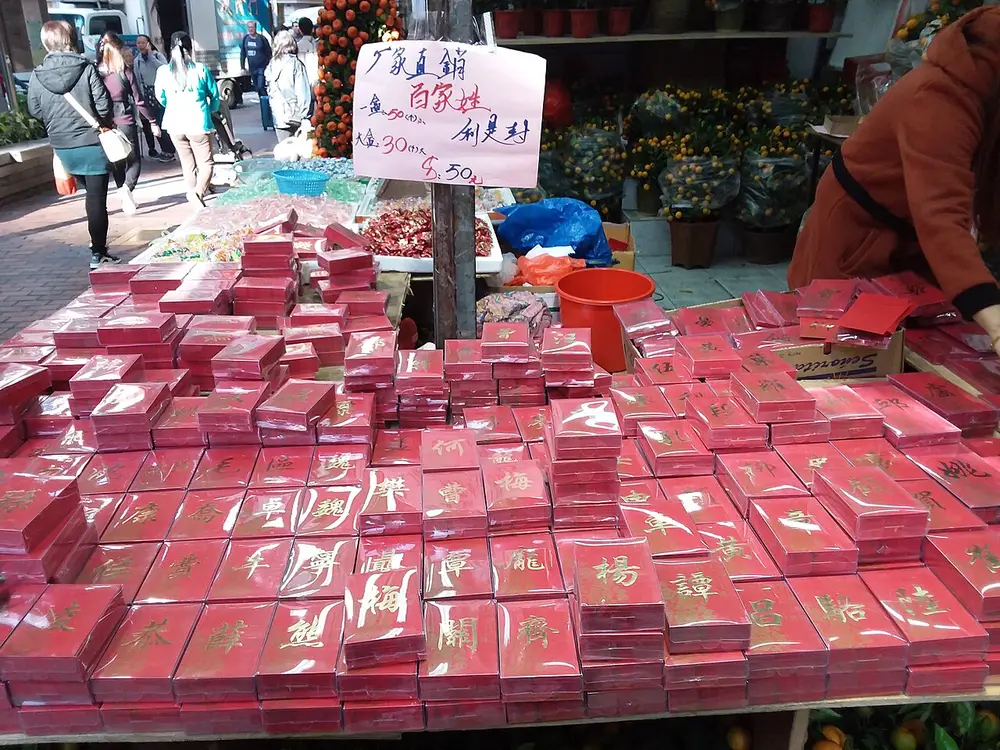
The text is no longer a schoolbook, but its name has stayed in everyday life. The photograph at the top of this page was taken at a Lunar New Year stall on Wing Lok Street in Sheung Wan, Hong Kong, in January 2019. It sells red envelopes (利是 lai see in Cantonese), the packets in which money is given at the New Year, each pack printed with a surname in gold. The handwritten sign reads 百家姓利是封, “Hundred Family Surnames red envelopes”: a customer looks for the family name and buys envelopes bearing it.
To check whether a surname appears in the text, read the full version on Wikisource, or start from a spelling with the surname finder. For the origins of the surnames themselves, see where Chinese surnames come from.
Frequently asked questions
How many surnames are in the Hundred Family Surnames?
504 in the usual version: 444 single-character surnames and 60 compound surnames of two characters. The title's hundred simply means many families. Chinese Wikipedia notes that the original text had 411 surnames and was later extended.
Why does the Hundred Family Surnames start with Zhao?
According to the Song scholar Wang Mingqing, the first four surnames were those of the most important families of the time in the Jiangnan region. Zhao was the surname of the Song emperors, Qian that of the kings of Wuyue, Sun that of the queen of the last king, Qian Chu, and Li that of the rulers of Southern Tang.
Are the surnames listed from most to least common?
No. The order follows the politics of the time and the needs of the rhyme. Zhao, the first surname, is not the most common today, and some surnames in the list, such as Yong 雍, Ping 平, Mi 米 and Zhan 湛, ranked below 300th in a 2013 ranking of surnames in China.
Is my surname in the Hundred Family Surnames?
Most common Chinese surnames are, but not all: there are thousands of Chinese surnames and the list has only 504. Search for your character in the full text on Wikisource, or start with the surname finder on this site, which gives the character for each spelling.
What does Bai Jia Xing mean?
Bai 百 means a hundred, jia 家 family and xing 姓 surname. The phrase is also related to the everyday word 百姓 baixing, the hundred surnames, which in Chinese means the common people.
Sources and open data
- Hundred Family Surnames, English Wikipedia
- 百家姓, Chinese Wikisource (full text)
- Qian Chu, English Wikipedia
- Wuyue, English Wikipedia
- Three Character Classic, English Wikipedia