Key facts
- A mainland Chinese passport prints the name in characters with a pinyin line below, with a comma between surname and given names in the pinyin only.
- Under the mainland rule on the letter ü, LÜ and NÜ become YU (吕 and 女) and LÜE and NÜE become U (略 and 虐).
- Taiwan encourages Hanyu Pinyin but lets the holder choose, and since August 2019 Hoklo, Hakka and indigenous-language romanizations are allowed.
- Hong Kong and Macao passports use their own conventions: Hong Kong's government romanization is not published as a standard, and Macao prints traditional Chinese, English and Portuguese.
- The machine-readable zone uses only A to Z, digits and the filler character, so spaces, hyphens and punctuation become filler and apostrophes are dropped.

On a mainland Chinese passport, the holder’s name is printed in Chinese characters and, below it, in pinyin without tone marks. Other Chinese-speaking places differ: Taiwan lets the holder choose the spelling, Hong Kong uses a government convention that is not published as a standard, Macao adds Portuguese, and Singapore prints a pinyin name with an optional married-name alias. This guide covers each one and the practical limits of the machine-readable zone.
Mainland China: characters plus pinyin
English Wikipedia describes the layout: the name in Chinese characters above, the pinyin transcription below, and a comma between surname and given names in the pinyin line only. Pinyin has been used for names in mainland China since 1958, according to the same source’s article on Chinese names. See pinyin for names for how the system works.
Biometric ordinary passports were introduced on 15 May 2012, and since January 2015 only biometric passports are issued, again per English Wikipedia. The format matters because the biometric page carries a machine-readable zone, described below.
The ü rule: Lü, Nü, Lüe, Nüe
Pinyin writes some syllables with the vowel ü, which is not among the letters A to Z used in machine-readable documents. The National Immigration Administration announced a rule on 29 September 2021 for entry-exit documents of mainland residents. It says the letter Ü is printed following GB/T 28039-2011 and international machine-readable travel document specifications.
| Surname or syllable | Character | Printed as |
|---|---|---|
| LÜ | 吕 | YU |
| NÜ | 女 | YU |
| LÜE | 略 | U |
| NÜE | 虐 | U |
The notice also says holders of documents printed under the old rule may ask that the new document keep the old spelling. The page does not state an effective date, and it does not describe the old rule, so this guide does not either. For the surname itself, see Lyu 吕.
Taiwan: Hanyu Pinyin, but the holder decides
The Taiwan Ministry of Education guide says passport names follow the Enforcement Rules of the Passport Act of the Ministry of Foreign Affairs. It encourages Hanyu Pinyin for passports and civil registration. The guide’s format is surname first, with no comma, and only the initial letters capitalized. It also states that the choice of the party concerned overrides the default.
English Wikipedia says Taiwan officially adopted pinyin in 2009 but allows other romanizations on official documents. Focus Taiwan reported on 15 August 2019 that the Ministry of Foreign Affairs would allow passport names to be romanized in Hoklo, Hakka and indigenous languages. English Wikipedia dates the amendment of Article 14 of the Enforcement Rules to 9 August 2019.
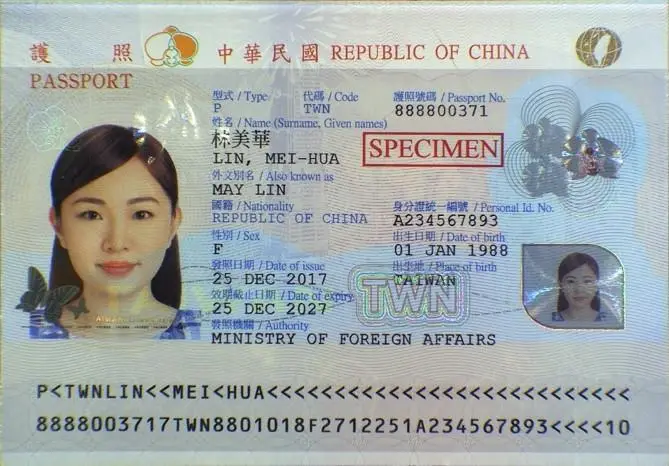
The image on this page is a specimen ROC passport data page marked SPECIMEN, with the name 林美華 shown as “LIN, MEI-HUA”. For the regional spelling systems behind these choices, see the guides on Wade-Giles and Hokkien and Teochew spellings, and the Taiwan surname data.
Hong Kong: government romanization and English names
English Wikipedia says the Hong Kong government romanizes Cantonese names with an unpublished system that follows earlier systems by Dyer-Ball and Eitel. It was checked against the Three Way Chinese Commercial/Telegraphic Code Book of 1971, which gives no tone marks. The older observations page of the HKSAR passport carried the Chinese Commercial Code of the Chinese name.
The Hongkonger name article adds that in 2015, 25.8% of Hongkongers had a legal English first name and another 38.3% used one without it being legal. The surname is conventionally written in capitals before the given names, as in “KUO Chi Yung Peter”. People from outside the Cantonese area sometimes keep their original romanization, for example Joseph Zen Ze-kiun, a Shanghainese bearer. See Hong Kong Cantonese spellings.
Macao: Chinese, English and Portuguese
English Wikipedia says every entry in a Macao SAR passport appears in traditional Chinese and Portuguese as well as English. The data page shows Surname and Given Names in traditional Chinese and in English or Portuguese. The issuing authority is the Identification Services Bureau.
Singapore: pinyin and a married-name alias
According to the Singapore Ministry of Foreign Affairs, the main name in a passport is the holder’s full pinyin name or married name. A married name can appear as an alias in brackets under the main name, and only one alias is allowed. To remove or replace the main name, a deed poll is needed. The page does not discuss dialect names or characters.
English Wikipedia’s article on Chinese names notes that in Malaysia and Singapore a Western name may come before or after the Chinese given name (“Tony Tan Keng Yam” or “Tan Keng Yam Tony”), and that people choose the format on their identity card. See married women and surnames for the wider custom.
Why the same name differs between passports
A passport records one romanization chosen under local rules, so the same character can appear differently depending on the issuing place. English Wikipedia’s article on Malaysian names notes that 陈 is more often written Tan, Ding, Ting, Chin, Chan or Tang than Chen there. A mainland passport for the same character would print CHEN. Neither spelling is wrong: each follows the system of the issuing country and the family’s language. The surname Chen 陳 page lists the variants in detail.
The machine-readable zone
English Wikipedia describes the machine-readable zone as two lines of 44 characters using A to Z, digits and the filler character <. In the name field, spaces, hyphens and punctuation become filler, except the apostrophe, which is omitted. Names that are too long are abbreviated.
This is why LÜ cannot appear, and why a hyphenated given name such as MEI-HUA may show as MEI<HUA in the zone. The specimen page above shows “P<TWNLIN<<MEI<HUA<<<”.
Practical tips for forms and tickets
- Copy the name exactly as printed in the passport’s visual zone, not from the machine-readable zone.
- Keep the order of surname and given names the same as the passport. The name order formatter helps rearrange it for forms.
- Check the spelling against the characters with the Chinese name to pinyin tool.
- If an older document used a different spelling of ü, ask whether the issuing office allows keeping it.
- For airline tickets, use the passport spelling. The reasons for variants are explained in one surname, many spellings.
Frequently asked questions
How is a Chinese name written on a mainland Chinese passport?
The name appears in Chinese characters, and below it in pinyin. According to English Wikipedia, the pinyin line puts a comma between the surname and the given names, and the characters line has no comma.
How is the letter ü handled on mainland passports now?
The National Immigration Administration says the letter Ü is printed under GB/T 28039-2011 and international machine-readable standards. LÜ and NÜ become YU (吕 and 女), and LÜE and NÜE become U (略 and 虐).
Can a Taiwanese passport use a spelling other than Hanyu Pinyin?
Yes. The Ministry of Education guide says the holder's own choice overrides the default, and Focus Taiwan reported on 15 August 2019 that the Ministry of Foreign Affairs allowed Hoklo, Hakka and indigenous-language romanizations.
Can I keep my old spelling if my new passport changes it?
For mainland documents, the National Immigration Administration says holders of documents printed under the old rule can ask for the new document to keep the old spelling. For other passports, ask the issuing office.
Why is my name missing a hyphen or apostrophe in the machine-readable zone?
The machine-readable zone allows only A to Z, digits and the filler character. English Wikipedia says spaces, hyphens and punctuation in the name become filler characters, and the apostrophe is omitted.
Sources and open data
- Chinese passport, English Wikipedia
- Notice on printing the letter Ü in entry-exit documents, National Immigration Administration of China
- Guide to romanization of Chinese names (Taiwan), Ministry of Education, Taiwan
- Passports in Taiwan to allow Hoklo, Hakka and indigenous romanization, Focus Taiwan
- Hongkonger name, English Wikipedia
- Machine-readable passport, English Wikipedia
- Change of name or inclusion of married name in passport, Singapore Ministry of Foreign Affairs