Key facts
- Most Chinese Indonesians descend from Hokkien (Southern Min) speakers, so older Chinese Indonesian surnames follow Hokkien sounds: Tan 陳, Liem 林, Oei 黃, Ong 王.
- The Dutch colonial administration wrote these names in Dutch-based spelling (Oei, Loe, Njoo, Lie); later Indonesian spelling reforms turned oe into u and j into y.
- Cabinet Presidium Decision 127/U/Kep/12/1966 strongly encouraged Chinese Indonesians to adopt Indonesian-sounding names, and many built the new name around their old surname.
- Examples documented on English Wikipedia: Tan to Tanoto and Danandjaja, Oei to Wijaya, Lim to Taslim and Nursalim.
- Pinyin is rarely used in these names; the spelling you see is usually Hokkien, Dutch-era or Indonesianized, not Mandarin.

Chinese Indonesian names come in three layers: an old Hokkien surname written in Dutch-era spelling (Tan, Liem, Oei), an Indonesian-sounding name adopted mostly after 1966, and, for a small minority today, a pinyin form. The largest group of Chinese Indonesians is of Hokkien descent, which is why the surname you meet in Indonesia is usually a Hokkien sound and not the Mandarin one. The same character, for instance 陳, is Tan in Indonesia and Chén in pinyin.
Who the names belong to
English Wikipedia describes the largest group of Chinese Indonesians as Hokkien, with other major groups being Teochew, Hakka, Cantonese and Hainanese. Hokkien is why the older surnames are the same ones covered in Hokkien and Teochew spellings. The Hakka and Cantonese families have their own spellings, described in the Hakka and Hong Kong Cantonese guides.
The same article says that using a Chinese surname, in some form or circumstance, is generally a sign of self-identification as ethnic Chinese or alignment with a Chinese social system.
Dutch-era spelling
During the colonial period, the Dutch administration recorded Chinese names in birth certificates and legal documents using the nearest Dutch spelling of the Hokkien sound. English Wikipedia notes that no Hokkien romanization standard existed then, so some spellings varied slightly. The British did the same in Malaya with English spelling, which is why the same surname can look different in Jakarta and in Kuala Lumpur.
Indonesian spelling was later reformed, first in 1947 (Ejaan Soewandi) and again in 1972 (Ejaan Yang Disempurnakan). Dutch oe became u and Dutch j became y. English Wikipedia gives these surname shifts:
| Older spelling | Current spelling |
|---|---|
| Lie | Li |
| Loe | Lu |
| Njoo | Nyoo |
| Oei | Wi |
The same logic explains why one Indonesian name can appear in several forms. Wijaya may be written Widjaja, Widjaya or, less commonly, Oeidjaja, according to the article.
Common surnames and their characters
The characters below come from the examples on the English Wikipedia page “Chinese Indonesian surname”. The pinyin is the standard Mandarin reading of each character. The Indonesian forms are examples that the page attributes to named people, not a complete list.
| Spelling | Character | Pinyin | Documented Indonesian-sounding forms |
|---|---|---|---|
| Tan | 陳 | Chén | Tanoto, Danandjaja |
| Lim / Liem | 林 | Lín | Taslim, Nursalim, Wanandi |
| Oei | 黃 | Huáng | Wijaya, Winata, Wiyoko |
| Ong | 王 | Wáng | Ongkosandjojo, Sasongko |
| Loe | 呂 | Lǚ | Lukita, Loekito |
| Phang | 彭 | Péng | Pangestu |
| Njoo | 楊 | Yáng | Muljoto |
| Han | 韓 | Hán | Johanes |
| Liauw | 廖 | Liào | Leo |
To see why these spellings exist side by side, read one surname, many spellings. The Chinese side of the biggest names is on the Chen 陈, Lin 林 and Huang 黄 pages.
The 1966 policy
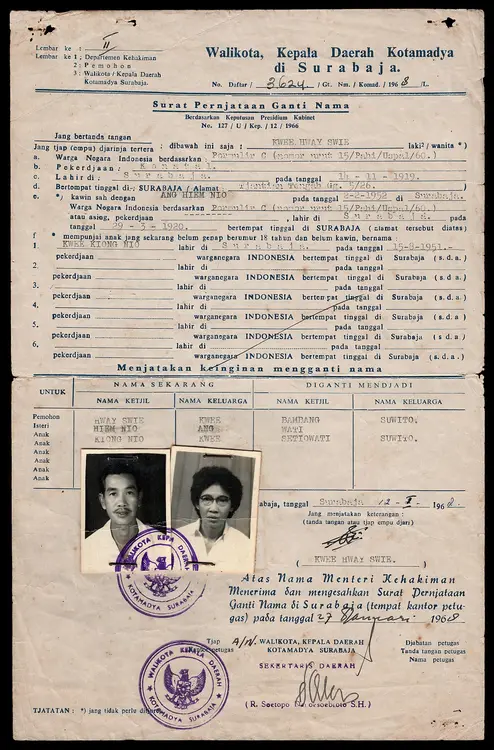
The key text is Cabinet Presidium Decision 127 of 1966 (127/U/Kep/12/1966). English Wikipedia says it suggested Indonesian-sounding names for Chinese Indonesians and classes it as part of anti-Chinese legislation. The Chinese Indonesian surname article says it strongly encouraged them to move away from the traditional three-part Chinese name.
It was followed by Presidential Decision 240 of 1967, which supported the earlier directive. The same legislation page says Presidential Instruction 14/1967 did not mention Chinese names explicitly, but “newly naturalized” Chinese Indonesians were strongly advised to adopt non-Chinese names. That instruction was annulled in 2000 by President Abdurrahman Wahid.
Compliance was not simply voluntary. The Chinese Indonesian surname article says many people reported changing their names in response to government “suggestions” and often felt compelled to do so in a climate of fear and coercion. Others complied voluntarily, though not always free from pressure.
The Wikimedia Commons image at the top of this page is a scan of a letter dated 27 January 1968 from a family in Surabaya. According to its description, Kwee Hwae Swie and his daughter took the family name Suwito, while his wife simply used the name Wati.
How a Chinese surname hides inside an Indonesian name
English Wikipedia describes several strategies and notes that people with the same Chinese surname could choose different names. Most names were Hokkien surname syllables with an Indonesian or Western prefix or suffix.
- Keep the surname, change the given name. Sofyan Tan put 陳 at the end as Tan. Ong Yenny and Lie A. Dharmawan kept Ong (王) and Lie (李) first, in Chinese order.
- Add a suffix. Sukanto Tanoto keeps Tan (陳) inside Tanoto. Enggartiasto Lukita uses Lu (呂) in Lukita.
- Add a prefix. Joe Taslim and Cherie Nursalim carry Lim (林) at the end of their surnames.
- Insert the surname between syllables. Sasongko holds Ong (王), Johanes holds Han (韓). The article calls this the most common method.
- Put the surname first. Loekito Sudirman placed Loekito, derived from Loe (呂), before his Indonesian given name.
- Write the surname phonetically and extend it. Eka Tjipta Widjaja built his surname from Oei (黃), written Wi-, plus -djaja, meaning “victory”. The article notes that many names beginning with Wi- (Wijaya, Winata, Wiyoko) come from Oei and Wei (魏).
- Translate the meaning. Sofjan Wanandi turned Liem (林), “forest”, into the old Javanese word wana, plus a suffix. The article also says that Kok (國, “country”) may become negara and Ong (王, “king”) may become raja or ratu.
- Keep only the given name. Mochtar Riady adapted his given name Lie Mo Tie (李文正) as Mochtar and dropped the surname.
- Take an unrelated name. Sutanto Djuhar, born Liem Oen Kian (林文镜), kept nothing of his Chinese name.
Business tycoon Liem Sioe Liong, to take a well-known case from English Wikipedia’s “Indonesian names”, became Sudono Salim. Some people did not change at all, such as Kwik Kian Gie (郭建義) and Liem Swie King.
After 1998
English Wikipedia says that after Suharto resigned, later governments revoked the ban on speaking and learning Chinese in public, and most of the discriminatory legislation was revoked after his fall. Using the original surname is no longer taboo, but only a small minority re-adopted original Hokkien names or pinyin spellings. The article’s example is the author Maria Audrey Lukito, who legally changed her name to Audrey Yu Jia Hui (俞佳慧).
Reasons given for keeping the Indonesian name include worry about racial issues, habit from the New Order era, doubt that non-Chinese speakers will pronounce Chinese names, and a family that no longer speaks Chinese. A 2022 regulation of the Minister of Home Affairs (Number 73 of 2022) requires legal names in Indonesia to have at least two words, which addressed the earlier cases of people with a given name and no surname.
Many families in the diaspora, in the Netherlands, Germany and the United States, kept their Hokkien surnames.
From a name back to a character
An Indonesian name rarely gives the character directly. The practical route is:
- Look for a Hokkien surname syllable inside the name, such as Tan, Lim, Oei, Ong or Han.
- Check the old Dutch spelling if the name is in a legal or archival record (oe for u, tj and dj forms).
- Match the syllable to a character using the table above or the surname finder.
- Confirm with family records, because one syllable can stand for more than one character. The English page lists Phang as both 彭 and 馮, and Ong as both 王 and 汪.
For a comparable case in the Philippines, where full Hokkien names became Spanish-looking surnames, see Filipino Chinese surnames. For how a Vietnamese reading differs from pinyin, see Vietnamese surnames and Chinese characters.
Frequently asked questions
What are common Chinese Indonesian surnames?
Spellings that appear in English Wikipedia's article on Chinese Indonesian surnames include Tan (陳), Liem or Lim (林), Oei (黃), Ong (王), Lie (李), Han (韓) and Phang (彭). They are mostly Hokkien-based spellings.
Why do many Chinese Indonesians have Indonesian-sounding names?
A 1966 decision of the Cabinet Presidium, 127/U/Kep/12/1966, strongly encouraged Chinese Indonesians to adopt Indonesian-sounding names as part of an assimilation policy under Suharto's New Order. Many people reported feeling compelled to comply.
Can you tell someone's Chinese surname from an Indonesian name?
Sometimes. English Wikipedia says many adopted names keep a Hokkien surname syllable, for example Tan in Tanoto and Danandjaja, or Oei as Wi- in Wijaya. But people with the same Chinese surname chose different new names, and some new names have no link to the old one.
Is Oei the same as Huang?
Oei is a Dutch-era spelling of the Hokkien reading of 黃, which is Huáng in Mandarin pinyin. English Wikipedia lists Oei as 黃 and notes that modern spelling changed it to Wi in some names.
Can Chinese Indonesians use their Chinese names again?
Yes. English Wikipedia says that after 1998 the bans were lifted and using the original surname is no longer taboo, although only a small minority have re-adopted Hokkien names or pinyin spellings.
Sources and open data
- Chinese Indonesian surname, English Wikipedia
- Legislation on Chinese Indonesians, English Wikipedia
- Indonesian names, English Wikipedia
- Chinese Indonesians, English Wikipedia
- File: Letter for Name Change Request (Kwee Hway Swie, 1968).jpg, Wikimedia Commons