Key facts
- Chinese Filipinos are overwhelmingly of Hokkien descent: English Wikipedia puts Hokkien peoples at 98.7% of unmixed ethnic Chinese in the Philippines, so most single-syllable surnames follow Hokkien sound: Tan 陳, Lim 林, Chua 蔡, Uy 黃, Ong 王.
- Families that arrived before the late nineteenth century often carry multisyllabic Hispanized surnames such as Cojuangco, Ongpin and Yuchengco, which began as full Chinese names written in Spanish spelling.
- A group of surnames ending in -son, -zon or -chon (Tuason, Dizon, Lacson) transliterates Hokkien words for a numbered grandchild, written with the character 孫.
- Governor General Narciso Clavería's decree of 21 November 1849 pushed Filipinos to adopt Spanish surnames, and many Chinese families took Spanish given names at the same period.
- A Filipino surname alone is not a reliable guide: some Chinese Filipinos hold Spanish or native surnames, and the characters can only be confirmed from family records.

Chinese Filipino surnames fall into two families. The first is short Hokkien surnames written as they sound, such as Tan (陳), Lim (林), Chua (蔡), Uy (黃) and Ong (王). The second is long Hispanized surnames such as Cojuangco, Ongpin and Yuchengco, which began as full Chinese names spelled in Spanish orthography. Both groups come mostly from Hokkien, and neither follows pinyin.
Why the names are mostly Hokkien
English Wikipedia says most Chinese Filipinos are Hoklo people, historically Hokkien speakers, and that Hokkien peoples form 98.7% of all unmixed ethnic Chinese in the Philippines. It adds that, unlike other Southeast Asian Chinese communities with an assortment of dialect groups, Chinese Filipinos descend overwhelmingly from Hokkien-speaking southern Fujian.
One of its examples is a study of around 30,000 gravestones in the Manila Chinese Cemetery. Of those with a marked birthplace, 89.26% were from the Hokkien-speaking Southern Min region and 9.86% from Cantonese regions in Guangdong. Cantonese people make up about 1.2% of the unmixed ethnic Chinese population, according to the same article.
This is why the spellings are the ones described in Hokkien and Teochew spellings and not those of Hong Kong Cantonese. The same pattern, with a Dutch rather than Spanish layer, applies in Chinese Indonesian names.
Short surnames: five to know
The page “Filipino name” lists five common single-syllable Chinese Filipino surnames and says most are spelled according to their Hokkien pronunciation. The pinyin below is the standard Mandarin reading of each character.
| Filipino spelling | Character | Pinyin | Character page |
|---|---|---|---|
| Tan | 陳 | Chén | Chen |
| Lim | 林 | Lín | Lin |
| Chua | 蔡 | Cài | Cai |
| Uy | 黃 | Huáng | Huang |
| Ong | 王 | Wáng | Wang |
Two of these show how far a Hokkien spelling can sit from the Mandarin one: 黃 is Uy in the Philippines and Huáng in pinyin, and 蔡 is Chua and Cài. For the general pattern, see one surname, many spellings.
Long surnames: whole Chinese names in Spanish spelling
English Wikipedia says that Chinese Filipinos whose ancestors arrived before a late-nineteenth-century cutoff usually have multisyllabic surnames, such as Gokongwei, Ongpin, Pempengco, Yuchengco, Teehankee and Yaptinchay. These were originally full Chinese names transliterated in Spanish orthography and adopted as surnames.
The two Wikipedia articles disagree on the cutoff. “Chinese Filipinos” says 1885 and “Filipino name” says 1898, so this page treats the date as approximate.
Its clearest example is Alberto Cojuangco, given as 許寰哥 (Pe̍h-ōe-jī Khó-hoân-ko). Here the whole three-character name became the clan surname. In pinyin the same characters are Xǔ Huán Gē. The article also names José Antonio Chuidian (Pe̍h-ōe-jī Chui-lian) as a case of a full Chinese name taken as a surname.
Because the Chinese name was one unit, these surnames cannot be split into a clan name plus a given name. Wikipedia lists dozens of them, including Angseeco, Consunji, Dysangco, Sycip, Tantoco and Tambunting. It does not give characters for most, so this page does not guess them.
The grandchild surnames ending in -son
A separate group sounds Spanish but is Hokkien. English Wikipedia says that surnames such as Tuason and Lacson are Spanish transliterations of Hokkien designations that use the suffix 孫 (sun, “grandchild”), with a number or size word before it. It points out that 孫, 仲孫 and 長孫 appear in the classic text Hundred Family Surnames (see the Hundred Family Surnames).
| Surname | Characters | Hokkien (as given) | Meaning |
|---|---|---|---|
| Echon, Ichon | 一孫 | It-sun | First grandchild |
| Tuason | 大孫 | Tuā-sun | Eldest grandchild |
| Tiongson, Tiongzon | 長孫 or 仲孫 | Tióng-sun, Tiōng-sun | Eldest or second (middle) grandchild |
| Sioson | 小孫 | Sió-sun | Youngest grandchild |
| Dizon | 二孫 | Lī-sun | Second grandchild |
| Samson, Sanson | 三孫 | Sam-sun | Third grandchild |
| Sison | 四孫 | Sì-sun | Fourth grandchild |
| Gozon, Goson, Gozum | 五孫 | Gǒ͘-sun | Fifth grandchild |
| Lacson | 六孫 | La̍k-sun | Sixth grandchild |
| Sitchon, Sichon | 七孫 | Chhit-sun | Seventh grandchild |
| Pueson | 八孫 | Pueh-sun | Eighth grandchild |
| Causon, Cauzon | 九孫 | Káu-sun | Ninth grandchild |
The table follows “Chinese Filipinos”. The shorter “Filipino name” article gives some different renderings, for example Tuazon for 大孫 and a different reading of Tiongson, so treat individual identifications as the article’s rather than settled. Wikipedia also lists other surnames ending in -son built on a clan character, such as Yanson (燕孫), Ganzon (顏孫) and Yuson (楊孫), and says some people chose two-syllable surnames ending in “son”, “zon” or “co” after a massacre in Manila in the 1700s to hide their identity.
The 1849 edict and Spanish name formats
According to English Wikipedia, on 21 November 1849 Governor General Narciso Clavería y Zaldúa issued a decree that Filipinos should adopt Spanish surnames to make census counting easier. The surnames were distributed through the Catálogo alfabético de apellidos, most of them Spanish.
Many Chinese who lived through the edict adopted Spanish name formats with a Spanish given name, for example Florentino Cu y Chua. Chinese mestizos, and some Chinese who chose to assimilate, took Spanish surnames outright, as did other Filipinos. Today, the article warns, it can be difficult to identify Chinese Filipinos from surnames alone: it lists Bautista, De la Cruz, Garcia, Gatchalian, Palanca and Tagle among the Spanish or native surnames some adopted upon naturalization.
Name order and format
The format changed with each wave of arrivals.
- Spanish colonial style. A Spanish given name plus the family names, as in Florentino Cu y Chua.
- American colonial style. Newer migrants used an adopted Spanish or sometimes English name together with their Chinese name, for example Carlos Palanca Tan Quin Lay or Vicente Go Tam Co. The article says this trend continued to the late 1970s.
- English names. The article says second-generation families favored English names ending in -son, such as Emerson and Anderson, and gives the example of a young Chinese Filipino named Chase Tan, whose father is Emerson Tan and whose grandfather is Elpidio Tan Keng Kui.
In the older examples the Chinese surname comes before the given-name syllables, as in Chinese name order. In modern Filipino usage the Western order is standard.
Purchased surnames
The same article describes a practice from the 1900s. During the American colonial period, when the Chinese Exclusion Act applied to the Philippines, new Chinese migrants bought the Hispanic or native surnames of native and mestizo Filipinos to pass as long-time residents. Some also bought the Alien Landing Certificates of Chinese who had returned to China, and others used adoption to gain citizenship and a new surname.
This is why a matching surname does not prove a family link. It is also a reason the surname-to-character step needs family records, not guesses.
From a Filipino spelling to a character
- Check whether the surname is one of the short Hokkien forms in the first table. Those map directly to a character.
- For a long surname, check whether it looks like a full Chinese name transliterated in Spanish spelling. The characters need a family source such as a gravestone, a clan register or the Pe̍h-ōe-jī spelling.
- For a name ending in -son, -zon or -chon, compare it with the grandchild table above.
- Use the surname finder to match a Hokkien syllable to candidate characters, and confirm with the family.
For a parallel case in Vietnam, where the Latin spelling is a Sino-Vietnamese reading, see Vietnamese surnames and Chinese characters.
Frequently asked questions
Are Filipino Chinese surnames Hokkien?
Mostly. English Wikipedia says Chinese Filipinos descend overwhelmingly from Hokkien-speaking southern Fujian, and that most single-syllable surnames such as Tan, Lim, Chua, Uy and Ong are spelled according to their Hokkien pronunciation.
What does a name like Cojuangco mean?
It is a Chinese full name written in Spanish spelling. English Wikipedia gives Alberto Cojuangco as 許寰哥, in Pe̍h-ōe-jī Khó-hoân-ko, as an example of an entire Chinese name adopted as a clan surname.
Why do some Filipino surnames end in -son?
English Wikipedia explains that surnames such as Tuason, Dizon and Lacson are Spanish transliterations of Hokkien terms ending in 孫 (sun, grandchild), with a number in front: 大孫 for Tuason, 二孫 for Dizon, 六孫 for Lacson.
How do Chinese Filipinos write their full names?
It varies by period. English Wikipedia gives Florentino Cu y Chua for the Spanish format and Carlos Palanca Tan Quin Lay for a Spanish given name followed by the Chinese name. Younger people may use English first names, as in Chase Tan.
Can you tell if a Filipino is of Chinese descent from the surname?
Not reliably. English Wikipedia says many Chinese Filipinos took Spanish or native surnames upon naturalization or by purchase, so it can be difficult to identify Chinese Filipinos by surname alone.
Sources and open data
- Chinese Filipinos, English Wikipedia
- Filipino name, English Wikipedia
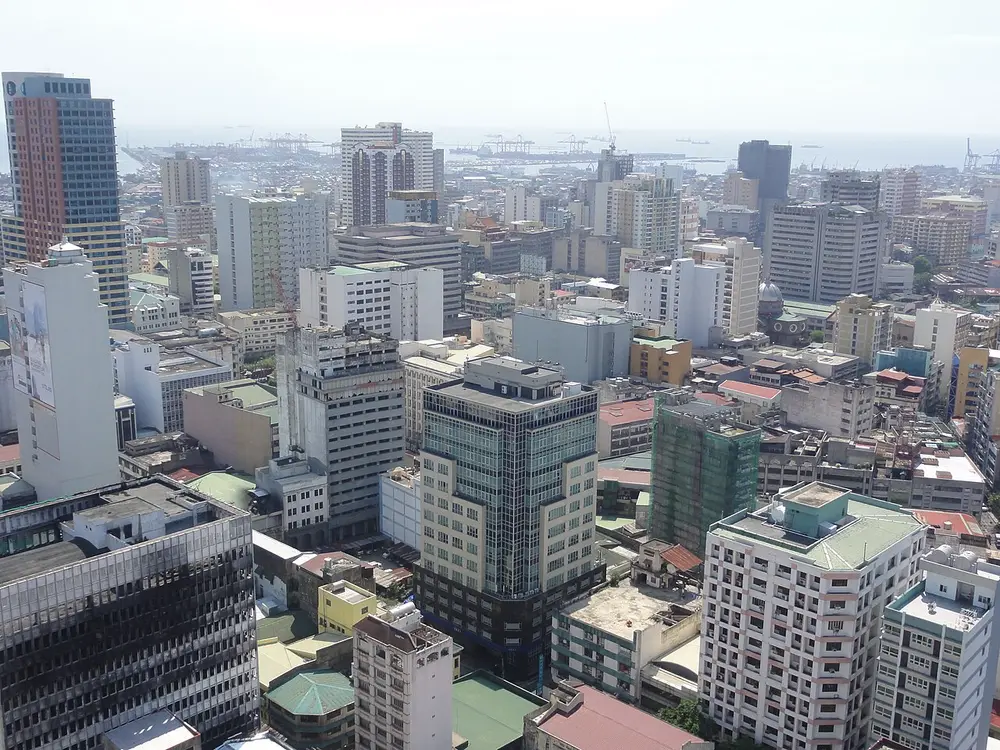
- File: Aerial view of Binondo Chinatown business district in Binondo, Manila.jpg, Wikimedia Commons