Key facts
- Zhu is written 朱 in both simplified and traditional Chinese (6 strokes). The character means vermilion, cinnabar red.
- It was the 14th most common surname of mainland China in the 2019 official ranking, with about 17 million bearers in a 2013 study.
- It was the imperial surname of the Ming dynasty (1368 to 1644), founded by Zhu Yuanzhang, and of the short-lived Later Liang (907 to 923).
- Tradition traces most Zhus to the small state of Zhu 邾 in Shandong, whose descendants dropped the 邑 radical from its name.
- Spellings: Chu (Wade-Giles, Hong Kong, Taiwan), Choo (Singapore, Malaysia), Gee (older Chinese-American families), Ju (Korean). The 2010 US Census counted 21,265 people spelled Zhu.
朱
Pinyin: Zhū
Same character in simplified and traditional: 朱
Rank in mainland China: 14 of the top 100 (Ministry of Public Security, 2019 report)
Characters and spellings of 朱
| Unicode code point | U+6731 |
|---|---|
| Stroke count | 6 |
| Radical (simplified form) | No. 75 ⽊, plus 2 strokes |
| Dictionary meaning (Unihan) | cinnabar, vermilion; surname |
Romanizations by Chinese language
| Language | System | Spelling |
|---|---|---|
| Mandarin | Hanyu Pinyin (PRC standard) | Zhū |
| Mandarin | Wade-Giles (Taiwan, older English texts) | Chu |
| Cantonese | Jyutping (Unihan) | zyu1 |
| Cantonese | Hong Kong / common spellings | Chu, Chue |
| Hokkien (Min Nan) | Pe̍h-ōe-jī and common spellings | Chu, Choo |
| Hakka | Pha̍k-fa-sṳ and common spellings | Chû, Choo |
| Gan | Romanization and common spellings | Tu, Chu |
| Wu (Shanghainese) | Romanization and common spellings | Tsy, Tsyu, Tzu, Chu |
Equivalent surnames in other languages
| Language | Form |
|---|---|
| Vietnamese | Châu |
| Korean | Ju (주) |
| Japanese | Shu |
| Filipino | Chu |
| Can | Gee |
| Misc | Ju |
These spellings in the 2010 US Census
| Spelling | People | US rank | Asian / Pacific Islander |
|---|---|---|---|
| CHU | 28,508 | 1,238 | 92.14% |
| ZHU | 21,265 | 1,694 | 98.23% |
| CHAU | 16,667 | 2,181 | 94.44% |
| TU | 9,230 | 3,835 | 94.03% |
| CHOO | 1,819 | 15,964 | 85.54% |
| CHUE | 446 | 47,521 | 84.3% |
Counts are people recorded with each spelling among the 265,667,228 people with a surname shared by at least 100 people (US Census Bureau, 2010, public domain). A spelling is not proof of Chinese origin: the last column shows the share of bearers who identified as Asian or Pacific Islander. Together these spellings total 77,935 people, but some of them belong to unrelated surnames (for example English Lee, Hmong Vang or Vietnamese Ly). Search any spelling with the US census surname lookup.
Stroke order
Animation by the open-source Hanzi Writer library (MIT) with stroke data from Make Me a Hanzi (Arphic Public License). Stroke order tool for any character.
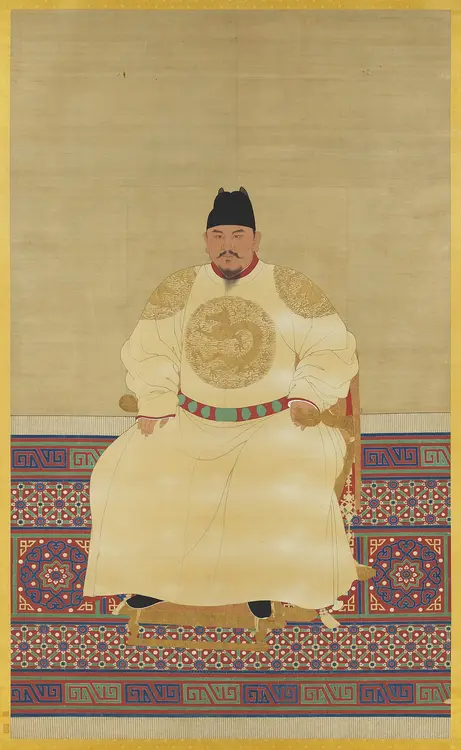

Zhu (朱) is a Chinese surname written with the character for “vermilion”, and it was the family name of the Ming emperors. It is pronounced zhū, roughly like the English “Jew” or the start of “juice”, with a high level tone, and the character is the same in simplified and traditional Chinese. It is spelled Chu in Wade-Giles, Hong Kong and Taiwan, Choo in Singapore and Malaysia, Gee in some older Chinese-American families and Ju in Korean. It was the 14th most common surname of mainland China in 2019, with about 17 million bearers.
Meaning of the character 朱
Unihan glosses 朱 as “cinnabar, vermilion; surname”. The character is filed under radical 75 (木, tree) and has 6 strokes; the Han dynasty dictionary Shuowen Jiezi defines it as a tree with a red heart (赤心木). Red cinnabar (朱砂 zhūshā) was the pigment of imperial rescripts, seals and temple lacquer, so the name has a strong association with authority, an association the Ming made literal.
Pinyin Zhu also writes four rarer surnames, 祝, 竺, 诸 and 猪, which are unrelated.
Origin: the state of Zhu 邾
The fullest traditional account comes from the Yuanhe Xingzuan (元和姓纂), the Tang dynasty book that is the oldest surviving surname dictionary, quoted by Chinese Wikipedia:
- Under the early Zhou, a descendant of the legendary emperor Zhuanxu, of the Cao (曹) clan, was enfeoffed at Zhu (邾), near modern Qufu and Zoucheng in Shandong. The state was later called Zou (邹).
- Zhu was conquered and annexed by the southern state of Chu in the 4th century BC.
- The ruling family kept the name of their state but dropped the 阝 (邑, “city”) radical, giving 朱.
That is why English Wikipedia calls Zhu “technically a branch” of the Cao surname. Other traditional origins listed by Chinese Wikipedia include descendants of Danzhu, son of the sage king Yao; a branch of the Song royal house; and two Xianbei clans, 渴烛浑 and 可朱浑, that switched to Zhu in the Northern Wei. These are traditional accounts, best read with where Chinese surnames come from in mind.
The imperial Zhus
Zhu is one of the few surnames to have founded two dynasties:
- Later Liang (907 to 923). Zhu Wen (朱温, 852 to 912), a Tang general who later took the name Zhu Quanzhong, overthrew the Tang in 907 and opened the Five Dynasties period.
- Ming (1368 to 1644). Zhu Yuanzhang (朱元璋, 1328 to 1398), an orphaned peasant from Anhui who rose through the uprisings against the Mongol Yuan, founded the Ming and reigned as the Hongwu Emperor. Every Ming emperor after him was a Zhu.
The imperial clan grew to a very large size under the Ming. After the Manchu conquest, English Wikipedia notes, many members of the House of Zhu were executed by the Qing, and others hid their origins. Chinese Wikipedia also records that Ming emperors repeatedly granted the imperial surname to people from other families, so a Zhu genealogy claiming imperial descent deserves a careful look. On how clans record such claims, see clan associations and hall names.
Spellings of Zhu
| Spelling | Where it comes from | Example |
|---|---|---|
| Zhu | Hanyu Pinyin | Zhu De |
| Chu | Wade-Giles; also Hong Kong Cantonese (zyu1) | Steven Chu, physicist |
| Choo | Hokkien and Hakka (Singapore, Malaysia) | Desmond Choo, Singapore |
| Chue | Older Cantonese spelling | |
| Gee | Taishanese-based spelling of early Chinese-American families | |
| Tsy, Tsyu | Wu Chinese (Shanghai area) | |
| Ju (주) | Korean | |
| Shu | Japanese on’yomi |
The Wade-Giles ch corresponds to pinyin zh, as the Wade-Giles guide explains; Zhu Xi, the philosopher, appears as Chu Hsi in older English books. The Hokkien and Hakka form Choo is covered in the Hokkien and Teochew spellings guide.
Chu is the ambiguous one. It also writes 周 Zhou in some communities, the separate surname 楚 Chu, and other names in Vietnamese. The surname finder lists every character behind a spelling.
Zhu in the United States
The 2010 US Census gives:
- Chu: 28,508 people (rank 1,238, 92.1% Asian or Pacific Islander). This figure mixes 朱 with 周 and other names and cannot be split.
- Zhu: 21,265 (rank 1,694, 98.2%), mostly recent mainland Chinese immigrants.
- Choo: 1,819 (85.5%), Singaporean and Malaysian families.
- Chue: 446 (84.3%).
The spelling Gee, used by some early Chinese-American families of 朱, is not among the spellings this site’s data links to Zhu, so no figure is given for it. The US census surname lookup gives the raw count for any spelling, and the census analysis explains how shared spellings blur the totals.
Famous people named Zhu
- Zhu Wen (朱温, 852 to 912), founder of the Later Liang.
- Zhu Xi (朱熹, 1130 to 1200), Southern Song philosopher, the central figure of Neo-Confucianism. Chinese Wikipedia notes that Zhu clan halls named “White Deer Hall” (白鹿堂) honor his teaching at the White Deer Grotto Academy.
- Zhu Yuanzhang (朱元璋, 1328 to 1398), the Hongwu Emperor, pictured above.
- Bada Shanren (1626 to 1705), born Zhu Da (朱耷), a Ming prince who became a monk and one of China’s great painters after the fall of his dynasty.
- Zhu De (朱德, 1886 to 1976), co-founder of the Chinese Red Army.
- Steven Chu (朱棣文, born 1948), American physicist, co-winner of the 1997 Nobel Prize in Physics and 12th US Secretary of Energy.
- Desmond Choo (朱倍庆), Singaporean politician, with the Hokkien-style spelling.
Distribution in China
A 2013 study cited by English Wikipedia found about 17.0 million people surnamed Zhu, 1.28% of the population, with Jiangsu the province with the most. Chinese Wikipedia describes Zhu as historically one of the major surnames of southern China. Zhu is the 17th name of the Hundred Family Surnames; see the 100 most common surnames in China for its modern rank.
Related surnames and confusions
- Cao 曹: the clan of the rulers of Zhu 邾; see the Cao page.
- Zhou 周: also spelled Chu; see the Zhou page.
- Chu 楚: a different, less common surname with the same Wade-Giles spelling.
- Zhu 祝, 竺, 诸: same pinyin, different surnames.
Frequently asked questions
What does the surname Zhu mean?
The character 朱 means vermilion or cinnabar red, the color of imperial ink and lacquer. As a surname it is traditionally traced to the ancient state of Zhu 邾, whose name was written with a different character.
How do you pronounce Zhu?
It is zhū, said like the English word Jew or the first part of juice, with a high level tone. The pinyin zh is close to an English j.
Is Chu the same surname as Zhu?
Often, but not always. Chu is the Wade-Giles and Cantonese spelling of 朱 Zhu, but it is also used for 周 Zhou in Vietnamese and some Chinese communities, and for the different surname 楚 Chu. Only the character settles it.
Are all people named Zhu descended from the Ming emperors?
No. The surname is far older than the Ming, and several unrelated lines bear it. The Ming emperors also gave their surname to people outside the family, and many Ming princes were killed or hid their identity after 1644.
Sources and open data
- Unihan database entry for U+6731 朱, Unicode Consortium
- Frequently Occurring Surnames from the 2010 Census, US Census Bureau
- Zhu (surname), English Wikipedia
- 朱姓 (Zhu surname), Chinese Wikipedia
- Hongwu Emperor, English Wikipedia
- Zou (state), English Wikipedia
- Zhu, family name (Q13391907), Wikidata