Key facts
- A courtesy name (字 zì) was a second given name received at adulthood, traditionally by men at 20 sui, and sometimes by women at marriage.
- After that age, people of the same generation used the courtesy name; the given name was reserved for the person himself and his elders.
- The courtesy name always follows the surname, which never changes: Zhuge Liang is also Zhuge Kongming, Cao Cao is Cao Mengde.
- It was often linked in meaning to the given name, or started with a character showing birth order: 伯 bo for the eldest, 仲 zhong for the second son.
- An art name (号 hào) is different: a self-chosen or given pen name, such as Su Shi's Dongpo. Both customs are now rare.

Readers of Chinese history quickly meet a puzzle: the same person seems to have two names. The strategist of the Three Kingdoms is Zhuge Liang in one chapter and Zhuge Kongming in the next; the warlord Cao Cao is also Cao Mengde. The second name is a courtesy name, 字 zì in Chinese, a name received at adulthood and used by one’s equals. The surname, on the other hand, never changes.
What a courtesy name is
English Wikipedia defines the courtesy name as a name “bestowed upon a person at adulthood in addition to their given name”. It was traditionally given to men at the age of 20 sui, the Chinese count of age, to mark their coming of age, and sometimes to women, usually at marriage. The tradition spread across the East Asian cultural sphere, including Korea, Japan and Vietnam.
The reason was respect. According to the Book of Rites, once a man was an adult it was disrespectful for people of his own generation to call him by his given name. The given name (名 míng) was kept for himself and for his elders, such as his parents and teachers, while friends and colleagues used the courtesy name on formal occasions and in writing. This is related to the wider Chinese naming taboo against using the given names of exalted persons, such as emperors and ancestors.
The courtesy name is sometimes translated as “style name”, but English Wikipedia notes that this term is misleading, as it is more often used for the art name.
How a full name with a courtesy name works
A courtesy name takes the place of the given name, never of the surname. The surname still comes first:
| Common name | Surname | Given name | Courtesy name | Known as |
|---|---|---|---|---|
| Confucius 孔子 | Kong 孔 | Qiu 丘 | Zhongni 仲尼 | Kong Zhongni |
| Cao Cao 曹操 | Cao 曹 | Cao 操 | Mengde 孟德 | Cao Mengde |
| Liu Bei 劉備 | Liu 劉 | Bei 備 | Xuande 玄德 | Liu Xuande |
| Guan Yu 關羽 | Guan 關 | Yu 羽 | Yunchang 雲長 | Guan Yunchang |
| Zhuge Liang 諸葛亮 | Zhuge 諸葛 | Liang 亮 | Kongming 孔明 | Zhuge Kongming |
| Li Bai 李白 | Li 李 | Bai 白 | Taibai 太白 | Li Taibai |
| Su Shi 蘇軾 | Su 蘇 | Shi 軾 | Zizhan 子瞻 | Su Zizhan |
| Yue Fei 岳飛 | Yue 岳 | Fei 飛 | Pengju 鵬舉 | Yue Pengju |
| Mao Zedong 毛澤東 | Mao 毛 | Zedong 澤東 | Runzhi 潤之 | Mao Runzhi |
Characters are given in traditional form, as in the sources. Zhuge is one of the compound surnames, two characters long, so “Zhuge Kongming” has a two-character surname and a two-character courtesy name.
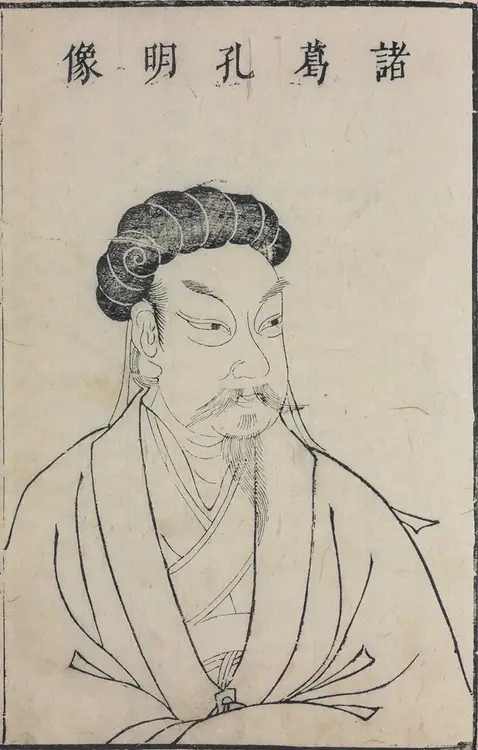
The image at the top of this page comes from the Sancai Tuhui, an illustrated encyclopedia compiled by Wang Qi and his son Wang Siyi and published in 1609, under the Ming dynasty. The title above the portrait, read from right to left, is 諸葛孔明像, “portrait of Zhuge Kongming”: the encyclopedia names him by surname and courtesy name, as was usual for a respected figure.
How a courtesy name was chosen
English Wikipedia describes several patterns.
Length. Before the Qin dynasty, courtesy names had one syllable; from the Qin to the 20th century they mostly had two characters.
A link with the given name. The courtesy name often echoed the meaning of the given name, as a synonym, a related idea or, more rarely, an opposite. Chiang Kai-shek’s given name 中正 Zhongzheng and his courtesy name 介石 Jieshi, romanized Kai-shek, both come from the same hexagram of the I Ching. Liang 亮, “bright”, and Kongming 孔明, “very bright”, show the same kind of echo.
The character 子 zi. A courtesy name could begin with 子, a respectful word for a man, as in Su Shi’s Zizhan 子瞻, Zhao Yun’s Zilong 子龍 or Du Fu’s Zimei 子美.
Birth order. The first character could show the man’s rank among his brothers:
| Character | Pinyin | Meaning | Example |
|---|---|---|---|
| 伯 | bó | eldest son | Sun Ce, courtesy name Bofu 伯符 |
| 仲 | zhòng | second son | Sun Quan, Zhongmou 仲謀; Confucius, Zhongni 仲尼 |
| 叔 | shū | third son | Sun Yi, Shubi 叔弼 |
| 季 | jì | youngest son | Sun Kuang, Jizuo 季佐 |
The four sons of General Sun Jian, listed in the table, show the whole series in one family; see the Sun surname. Confucius’s courtesy name tells us that he was a second son. This use of a shared character to place a person in the family is close in spirit to generation names, in which all the cousins of one generation share a character.
The scholar Yan Zhitui, of the Northern Qi dynasty, summed up the difference: a given name distinguishes one person from another, while a courtesy name should express the bearer’s moral integrity.
Courtesy names and art names
A second kind of personal name, the art name (号 hào), is often confused with the courtesy name. According to English Wikipedia, an art name was a professional name or pen name used by artists, poets and writers. It was usually chosen by the person, sometimes given by others or by the emperor, often in middle age, and it could change several times: the Ming painter Tang Yin had more than ten.
Art names followed their own patterns:
- A place of residence. Su Shi became Dongpo Jushi, “Householder of the Eastern Slope”, after the place where he lived in exile; he is still widely known as Su Dongpo.
- A saying or a poetic image. Li Bai was called the “Banished Immortal”, and Ouyang Xiu called himself the “Householder of the Six Ones”.
- An office or a birthplace. Du Fu was known as Du Gongbu, after his post in the Ministry of Works.
By the Song dynasty, most literati called each other by their art names. Like the courtesy name, the art name left the surname untouched, but it was often used alone, without it.
Courtesy names today
English Wikipedia notes that the practice is no longer common in modern Chinese society. Its traces remain in the way famous people are known. Chiang Kai-shek is known in the West by his courtesy name, in its Cantonese-influenced spelling, and Sun Yat-sen, whose courtesy name was Zaizhi 載之, is called Sun Zhongshan in China after another of his names. In Korea, Japan and Vietnam, educated men also used courtesy names until the 20th century.
For modern families, the closest living customs are the generation names still recorded in many genealogies, and the care taken in choosing a Chinese name. To trace the surname of a historical figure, start with the Hundred Family Surnames or the surname finder.
Frequently asked questions
What is a Chinese courtesy name?
A courtesy name, zi in Chinese, is a name given to a person at adulthood in addition to the given name. Men traditionally received it at 20 sui, the Chinese way of counting age. After that, equals addressed him by his courtesy name rather than his given name, which was considered too familiar. The custom is no longer common.
Why is Zhuge Liang called Kongming?
Liang 亮 is his given name and Kongming 孔明 his courtesy name. Zhuge 诸葛 is his surname, one of the Chinese compound surnames. Books and plays use both names, Zhuge Liang and Zhuge Kongming, for the same person.
Does a courtesy name replace the surname?
No. The courtesy name replaces only the given name in use. The surname stays first and unchanged: Cao Cao is Cao Mengde, Guan Yu is Guan Yunchang, Mao Zedong is Mao Runzhi.
What is the difference between a courtesy name and an art name?
A courtesy name (zi) was given at adulthood and used by equals in place of the given name. An art name (hao) was a pen name or nickname, often chosen by the person later in life, sometimes several times; Su Shi's art name Dongpo Jushi comes from the place where he lived in exile.
Do Chinese people still have courtesy names?
Rarely. The practice is no longer common in modern Chinese society. Some 20th-century figures still had one, such as Mao Zedong (Runzhi) and Chiang Kai-shek, whose name Kai-shek is in fact his courtesy name.
Sources and open data
- Courtesy name, English Wikipedia
- Art name, English Wikipedia
- Naming taboo, English Wikipedia
- Zhuge Liang, English Wikipedia
- Sancai Tuhui, English Wikipedia