Key facts
- Galileo spent his last years under house arrest at Arcetri, near Florence, where the young Vincenzo Viviani lived with him from 1639.
- Evangelista Torricelli succeeded Galileo as grand-ducal mathematician and in 1643 produced the first sustained vacuum with a mercury tube about 76 cm high.
- The Accademia del Cimento was founded in 1657 and published its only book, the Saggi di naturali esperienze, in 1666.
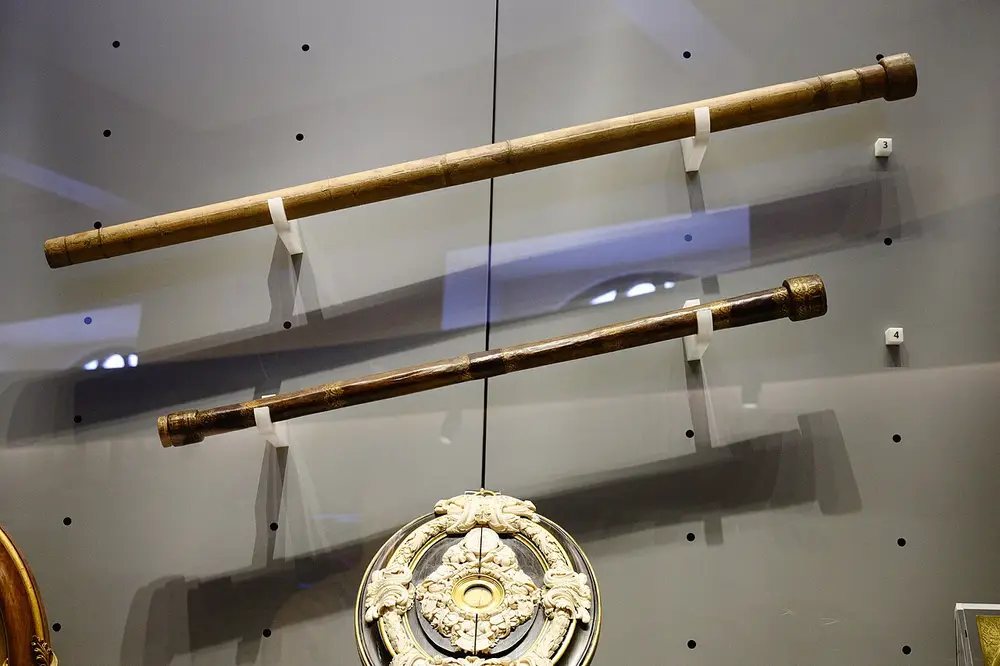
- The Museo Galileo in Florence holds Galileo's only two surviving telescopes and instruments of the Cimento.

Florence in the seventeenth century produced a chain of experimental physicists: Galileo Galilei, who died in 1642, his pupils Evangelista Torricelli and Vincenzo Viviani, and the Accademia del Cimento, which carried out organized experiments from 1657. Their work gave us the barometer, the sealed thermometer and an early measurement of the speed of sound. Many of the instruments survive in the Museo Galileo beside the Arno. This note follows the chain from Galileo’s last years to the academy’s single publication, and ends with the museum. It is part of the science notes.
Galileo at Arcetri
Galileo was born on 15 February 1564 and died on 8 January 1642. After his trial in 1633 he lived under house arrest, and from 1634 at Arcetri, on a hill just south of Florence. He had gone blind by 1638, yet in those years he worked on the Two New Sciences.
English Wikipedia’s article on Villa Il Gioiello says Galileo lived there from 1631 to 1642, next to the convent where his daughter Maria Celeste was a nun. 124 of her letters to him survive.
Torricelli and the ocean of air
Evangelista Torricelli (15 October 1608 to 25 October 1647) was a pupil of Benedetto Castelli. He visited Galileo at Arcetri about three months before Galileo’s death. After Galileo died, Grand Duke Ferdinando II named Torricelli grand-ducal mathematician.
His best-known experiment dates from 1643. He filled a tube of mercury, inverted it in a basin, and found that the column settled at about 76 cm, leaving an empty space above it, the Torricellian vacuum. On 11 June 1644 he wrote: “We live submerged at the bottom of an ocean of air.” The column was held up by the weight of the atmosphere, which is the principle of the mercury barometer. The torr, a unit of pressure, is named after him. His Opera Geometrica appeared in 1644.
Viviani, the last disciple
Vincenzo Viviani (5 April 1622 to 22 September 1703) lived with Galileo at Arcetri from 1639 and is counted as his last disciple. He helped with the Two New Sciences and edited Galileo’s works in 1655 and 1656. In 1660 he and Giovanni Borelli measured the speed of sound and obtained about 350 m/s. From 1666 he held the post of First Mathematician of the Tuscan Court, and in 1674 he published Torricelli’s fifth dialogue.
The Accademia del Cimento
The academy was founded in Florence in 1657 by students of Galileo, with Prince Leopoldo and Grand Duke Ferdinando II de’ Medici as patrons. Its motto, Provando e riprovando, “testing and testing again”, states its method. It declined after Leopoldo was made a cardinal in 1667.
| Item | Detail |
|---|---|
| Founded | 1657 |
| Patrons | Prince Leopoldo and Grand Duke Ferdinando II de’ Medici |
| Secretaries | Alessandro Segni (1657 to 1660), Lorenzo Magalotti (1660 to 1667) |
| Members named by Wikipedia | Borelli, Viviani, Paolo and Candido del Buono, Marsili, Rinaldini, Steno, Uliva, and Redi (his membership is disputed) |
| Only publication | Saggi di naturali esperienze, 1666 |
| Latin translation | 1731 |
The Saggi appeared anonymously and was written mainly by the secretary, Magalotti. English Wikipedia calls it the laboratory manual of the eighteenth century. Its first part describes instruments, including the thermometer, the hygrometer and the pendulum. The twelve sets of experiments that follow cover:
- air pressure with mercury barometers, and Boyle’s vacuum work;
- artificial and natural cooling, and the effects of heat and cold;
- the compressibility of water, and smoke in a vacuum;
- magnetism, amber and color;
- the speed of sound and falling bodies.
The original manuscripts are lost, but Targioni-Tozzetti copied them into sixteen volumes. The Saggi offers experiments with little theory. Some scholars link that restraint to caution after Galileo’s trial, though Wikipedia presents this as an argument rather than a settled fact.
Thermometers, and a misleading name
The history of the thermometer shows how the Florentines refined earlier ideas. Galileo’s thermoscope existed in or before 1603. Delmedigo described a sealed thermometer in 1629, and Ferdinando II made a sealed liquid-in-glass thermometer around 1654, which removed the dependence on air pressure.
The popular “Galileo thermometer”, a tube of liquid with floating glass bulbs, is a misnomer. Wikipedia says it was developed by the Cimento. The Saggi calls it the “Fifth Thermometer”, and the 1684 English translation describes it as “slow and lazy”. In other words the Florentines ranked it below their other designs.
The Museo Galileo
The museum occupies the Palazzo Castellani on the Arno near the Uffizi and was renamed Museo Galileo in June 2010. Paolo Galluzzi directed it from 1982 to 2021. The Medici collections fill nine rooms on the first floor. They include Galileo’s only two surviving telescopes, the objective lens he used to discover the moons of Jupiter, and thermometers of the Cimento. The Lorraine collections are on the second floor. The museum’s own site describes the collections.
For pressure and heat, the centuries after Florence led to the statistical ideas of Boltzmann, told in entropy and the arrow of time. Precision measurement of another kind appears in quantum cartography, and the career of a modern theorist is in Mark Wise.
What the sources leave open
Several details are disputed or lost. Wikipedia notes that Redi’s membership in the Cimento is questioned, that the original manuscripts are lost, and that the reasons for the academy’s lack of theory are interpretations. This note therefore avoids attributing individual experiments in the Saggi to named members, because the book was anonymous.
About the image
The image shows the two surviving telescopes of Galileo as displayed in the Museo Galileo in Florence, the museum described above. It was chosen because the telescopes are the best-known objects of the Medici collections, which also hold the Cimento thermometers discussed in this note.
Frequently asked questions
What was the Accademia del Cimento?
It was an experimental academy founded in Florence in 1657 by students of Galileo, under the patronage of Prince Leopoldo and Grand Duke Ferdinando II de' Medici. Its motto was Provando e riprovando, 'testing and testing again'. It faded after Leopoldo became a cardinal in 1667.
What did Torricelli discover?
In 1643 Torricelli filled a glass tube with mercury and inverted it, leaving a column about 76 cm high and a vacuum above it. This showed that the air has weight and led to the barometer. The unit torr is named after him.
Did Galileo invent the thermometer?
Not in the modern sense. Galileo's thermoscope existed in or before 1603, but it was open to air pressure. Ferdinando II made a sealed liquid-in-glass thermometer around 1654. The floating-bulb 'Galileo thermometer' was in fact developed by the Cimento.
Where can you see Galileo's instruments?
The Museo Galileo in Florence, in the Palazzo Castellani beside the Uffizi, holds Galileo's only two surviving telescopes and the objective lens he used to discover the moons of Jupiter.
Sources and open data
- Accademia del Cimento, English Wikipedia
- Evangelista Torricelli, English Wikipedia
- Vincenzo Viviani, English Wikipedia
- Galileo thermometer, English Wikipedia
- Museo Galileo, English Wikipedia
- Museo Galileo: collections, Museo Galileo