Key facts
- Since 2019, five families of experiments have claimed a quantum advantage: Sycamore (2019), Jiuzhang (2020), Zuchongzhi (2021), Borealis (2022) and Google's Willow (2024).
- The first claim, 10,000 years of classical time, was cut to days by IBM in 2019 and, in 2021 and 2022, a tensor network method reproduced the samples with 60 GPUs.
- Photonic experiments use Gaussian boson sampling, with up to 219 photons in the Borealis machine; Nature's own abstract notes earlier photonic claims were open to spoofing.
- Claimed classical costs are estimates, so the strongest evidence is a claim that survives a few years of attacks.

Since 2019, at least five experiments have claimed that a quantum machine beat classical computers at a specific task. This second part compares them: what each machine did, the classical time its authors claimed, and the classical simulations that answered. The pattern is consistent. Each claim rests on an estimate of what classical computers cannot do, and estimates have moved. The definitions and the complexity-theory background are in part 1; the wider list of topics is in the science notes.
The record at a glance
| Year | Platform | Task | Claimed classical time | Later challenge |
|---|---|---|---|---|
| 2019 | Google Sycamore, 53 qubits | Random circuit sampling | About 10,000 years, against 200 s on the device | IBM: days on Summit (2019); Pan and Zhang tensor network on 60 GPUs (2021, published 2022) |
| 2020 | USTC Jiuzhang, 76 detected photons | Gaussian boson sampling | 2.5 billion years on Sunway TaihuLight, against 200 s | None found in the sources cited |
| 2021 | USTC Zuchongzhi, 66 qubits | Random circuit sampling, up to 56 qubits and 20 cycles | At least 8 years on the most powerful supercomputer, against about 1.2 hours | None found in the sources cited |
| 2022 | Xanadu Borealis, 216 squeezed modes | Gaussian boson sampling | Over 9,000 years for exact methods, against 36 microseconds | None found in the sources cited |
| 2024 | Google Willow, 105 qubits | Random circuit sampling | 10 to the power 25 years, against under five minutes | None found in the sources cited |
The rows summarize the authors’ own figures, not independent verification. The last column records only what the sources used for this note report.
Sycamore: the claim and two answers
The Nature paper of 2019 describes 53 qubits, a state space of about 2 to the power 53, and a task of roughly one million samples taking 200 seconds. The authors estimated 10,000 years for the best classical supercomputer.
The first answer came from IBM, in arXiv 1910.09534 by Pednault and colleagues. They showed that deep 54-qubit Sycamore circuits could be simulated on the Summit supercomputer by using secondary storage, in days rather than millennia. Wikipedia gives 2.5 days. The method outputs amplitudes, not a stream of samples, so it did not fully replace the experiment, but it shrank the claimed gap.
The second answer was stronger. Feng Pan and Pan Zhang posted arXiv 2103.03074 in March 2021. They used a tensor network method on 60 GPUs to produce one million correlated bitstrings for the 53-qubit, 20-cycle circuit, with a cross-entropy benchmark fidelity of 0.739, higher than Google’s own. It appeared in Physical Review Letters 129, 090502 in August 2022 as “Solving the Sampling Problem of the Sycamore Quantum Circuits”. Wikipedia adds that in 2024 Google estimated that with improved tensor network algorithms, simulating the 53-qubit task would take about six seconds on the Frontier supercomputer.
Photonic machines
Photonic experiments use Gaussian boson sampling, in which squeezed light enters a network of beam splitters and detectors count photons at the output. This is a relative of the boson sampling problem described in part 1.
Jiuzhang (2020). The University of Science and Technology of China (USTC) announced Jiuzhang in December 2020. Wikipedia reports 76 detected photons and a claimed 200 seconds against 2.5 billion years on the Sunway TaihuLight supercomputer. A later version, Jiuzhang 2.0 (arXiv 2106.15534), used 144 modes and up to 113 detection events, with a Hilbert space dimension up to 10 to the power 43, and claimed sampling 10 to the power 24 times faster than brute-force simulation. The paper does not claim that its output cannot be spoofed.
Borealis (2022). Xanadu’s machine, described in Nature 606, used 216 squeezed modes and detected up to 219 photons, with a mean of 125. The authors report 36 microseconds of sampling against over 9,000 years for exact classical methods, and say the task was over 50 million times more extreme than earlier photonic machines. Their abstract also notes that earlier photonic demonstrations were vulnerable to spoofing, meaning that a classical algorithm could produce output that passes the statistical tests without simulating the circuit.
Zuchongzhi: more qubits, more cycles
USTC’s Zuchongzhi, described in arXiv 2106.14734, has 66 qubits and ran random circuit sampling up to 56 qubits and 20 cycles. The authors state that the classical cost is two to three orders of magnitude higher than for Sycamore, with about 1.2 hours on the device against at least 8 years on the most powerful supercomputer. Wikipedia says a later version, Zuchongzhi 2.1, is described as about six orders of magnitude harder to simulate. Note that USTC publication dates differ across sources: the arXiv posts are from June 2021, and Wikipedia cites October 2021 for the journal version.
Willow and the Quantum Echoes
In December 2024 Google announced Willow, a 105-qubit chip. Its blog post says the chip completed a random circuit sampling benchmark in under five minutes, which it compares with 10 to the power 25 years (10 septillion) for a classical supercomputer. The post is the source for that figure, since the accompanying Nature paper, “Quantum error correction below the surface code threshold”, is about error correction: a distance-7 code on 101 qubits, an error suppression factor of 2.14 per step up in code distance, and 0.143 percent error per cycle.
In October 2025 Nature published a different kind of test from Google, “Observation of constructive interference at the edge of quantum ergodicity”. It measured a second-order out-of-time-order correlator on a superconducting processor in 40-qubit experiments. The authors estimate that simulating one circuit on the Frontier supercomputer with tensor networks would take about 3.2 years, against 2.1 hours on the quantum processor, a factor of about 13,000. This is presented as a beyond-classical result for a quantity with physical meaning, not for random sampling alone.
What the pattern shows
Reading across the table, four points stand out.
- Claims have outlived some answers and not others. The 2019 claim was undercut within two years by tensor network methods. Nothing equivalent is documented in the sources cited here for the later experiments, which could mean they are stronger or only that they are newer.
- Photonic and superconducting claims differ. Photonic machines are not universal and lose photons, so their output is exposed to spoofing. Superconducting machines can in principle be made fault tolerant.
- Classical estimates are the weak link. Every number in the “claimed classical time” column is an extrapolation by the experimenters, not a measurement.
- Verification remains partial. Wikipedia observes that sampling tasks are hard to verify, which is why the benchmark scores are central.
A related lesson applies to quantum sensing, which has no such dispute because a sensor is judged by its measurement, as in quantum cartography. Statistical arguments about disorder and information, such as why noise degrades a quantum state, are treated in the entropy note.
What would settle the question
The sources point to three developments. A claim based on a task with a verifiable answer would remove the verification problem. Error-corrected devices, as in the Willow error-correction paper, would move the discussion away from noisy sampling. And a stable gap that persists after years of classical attempts would be the most persuasive evidence. None of these is yet documented in the sources used here as complete.
About the image
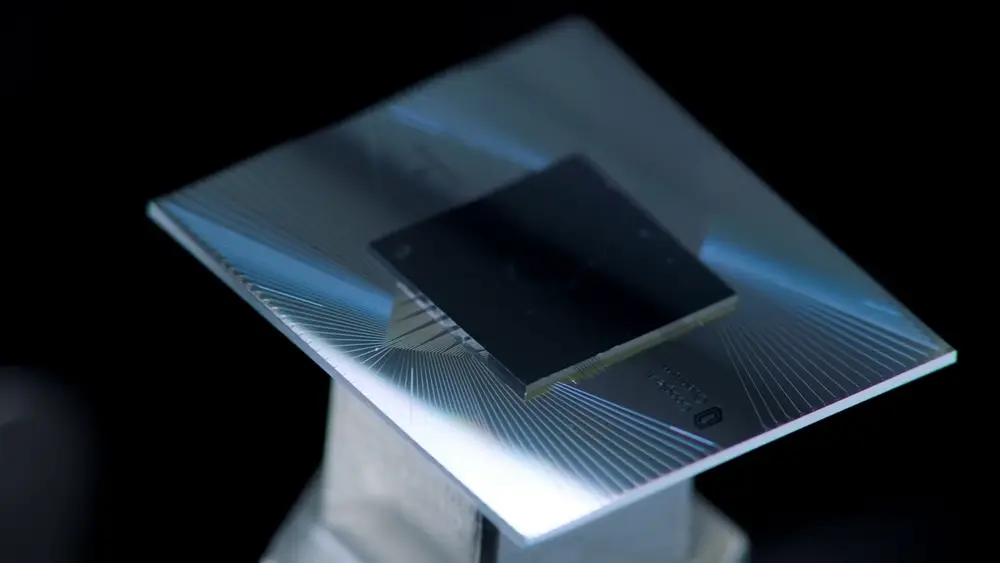
The image is a still from a Google video showing the Sycamore processor, the 53-qubit chip behind the first claim in the table above. It was chosen because the Sycamore result is the baseline against which later claims and classical simulations are measured.
Frequently asked questions
Has quantum advantage been achieved?
Several experiments claim it on sampling tasks, but the first claim, Google's 2019 Sycamore result, was disputed by IBM and later undercut by classical tensor network simulations. Newer experiments claim larger margins. Whether any claim is final is still debated, since classical methods keep improving.
Was Google's 2019 quantum supremacy claim disproved?
It was weakened. IBM argued that the task would take days, not 10,000 years. In 2021 Pan and Zhang posted a tensor network method that produced one million correlated bitstrings for the 53-qubit, 20-cycle circuit using 60 GPUs, with a higher benchmark score than Google's. It was published in Physical Review Letters in 2022.
What is Gaussian boson sampling?
It is a form of boson sampling in which squeezed light, rather than single photons, enters a network of beam splitters, and detectors count the photons that emerge. Jiuzhang and Borealis used it.
What did Google's Willow chip show?
Google reported a 105-qubit chip that completed a random circuit sampling benchmark in under five minutes, compared with a claimed 10 to the power 25 years for a classical supercomputer. A separate Nature paper reported a distance-7 error-correcting code on the same kind of hardware.
Sources and open data
- Quantum supremacy using a programmable superconducting processor, Nature
- Leveraging Secondary Storage to Simulate Deep 54-qubit Sycamore Circuits, arXiv
- Solving the Sampling Problem of the Sycamore Quantum Circuits, Physical Review Letters
- Strong quantum computational advantage using a superconducting quantum processor, arXiv
- Phase-Programmable Gaussian Boson Sampling Using Stimulated Squeezed Light, arXiv
- Quantum computational advantage with a programmable photonic processor, Nature
- Meet Willow, our state-of-the-art quantum chip, Google
- Jiuzhang (quantum computer), English Wikipedia