Key facts
- Mainland China's national standard GB/T 28039-2011 says the surname comes first, the given name is written as one word, and each of the two starts with a capital letter: Zhào Píng'ān.
- Tone marks and apostrophes may be omitted on passports, so Wú Xīng'ēn becomes WU XINGEN.
- The vowel ü exists only after l and n; the standard allows YU where ü cannot be printed, for example Lǚ Hépíng becomes LYU HEPING.
- Pinyin letters do not sound like English ones: q is close to an aspirated ch, x to a soft sh, zh to j, c to ts.
- Names that already have an established Latin spelling, such as Hong Kong, Taiwan or overseas names, may keep it; pinyin does not replace them.

Pinyin is the official romanization of Mandarin in mainland China and the system most English-language texts now use for Chinese personal names. For a name, the rule is short: surname first, given name as one word, both capitalized, as in Zhào Píng’ān (赵平安) or Wáng Fāng (王芳). Tone marks are optional outside dictionaries, and the apostrophe is used only to prevent misreading.
The rules below come from the Chinese national standard GB/T 28039-2011, titled “Chinese phonetic alphabet spelling rules for Chinese names” (中国人名汉语拼音字母拼写规则). It was published on October 31, 2011 and took effect on February 1, 2012. The text of the standard is available from the Ministry of Education, and a transcription is on BabelStone.
The basic order and capitalization
The standard sets out the following for a normal name:
- The surname and the given name are written separately, with the surname first and a space between them.
- The first letter of the surname and of the given name is capitalized.
- The given name is written as one word, even when it has two characters: Yáng Wèimín (杨为民), not Yang Wei Min.
Writing the given name as one word is the main difference from many older spellings, which hyphenated or split the two syllables (Tai-Lun, Tai Lun). Wade-Giles used a hyphen, and some overseas families still do; see the Wade-Giles guide. For indexing, the standard also lets the surname be written in capitals, as in ZHANG Ying, which avoids confusing surname and given name in English documents. For the order itself and when to reverse it, see surname-first name order.
Compound surnames and double surnames
Two different things are called “double” surnames, and the standard treats them differently:
| Case | Example in the standard | Rule |
|---|---|---|
| Compound surname (one surname of two characters) | Ōuyáng Wén 欧阳文, Sīmǎ Xiàngnán 司马相南 | written joined, as one word |
| Two surnames combined | Liú-Yáng Fān | joined by a hyphen |
On a passport the hyphen between two combined surnames may be dropped, as in ZHAOLI SHUGANG for Zhào-Lǐ Shūgāng. More on the first case is in compound surnames.
Tones and apostrophes
Tones. Mandarin has four tones, marked with accents over the vowel: Wáng, Wǎng, Wàng. The standard allows tone marks to be left out on passports and in indexes, and in English text names normally appear without them. The cost is ambiguity: Lǐ (李) and Lì (历, 利) both become Li, and so do other pairs. Where it matters, give the characters.
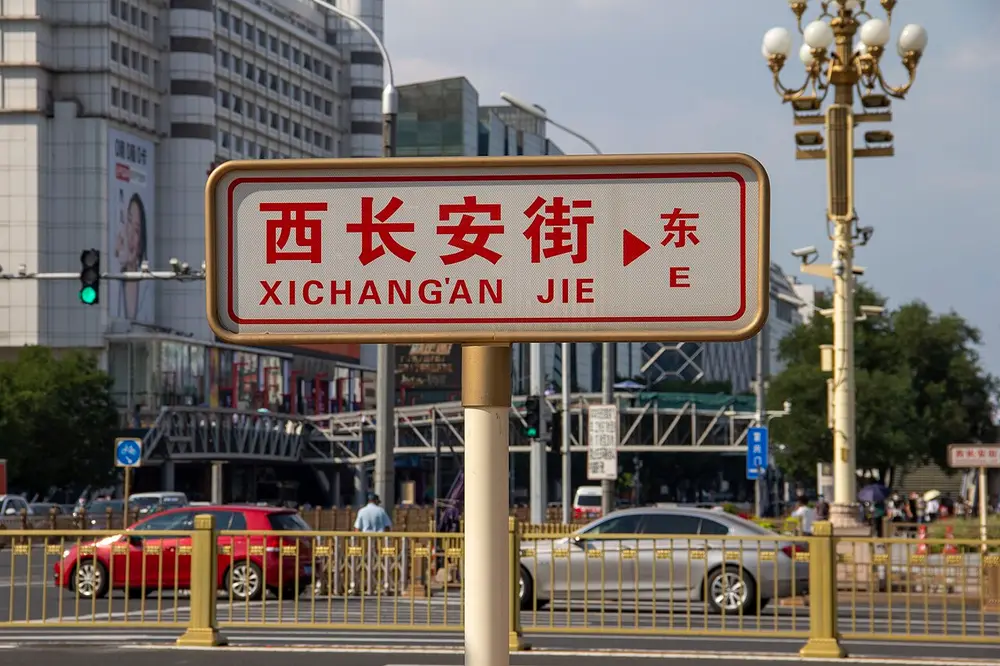
Apostrophes. A pinyin syllable that begins with a, o or e and follows another syllable is separated by an apostrophe. Chinese Wikipedia explains that the 1958 scheme required it where confusion could arise, with the example zǒng’éryánzhī. In names, the clearest examples are Píng’ān (平安) and the street name Xichang’an, shown in the image above, which is read as xi + chang + an and not as xi + chan + gan. On a passport the apostrophe may be dropped: Wú Xīng’ēn becomes WU XINGEN.
The letter ü on passports
The vowel ü is written only after l and n, where it contrasts with u: lǜ (绿, green) and lù (路, road). After j, q, x and y the umlaut is dropped and the vowel is written u, so 徐 is Xú and not Xü. English Wikipedia adds that many keyboards and phones use v for ü.
For names, this matters most for the surname 吕 (Lǚ). The standard says that where technically necessary, such as on passports and in documents for foreign readers, ü may be written YU, with the example Lǚ Hépíng becoming LYU HEPING (吕和平). English Wikipedia reports that the Ministry of Public Security fixed LYU and NYU for passports on July 10, 2012, after earlier variation between LV, NV and LU, NU. This page has not seen the ministry notice itself, so treat that date as reported rather than verified.
| What you see | Reason |
|---|---|
| Lü | the correct pinyin, needs ü on the keyboard |
| Lyu | the passport form allowed by GB/T 28039-2011 |
| Lv | keyboard shortcut, seen in software and on some documents |
| Lu | loses the ü distinction, and collides with 卢, 陆 and 鲁 |
The last row has a real effect. In the 2010 US Census, LU was held by 35,628 people, LYU by 355 and LUE by 1,184, so a Lü family may sit under any of several spellings. See Lü 吕 and Chinese names on passports.
Names that keep their old spelling
The standard does not force pinyin everywhere. Its section 6.1 says that names with an established Latin spelling, including well-known historical figures, people from Hong Kong, Macau and Taiwan, and overseas Chinese, may keep it. Taiwan officially adopted pinyin as its transliteration principle in 2008, according to Chinese Wikipedia, but personal names and passports follow the person’s own choice, so Wade-Giles, Hakka, Hoklo and other spellings remain in use there. For the main alternatives, see Wade-Giles and Hong Kong Cantonese spellings.
How to pronounce the tricky letters
Pinyin letters are not English letters. The comparisons below are approximations for English speakers; none is exact.
| Letter | Approximate English sound | Example |
|---|---|---|
| zh | like j in “judge”, tongue tip curled back | Zhang “jahng” |
| ch | like ch in “church”, tongue tip curled back | Chen “chun” |
| q | like ch, with a strong puff of air and the tongue spread flat | Qian “chyen” |
| x | like a soft sh, with the tongue tip behind the lower teeth | Xu “shoo”, lips rounded |
| j | like a soft, unaspirated j | Jiang “jyahng” |
| c | like ts in “cats” | Cai “tsai” |
| z | like ds in “kids” | Zeng “dzung” |
| ü | like French u or German ü | Lü “lyoo”, lips rounded |
The surname pages give a pronunciation guide for each name, and the Chinese name to pinyin tool converts any name using the open-source pinyin-pro library.
Why pinyin is not the whole story
Pinyin is a transcription of the Mandarin reading. Families whose ancestors spoke Cantonese, Hokkien or Hakka usually have a different spelling of the same character: 陈 is Chen in pinyin and Chan in Hong Kong. The one surname, many spellings guide shows the pattern. English Wikipedia describes pinyin as the dominant transcription for Chinese personal names in English, and the US Census file reflects it: pinyin spellings such as Zhang and Li grew fastest between 2000 and 2010, as the US Census guide shows.
Frequently asked questions
How do you write a Chinese name in pinyin?
Write the surname first, then the given name as a single word, each starting with a capital letter, as in Wáng Fāng or Yáng Wèimín. This is the rule of the Chinese national standard GB/T 28039-2011, which also allows tone marks to be dropped on passports.
How is the surname Lü written on a passport?
As LYU. The standard GB/T 28039-2011 allows ü to be written YU where the character cannot be printed, with the example Lǚ Hépíng becoming LYU HEPING. LV, LU and Lv are also seen on older documents and in software, so a visa or a database may differ.
Does a Chinese name in pinyin keep the tone marks?
Usually not. The standard allows tone marks and apostrophes to be omitted on passports, and in English text names normally appear without tones, for example Zhang Wei. Tones are kept in dictionaries and teaching materials, where they separate names that would otherwise look identical.
When is an apostrophe used in a pinyin name?
When a syllable starting with a, o or e follows another syllable, an apostrophe marks the break, as in Zhào Píng'ān, or in the street name Xichang'an. Without it the syllables could be misread, for example chang-an as chan-gan.
How do you pronounce the surname Xu?
Approximately 'shoo', with rounded lips and the tongue tip behind the lower teeth. It is only an approximation, since the Mandarin sound x has no exact English equivalent.
Sources and open data
- GB/T 28039-2011, Chinese phonetic alphabet spelling rules for Chinese names (official text, PDF), Ministry of Education of the PRC
- GB/T 28039-2011 (transcription and notes), BabelStone
- Pinyin, English Wikipedia
- 汉语拼音, Chinese Wikipedia
- Frequently Occurring Surnames from the 2010 Census, US Census Bureau