Key facts
- Wang is written 王, a 4-stroke character meaning king. Simplified and traditional forms are identical.
- It ranked first among mainland surnames in the Ministry of Public Security's 2019 report; the 2007 national ID count gave 92.88 million bearers, 7.25% of the population.
- Genealogies trace it to royal lines: descendants of Shang prince Bi Gan, of Prince Jin of Zhou, and of the Tian kings of Qi all took the name 'king'.
- Overseas it is also spelled Wong (Cantonese), Ong or Heng (Hokkien, Teochew), Vương (Vietnamese) and Vang (Hmong).
- The 2010 US Census counted 109,883 Wangs, 95.2% of them Asian or Pacific Islander, and 111,371 Wongs, a spelling shared with Huang 黄.
王
Pinyin: Wáng
Same character in simplified and traditional: 王
Rank in mainland China: 1 of the top 100 (Ministry of Public Security, 2019 report)
Characters and spellings of 王
| Unicode code point | U+738B |
|---|---|
| Stroke count | 4 |
| Radical (simplified form) | No. 96 ⽟ (the character is itself a radical) |
| Dictionary meaning (Unihan) | king, ruler; royal; surname |
Romanizations by Chinese language
| Language | System | Spelling |
|---|---|---|
| Mandarin | Hanyu Pinyin (PRC standard) | Wáng |
| Mandarin | Wade-Giles (Taiwan, older English texts) | Wang |
| Cantonese | Jyutping (Unihan) | wong4 |
| Cantonese | Hong Kong / common spellings | Wong, Vang |
| Hokkien (Min Nan) | Pe̍h-ōe-jī and common spellings | Ông, Wung, Heng |
| Hakka | Pha̍k-fa-sṳ and common spellings | Vòng, Wong |
| Gan | Romanization and common spellings | Uōng, Wong |
| Wu (Shanghainese) | Romanization and common spellings | Waon, Whang |
Equivalent surnames in other languages
| Language | Form |
|---|---|
| Vietnamese | Vương |
| Korean | Wang (왕) |
| Japanese | Ō |
| Filipino | Ong, Wong, Wang, Heng |
These spellings in the 2010 US Census
| Spelling | People | US rank | Asian / Pacific Islander |
|---|---|---|---|
| WONG | 111,371 | 274 | 86.49% |
| WANG | 109,883 | 282 | 95.24% |
| VANG | 48,036 | 726 | 96.7% |
| ONG | 9,584 | 3,704 | 87.39% |
| VUONG | 9,407 | 3,766 | 96.63% |
| VONG | 4,443 | 7,496 | 92.62% |
| HENG | 3,819 | 8,611 | 82.69% |
| WHANG | 1,522 | 18,253 | 93.17% |
| UONG | 386 | 53,538 | 95.6% |
| WUNG | 196 | 93,513 | 88.78% |
Counts are people recorded with each spelling among the 265,667,228 people with a surname shared by at least 100 people (US Census Bureau, 2010, public domain). A spelling is not proof of Chinese origin: the last column shows the share of bearers who identified as Asian or Pacific Islander. Together these spellings total 298,647 people, but some of them belong to unrelated surnames (for example English Lee, Hmong Vang or Vietnamese Ly). Search any spelling with the US census surname lookup.
Stroke order
Animation by the open-source Hanzi Writer library (MIT) with stroke data from Make Me a Hanzi (Arphic Public License). Stroke order tool for any character.

Wang (王) is the most common surname in mainland China. The character means “king”, has only 4 strokes and is the same in simplified and traditional script. It is pronounced wáng, roughly “wahng” with a rising tone. Abroad it is also spelled Wong (Cantonese), Ong or Heng (Hokkien and Teochew), Vương (Vietnamese) and Vang (Hmong). The 2007 national ID count gave it 92.88 million bearers, 7.25% of China’s population, and it ranked first again in the Ministry of Public Security’s 2019 report.
Another surname, 汪, is also romanized Wang. It is a different and much smaller family name: see Wang 汪.
Meaning of the character 王
The Unihan database glosses 王 as “king, ruler; royal; surname”. The character is drawn as three horizontal strokes joined by one vertical stroke, which is why Chinese speakers identify the surname as 三横王, “three-stroke Wang”, when they need to tell it apart from 黄 Huang in dialects where the two sound alike. It is Kangxi radical 96 (玉, jade) in dictionaries, a historical quirk: as a component, 王 often stands for jade.
Baxter and Sagart reconstruct the Old Chinese pronunciation as *ɢʷaŋ, the ancestor of every modern reading listed in the data panel above, from Cantonese wong4 to Korean wang and Japanese ō.
Origins of the Wang surname
No single family produced the name. Genealogical tradition, summarized in the English and Chinese Wikipedia articles, gives four main sources, all built on the same idea: descendants of a royal house took “king” as their surname.
- Zi 子 line (Shang dynasty). Bi Gan, uncle of the last Shang king, was executed for criticizing him. His descendants are said to have called themselves Wang as offspring of a prince. This is presented as the oldest line, settled in today’s Henan.
- Ji 姬 line (Zhou dynasty). Prince Jin (太子晋, also called Wangzi Qiao), son of King Ling of Zhou (reigned 571 to 545 BC), was demoted for remonstrating with his father. People called his descendants “the king’s family”, and the name stuck. The great medieval clans of Taiyuan and Langya traced themselves to this line.
- Gui 妫 line (state of Qi). After Qin destroyed Qi in 221 BC, descendants of its Tian royal family adopted Wang to remember their former rank. Wang Mang, who founded the short-lived Xin dynasty, belonged to this branch.
- Adoption by non-Han peoples. Xianbei, Qiang, Khitan and Jurchen families, among others, took or were granted the name over the centuries and merged into the Han population.
These are traditional accounts. They show how widely the name was claimed, not that any living family descends from a particular prince.
Taiyuan and Langya: the great clans
From the Three Kingdoms to the end of the Tang, the Langya Wang (琅琊王氏, Shandong) and the Taiyuan Wang (太原王氏, Shanxi) were among the most powerful aristocratic lineages in China. The Taiyuan Wang were one of the “seven great surnames” whose intermarriage Emperor Gaozong tried to ban in 659. The Fujian Wangs who founded the Min kingdom in the 10th century also claimed Langya descent. These choronyms (郡望) still appear on Wang clan association and hall names.
How Wang is spelled around the world
| Spelling | Source | Where you meet it |
|---|---|---|
| Wang | Hanyu Pinyin and Wade-Giles (identical here) | Mainland China, Taiwan, most of the diaspora |
| Wong | Cantonese | Hong Kong, Malaysia, older US and Canadian families |
| Ong, Heng | Hokkien (Ong) and Teochew (Heng) | Singapore, Malaysia, the Philippines, Indonesia |
| Vương | Vietnamese reading of 王 | Vietnam and Vietnamese diaspora |
| Vang | Hmong | Hmong communities in Laos, Thailand and the US |
| Ō | Japanese reading | Rare in Japan, mostly families of Chinese origin |
Two spellings deserve a warning. Wong is ambiguous, because Cantonese reads 王 and 黄 the same way (wong4): see the Hong Kong Cantonese spellings guide. Ong is mostly 王 in Hokkien, but some Huang families also use it. The Hokkien and Teochew guide explains why, and the surname finder lists every character a spelling can stand for.
Since pinyin and Wade-Giles both write “Wang”, the spelling alone does not tell you whether a family came from the mainland or from Taiwan, unlike Zhang and Chang.
Wang in the United States
The 2010 US Census file, the open dataset behind the panel above, shows how one character splits into several American surnames:
- Wong: 111,371 people (rank 274), 86.5% Asian or Pacific Islander. This count mixes 王 and 黄 families, mostly of Cantonese origin.
- Wang: 109,883 people (rank 282), 95.2% Asian or Pacific Islander, mostly mainland and Taiwanese families.
- Vang: 48,036 people (rank 726), 96.7%. These are almost all Hmong Americans: Vang (written Vaj in Hmong RPA) is one of the eighteen Hmong clan names and is cognate with Chinese 王.
- Ong: 9,584; Vuong: 9,407; Heng: 3,819.
Adding Wang, Vang, Vuong, Ong and Heng alone gives more than 180,000 people, before counting any of the Wongs. The US census analysis applies the same method to every surname on this site, and the census lookup tool queries any spelling.
Distribution in China
Wang is a northern name. In 2019 it was the most common surname in almost every northern province-level division: Xinjiang, Gansu, Inner Mongolia, Shaanxi, Shanxi, Henan, Hebei, Anhui, Jiangsu, Shandong, Beijing, Tianjin, Liaoning, Jilin and Heilongjiang, plus Hainan in the far south. A 2013 study found Henan to be the province with the most Wangs. In Taiwan it ranked sixth in 2018, with 4.10% of the population. See the 100 most common surnames in China for the full ranking.
In the Hundred Family Surnames (百家姓), the Song-era primer, Wang is only eighth. According to the Song scholar Wang Mingqing, it stands there because it was the surname of a consort of Qian Chu, last king of Wuyue, not because of its frequency. The Hundred Family Surnames page explains the order.
Famous people named Wang
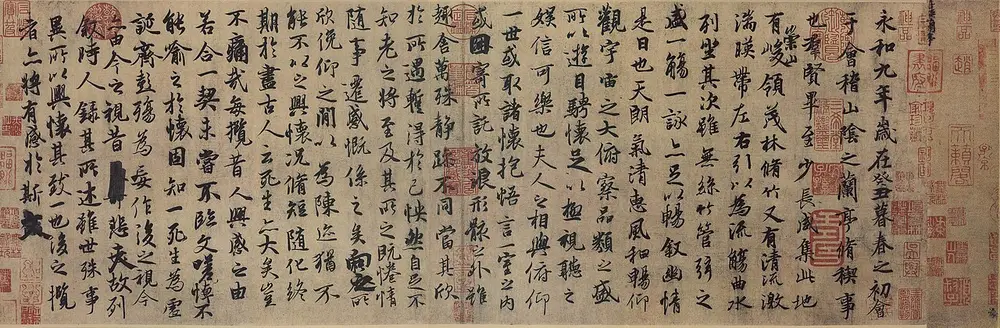
- Wang Xizhi (王羲之, c. 303 to c. 361), Jin dynasty calligrapher from the Langya Wang, often called the greatest calligrapher in Chinese history. His Preface to the Orchid Pavilion Poems is shown above in a Tang copy.
- Wang Mang (王莽, 45 BC to AD 23), founder and only emperor of the Xin dynasty, which interrupted the Han.
- Wang Wei (王維, 699 to 761), Tang poet, painter and musician, born to a Taiyuan Wang father.
- Wang Anshi (王安石, 1021 to 1086), Song chancellor known for the reforms called the New Policies.
- Wang Yangming (王陽明, 1472 to 1529), Ming statesman and neo-Confucian philosopher.
- Wang Geon (王建, 877 to 943), founder of the Goryeo dynasty of Korea.
- An Wang (王安, 1920 to 1990), Chinese-American engineer, co-founder of Wang Laboratories and contributor to magnetic-core memory.
- Wong Kar-wai (王家衛, born 1958), Hong Kong film director, an example of the Cantonese spelling of 王.
Sadaharu Oh (王貞治, born 1940), the Japanese baseball home run record holder, carries the same character in its Japanese reading.
Related surnames and confusions
- 黄 Huang: written differently but spelled Wong in Cantonese, exactly like 王. See Huang 黄.
- 汪 Wang: same pinyin, different character (water radical) and a much smaller family. See Wang 汪.
- To write a Wang name in standard order, try the name order formatter; to compare with the other giants, see Li 李 and Zhang 张.
Frequently asked questions
What does the surname Wang mean?
The character 王 means king or ruler. Families who took it as a surname usually claimed descent from a royal house, so the name records a claimed royal ancestry rather than a job.
How do you pronounce Wang?
In Mandarin it is wáng, said like wahng with the a of father and a rising second tone. It does not rhyme with the English word bang.
Is Wong the same surname as Wang?
Sometimes. Wong is the Cantonese spelling of 王 Wang, but it is also the Cantonese spelling of 黄 Huang, because both characters are read wong4 in Cantonese. Only the Chinese character tells you which one a family has.
Is Wang the most common surname in the world?
It is the most common surname in mainland China, with around 90 to 100 million bearers depending on the count. Li and Zhang are close behind, and no worldwide census exists to settle the question precisely.
Is Wang also a Korean surname?
Yes. 왕 Wang was the royal surname of the Goryeo dynasty founded by Wang Geon in 918, but it is rare in Korea today: the 2000 South Korean census recorded about 23,000 Wangs.
Sources and open data
- Unihan database entry for U+738B 王, Unicode Consortium
- Frequently Occurring Surnames from the 2010 Census, US Census Bureau
- Wang (surname), English Wikipedia
- 王姓 (Wang surname), Chinese Wikipedia
- Hundred Family Surnames, English Wikipedia
- Wang Xizhi, English Wikipedia
- Wang, family name (Q804943), Wikidata