Key facts
- Wang 汪 is written the same in simplified and traditional script (7 strokes) and pronounced wāng, with a high level tone.
- It is a different surname from Wang 王, the most common surname in China, which is pronounced wáng with a rising tone. In English both are usually spelled Wang.
- The character means vast, deep waters, and carries the water radical 氵. Chinese speakers tell the two names apart as "three-drops Wang" and "three-strokes Wang".
- It ranks 59th in mainland China in the Ministry of Public Security's 2019 report and 104th in the Hundred Family Surnames. Its heartland is Anhui, especially the old Huizhou region.
- Other spellings include Wong (Cantonese), Ong and Ang (Hokkien), Vong (Hakka), Uông (Vietnamese) and Wang (Korean 왕).
汪
Pinyin: Wāng
Same character in simplified and traditional: 汪
Rank in mainland China: 59 of the top 100 (Ministry of Public Security, 2019 report)
Characters and spellings of 汪
| Unicode code point | U+6C6A |
|---|---|
| Stroke count | 7 |
| Radical (simplified form) | No. 85 ⽔, plus 4 strokes |
| Dictionary meaning (Unihan) | vast, extensive, deep; surname |
Romanizations by Chinese language
| Language | System | Spelling |
|---|---|---|
| Mandarin | Hanyu Pinyin (PRC standard) | Wāng |
| Mandarin | Wade-Giles (Taiwan, older English texts) | Wang |
| Cantonese | Jyutping (Unihan) | wong1 |
| Cantonese | Hong Kong / common spellings | Wong, Wung |
| Hokkien (Min Nan) | Pe̍h-ōe-jī and common spellings | Ong (X, Q, K, T), Óng (Z) |
| Hakka | Pha̍k-fa-sṳ and common spellings | Wang, Vong |
| Gan | Romanization and common spellings | Wong, Uong |
| Wu (Shanghainese) | Romanization and common spellings | Waon, Whang |
Equivalent surnames in other languages
| Language | Form |
|---|---|
| Vietnamese | Uông |
| Korean | Wang (왕) |
| Japanese | Ō |
| Filipino | Ong, Ang |
These spellings in the 2010 US Census
| Spelling | People | US rank | Asian / Pacific Islander |
|---|---|---|---|
| WONG | 111,371 | 274 | 86.49% |
| WANG | 109,883 | 282 | 95.24% |
| ONG | 9,584 | 3,704 | 87.39% |
| VONG | 4,443 | 7,496 | 92.62% |
| ANG | 3,413 | 9,525 | 84.18% |
| WHANG | 1,522 | 18,253 | 93.17% |
| UONG | 386 | 53,538 | 95.6% |
| WUNG | 196 | 93,513 | 88.78% |
Counts are people recorded with each spelling among the 265,667,228 people with a surname shared by at least 100 people (US Census Bureau, 2010, public domain). A spelling is not proof of Chinese origin: the last column shows the share of bearers who identified as Asian or Pacific Islander. Together these spellings total 240,798 people, but some of them belong to unrelated surnames (for example English Lee, Hmong Vang or Vietnamese Ly). Search any spelling with the US census surname lookup.
Stroke order
Animation by the open-source Hanzi Writer library (MIT) with stroke data from Make Me a Hanzi (Arphic Public License). Stroke order tool for any character.

Wang (汪) is a Chinese surname pronounced wāng, with a high level tone. It ranks 59th in mainland China in the 2019 official list and is especially common in Anhui. It is not the same name as Wang 王, the most common surname in China, which is pronounced wáng with a rising tone. Pinyin without tone marks spells both Wang, so in English the two families look identical. Outside the mainland 汪 is spelled Wong (Cantonese), Ong or Ang (Hokkien), Vong (Hakka), Uông (Vietnamese) and Wang (Korean 왕).
Meaning of the character 汪
汪 combines the water radical 氵 (radical 85) with 王 (wáng), which gives the sound. The Unihan database glosses it as “vast, extensive, deep; surname”. In classical texts it describes a broad expanse of water, and in modern Chinese it still names a pool or puddle: 一汪水 is “a pool of water”. 汪洋 means a vast ocean.
The character has a second, informal life: 汪汪 (wāngwāng) is how Chinese writes a dog’s bark, the equivalent of “woof woof”. Neither sense has anything to do with the origin of the surname, which comes from place names and personal names.
Two Wangs: 汪 and 王
Because 汪 contains 王 as its sound part, the two surnames sound almost the same and share the same toneless spelling. The differences:
| Wang 汪 | Wang 王 | |
|---|---|---|
| Pronunciation | wāng, high level tone | wáng, rising tone |
| Strokes | 7 | 4 |
| Meaning | vast waters | king |
| Rank in China (2019) | 59th | 1st |
| Hundred Family Surnames | 104th | 8th |
| Cantonese | Wong | Wong |
| Hokkien | Ong, Ang | Ong |
In conversation, Chinese speakers resolve the ambiguity by describing the character: 三点水的汪, “Wang with three drops of water”, against 三横王, “Wang with three horizontal strokes”. In English that clue is lost. Even Cantonese and Hokkien spell both names the same way, so an Ong from Singapore or a Wong from Hong Kong could belong to either family. The guide to one surname, many spellings explains why toneless spellings merge so many names.
Origin: Lu, Wangmang and the Ongut
Chinese and English Wikipedia list several unrelated origins:
| Origin | Period | Story |
|---|---|---|
| Prince Wang of Lu (公子汪) | Spring and Autumn | descendants of a younger son of Duke Cheng of Lu used his name |
| state of Wangmang (汪芒) | Xia to Warring States | the people of a small state in today’s Deqing, Zhejiang, shortened its name |
| Xiao Wang (小汪) | Spring and Autumn | an outpost in Shaanxi taken by Qin, whose garrison families took the name |
| Ongut (汪古部) | Jurchen Jin dynasty | a Turkic people of the northern steppe, some of whom adopted the surname |
The Lu line is the one most Chinese genealogies favor. Lu was ruled by the Ji (姬) clan, the royal house of Zhou, which ties this branch to many other Ji surnames. The Wangmang tradition links the surname to Fangfeng, a giant of legend said to have been executed by Yu the Great. English Wikipedia also notes that in Gansu, some Hui families named 汪 descend from Han Chinese who converted to Islam through marriage. See where Chinese surnames come from for how place and personal names became surnames.
The Wang of Huizhou
No region is more closely tied to 汪 than Huizhou, the mountainous area of southern Anhui around Mount Huangshan. Chinese Wikipedia, citing a 1980s study, places about 44% of all Han people named 汪 in Anhui, followed by Hubei, Sichuan, Jiangsu, Hunan and Zhejiang.
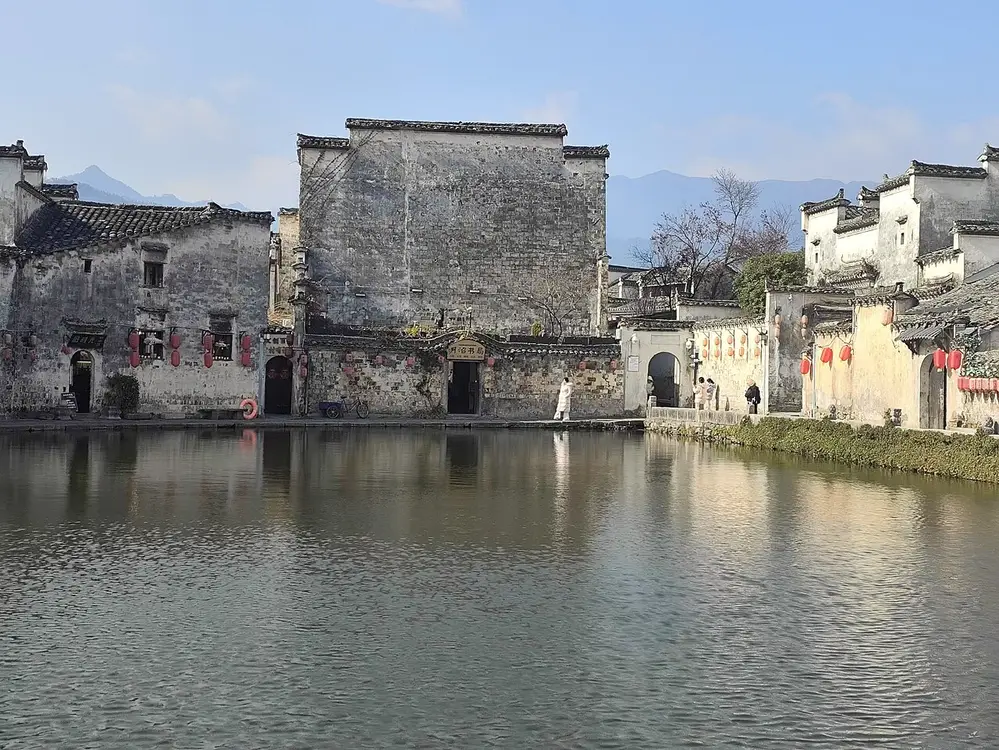
The village of Hongcun, shown above, is a good example. It was founded in 1131 by the Wang 汪 family and grew rich as the clan’s merchants prospered under the Ming and Qing. A clan elder of the Ming period had the village replanned and water channeled into it, forming the half-moon pond at its center and the South Lake below. Hongcun and neighboring Xidi became a UNESCO World Heritage Site in 2000, and scenes of Crouching Tiger, Hidden Dragon were filmed there.
How Wang 汪 is spelled around the world
| Spelling | Language or system | Where you meet it |
|---|---|---|
| Wang | Pinyin and Wade-Giles | mainland China, Taiwan |
| Wong / Wung | Cantonese (wong1) | Hong Kong, Macau |
| Ong / Ang | Hokkien, Teochew | Singapore, Malaysia, Philippines |
| Vong | Hakka | Malaysia, older US families |
| Waon / Whang | Wu (Shanghainese) | Shanghai, older spellings |
| Uông | Vietnamese | Vietnam |
| Wang (왕) | Korean | Korea |
| Ō | Japanese | Japan |
The Hokkien forms Ong and Ang are shared with other surnames, a point covered in the Hokkien and Teochew guide. For the Vietnamese form, see Vietnamese surnames and Chinese characters.
Wang 汪 in the United States
The 2010 US Census cannot separate 汪 from the far larger surnames that share its spellings:
- Wang: 109,883 people (95.2% Asian or Pacific Islander), overwhelmingly 王.
- Wong: 111,371 people (86.5%), mostly 黄 Huang and 王 in Cantonese.
- Ong: 9,584 people (87.4%), mostly Hokkien 王.
- Vong: 4,443 people (92.6%).
- Ang: 3,413 people (84.2%), shared with other Hokkien surnames.
- Whang: 1,522 people (93.2%), Uong: 386 (95.6%) and Wung: 196 (88.8%).
Uong, the Vietnamese spelling without its diacritic, is the only one that points clearly to 汪. The US census surname lookup shows every spelling side by side.
Famous people named Wang 汪
- Wang Dayuan (汪大渊, 14th century), traveler from Quanzhou who described the ports of Southeast Asia and the Indian Ocean.
- Wang Jingwei (汪精卫, 1883 to 1944), politician who headed the Japanese-backed government in Nanjing during the Second World War.
- Wang Zengqi (汪曾祺, 1920 to 1997), novelist and essayist known for his elegant style.
- Wang Feng (汪峰, born 1971), rock musician.
- Frank Wang (汪滔, born 1980), engineer and founder of the drone maker DJI.
- Chloe Bennet (汪可盈, born 1992 as Chloé Wang), American actress.
Related surnames and pages
- For the far more common surname spelled the same way, see Wang 王.
- Wang 汪 is the 104th name in the Hundred Family Surnames.
- The surname finder lists every character behind a spelling such as Wang, Wong or Ong.
- See the full ranking in the 100 most common surnames in China.
Frequently asked questions
Is Wang 汪 the same surname as Wang 王?
No. They are two unrelated surnames written with different characters and pronounced with different tones: 汪 wāng (high level) and 王 wáng (rising). In English both are usually spelled Wang, so only the character, or the tone, tells them apart.
How do Chinese speakers tell the two Wangs apart?
When introducing themselves, people named 汪 often say they are the Wang with three drops of water (三点水), pointing to the water radical on the left. People named 王 say they are the Wang of three horizontal strokes (三横).
What does the character 汪 mean?
It means vast or deep, as in a broad expanse of water, and it is used for pools and puddles. In modern Chinese 汪汪 is also the sound of a barking dog, a meaning unrelated to the surname.
Where in China is the surname 汪 most common?
In Anhui. Chinese Wikipedia, citing a 1980s study by Du Ruofu and Yuan Yida, puts about 44% of all Han people named 汪 in that province, followed by Hubei, Sichuan, Jiangsu, Hunan and Zhejiang.
Sources and open data
- Unihan database entry for U+6C6A 汪, Unicode Consortium
- Frequently Occurring Surnames from the 2010 Census, US Census Bureau
- Wāng (surname), English Wikipedia
- 汪姓 (Wang surname), Chinese Wikipedia
- Hongcun, English Wikipedia
- 宏村 (Hongcun), Chinese Wikipedia
- Wāng, family name (Q10826587), Wikidata