Key facts
- Huang is written 黄 in simplified and 黃 in traditional characters (11 and 12 strokes). It means yellow and is itself Kangxi radical 201.
- It ranked seventh in mainland China in the Ministry of Public Security's 2019 report; a 2013 study counted about 32.6 million bearers, the largest share in Guangdong.
- Tradition traces it to the state of Huang in today's Huangchuan, Henan, destroyed by Chu in 648 BC; Jiangxia (江夏) is its classic choronym.
- It is spelled Wong (Cantonese), Ng, Ooi, Wee, Uy (Hokkien, Teochew), Hoàng or Huỳnh (Vietnamese) and Hwang (Korean).
- The 2010 US Census counted 72,328 Huangs, 54,996 Huynhs, 29,798 Hoangs and 111,371 Wongs, a spelling shared with Wang 王.
黄
黃
Pinyin: Huáng
Simplified / traditional: 黄 / 黃
Rank in mainland China: 7 of the top 100 (Ministry of Public Security, 2019 report)
Characters and spellings of 黄
| Unicode code point | U+9EC4 (traditional 黃: U+9EC3) |
|---|---|
| Stroke count | 11 (traditional: 12) |
| Radical (simplified form) | No. 201 ⿈ (the character is itself a radical) |
| Dictionary meaning (Unihan) | yellow; surname; Kangxi radical 201 |
Romanizations by Chinese language
| Language | System | Spelling |
|---|---|---|
| Mandarin | Hanyu Pinyin (PRC standard) | Huáng |
| Mandarin | Wade-Giles (Taiwan, older English texts) | Huang |
| Cantonese | Jyutping (Unihan) | wong4 |
| Cantonese | Hong Kong / common spellings | Wong, Wang, Vong |
| Hokkien (Min Nan) | Pe̍h-ōe-jī and common spellings | N̂g (X, Q, K, T), Ûiⁿ (Z), Ng, Ung, Ooi, Uy, Wee |
| Hakka | Pha̍k-fa-sṳ and common spellings | Vòng, Wong, Wung |
| Gan | Romanization and common spellings | Uōng, Wong, Fong |
| Wu (Shanghainese) | Romanization and common spellings | Waon, Whang |
Equivalent surnames in other languages
| Language | Form |
|---|---|
| Vietnamese | Hoàng/Huỳnh |
| Korean | Hwang (황) |
| Filipino | Ng, Uy, Wee, Wong, Hwang, Huang |
| Japanese | Kō |
These spellings in the 2010 US Census
| Spelling | People | US rank | Asian / Pacific Islander |
|---|---|---|---|
| WONG | 111,371 | 274 | 86.49% |
| WANG | 109,883 | 282 | 95.24% |
| HUANG | 72,328 | 456 | 97.14% |
| HUYNH | 54,996 | 620 | 96.68% |
| NG | 31,210 | 1,125 | 93.2% |
| HOANG | 29,798 | 1,185 | 96.05% |
| HWANG | 17,900 | 2,017 | 96.04% |
| FONG | 17,889 | 2,018 | 81.11% |
| UNG | 4,519 | 7,369 | 91.79% |
| VONG | 4,443 | 7,496 | 92.62% |
Counts are people recorded with each spelling among the 265,667,228 people with a surname shared by at least 100 people (US Census Bureau, 2010, public domain). A spelling is not proof of Chinese origin: the last column shows the share of bearers who identified as Asian or Pacific Islander. Together these spellings total 461,901 people, but some of them belong to unrelated surnames (for example English Lee, Hmong Vang or Vietnamese Ly). Search any spelling with the US census surname lookup.
Stroke order
Animation by the open-source Hanzi Writer library (MIT) with stroke data from Make Me a Hanzi (Arphic Public License). Stroke order tool for any character.

Huang (黄, traditional 黃) is the seventh most common surname in mainland China and the first in Guangxi. The character means “yellow”. It is pronounced huáng, roughly “hwahng” with a rising tone. Few surnames have more spellings: Wong in Cantonese, Ng, Ooi, Wee, Uy or Eng in Hokkien and Teochew, Vong in Hakka, Hoàng or Huỳnh in Vietnamese and Hwang in Korean. Because Cantonese pronounces it exactly like 王 Wang, the spelling Wong is shared by two different surnames.
Meaning of the character 黄 / 黃
Unihan glosses 黃 as “yellow; surname; Kangxi radical 201”. It is one of the few surnames that are themselves dictionary radicals. The simplified form differs by a single stroke in the middle (11 strokes against 12), a change so small that many readers never notice it.
In speech, Mandarin speakers call it 草头黄, “grass-top Huang”, for the 艹-like top. The same phrase matters even more in Cantonese, where it is the only quick way to tell 黃 Wong from 王 Wong, “three-stroke Wong” (三画王).
Origin: the state of Huang
Chinese and English Wikipedia summarize several traditional lines:
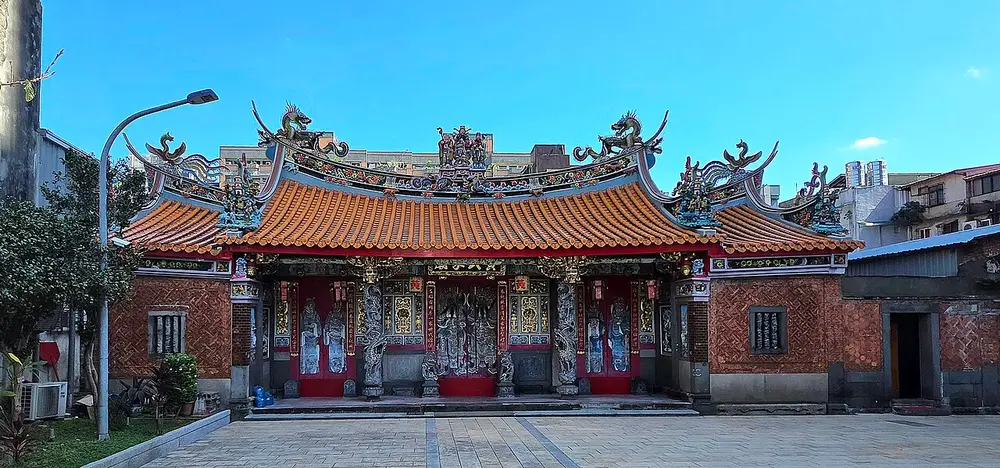
- The Ying 嬴 state of Huang (Henan). Bo Yi, who helped Yu the Great tame the flood, received the clan name Ying. One of the fourteen lineages descended from him ruled a state called Huang, in today’s Huangchuan county, Henan. Chu destroyed it in 648 BC, and its people kept Huang as a surname. Many settled around Jiangxia (in today’s Hubei), which became the classic Huang choronym: the “Jiangxia hall” (江夏堂) name is found on Huang ancestral halls across southern China, Taiwan and the diaspora, such as the Jiangxia Huang Zhongde hall in Taipei shown above.
- The Shanxi Huang. A descendant of Shaohao, Tai Tai, was enfeoffed on the Fen river; one of the small states of his line was also named Huang and was absorbed by Jin. Some genealogies prefer a different chain through Lu Zhong. Accounts disagree, which is normal for such early material.
- Southern peoples. The New Book of Tang already mentions Huang chiefs among the peoples of Yongguan, in Guangxi. The name is common among the Zhuang, which explains its first place in Guangxi.
- Changed names. Chinese Wikipedia notes that Huang and Wang sounded alike in early times, and that some Wang, Wu (巫) and other families became Huang.
These are traditional accounts, not documented descent.
South to Fujian and Guangdong
Huang was one of the eight clans said to have entered Fujian in 308, when northern families fled the turmoil of the Yongjia era. Later, according to the English Wikipedia article, about three million Huangs in Guangdong claim descent from Huang Qiaoshan (872 to 953), a Fujian ancestor whose sons founded Hakka, Teochew and Cantonese branches. Many Cantonese Huangs also trace their migration through Zhuji Lane (珠玑巷) in Nanxiong, the starting point of many Pearl River Delta lineages. See clan associations and hall names.
The spellings, and the Wong problem
| Spelling | Language | Where |
|---|---|---|
| Huang | Pinyin and Wade-Giles | Mainland China, Taiwan |
| Wong, Vong | Cantonese, Hakka (Vong) | Hong Kong, Macau, Malaysia, US |
| Ng, Eng | Quanzhou Hokkien, Teochew | Singapore, Malaysia, Thailand |
| Ooi, Oei, Oey, Uy, Wee | Zhangzhou and Xiamen Hokkien | Penang (Ooi), Indonesia (Oei), Philippines (Uy) |
| Hoàng, Huỳnh | Vietnamese | Vietnam |
| Hwang (황) | Korean | Korea |
| Kō | Japanese |
Wong is the main trap. In Cantonese, 黃 and 王 are both read wong4, so a Hong Kong “Mr. Wong” can be either. The Hong Kong Cantonese spellings guide covers this, and Wang 王 gives the other side.
Ng is the second trap. It is a syllabic nasal used for 黃 in Teochew and Quanzhou Hokkien, but in Cantonese it is the reading of 吴 and 伍. Andrew Ng, the computer scientist, is a 吳 Wu, not a Huang; see Wu 吴. The Hokkien and Teochew spellings guide explains Ooi and Uy.
In Vietnam, Hoàng and Huỳnh together are the fifth most common surname. Huỳnh spread in the south because of a naming taboo on the name of the lord Nguyễn Hoàng; see the Vietnamese surnames guide. In South Korea, the 2015 census counted 697,171 people named 황 Hwang, ranked 16th.
Huang in the United States
The 2010 census file:
- Huang: 72,328 people (rank 456), 97.1% Asian or Pacific Islander.
- Huynh: 54,996 (rank 620), 96.7%, and Hoang: 29,798 (96.1%), the two Vietnamese forms.
- Hwang: 17,900 (96.0%), mostly Korean Americans.
- Wong: 111,371 (rank 274), 86.5%, mixed between 黄 and 王. The census does not record characters, so the split cannot be measured.
- Ng: 31,210 (93.2%), mixed between 黄, 吴 and 伍.
- Ung 4,519, Uy 3,633, Wee 1,353, Ooi 474.
Huang, Huynh, Hoang and Hwang alone total 175,022 people, before any of the shared spellings. The US census lookup and the census analysis explain how to interpret shared spellings.
Distribution in China
Huang is a southern surname. It is first in Guangxi, second in Guangdong, Hong Kong and Macau, and third in Fujian and Taiwan, according to Chinese Wikipedia. Guangdong alone holds about 19% of all Chinese Huangs. A 2013 study counted 32.6 million bearers (2.45% of the population), and the 2019 report ranked it seventh. See the most common surnames in China. In the Hundred Family Surnames it is 96th.
Famous people named Huang
- Huang Chao (黃巢, 835 to 884), salt trader whose rebellion fatally weakened the Tang dynasty.
- Huang Tingjian (黃庭堅, 1045 to 1105), Song calligrapher, painter and poet.
- Huang Zongxi (黃宗羲, 1610 to 1695), Ming-Qing political theorist and philosopher.
- Wong Fei-hung (黃飛鴻, 1847 to 1925), Cantonese martial artist and physician, hero of countless films.
- Wong Kim Ark (黃金德), whose case before the US Supreme Court in 1898 confirmed birthright citizenship for children born in the United States.
- Anna May Wong (黃柳霜, 1905 to 1961), the first Chinese American film star in Hollywood.
- Jensen Huang (黃仁勳, born 1963), Taiwanese-American engineer, co-founder of Nvidia.
Related surnames and confusions
- 王 Wang: spelled Wong in Cantonese, like Huang. See Wang 王 and Wang 汪.
- 吴 Wu: spelled Ng in Cantonese. See Wu 吴.
- 皇 Huang: a very rare surname with the same pinyin. The surname finder lists all candidates for Wong, Ng and Ong.
Frequently asked questions
Is Wong the same as Huang or Wang?
Both. In Cantonese 黄 Huang and 王 Wang are pronounced identically, wong4, so both are spelled Wong in Hong Kong. Cantonese speakers tell them apart as grass-top Wong and three-stroke Wong; only the character settles it.
What does the surname Huang mean?
The character 黄 means yellow. The surname itself comes from the name of the ancient state of Huang, not from the color.
How do you pronounce Huang?
It is huáng, roughly hwahng in one syllable, with a rising second tone. The h is a light throaty sound, like the ch of Scottish loch but softer.
Is Ng a Chinese surname?
Yes. Ng is a syllable made of a single nasal sound. It spells 黄 Huang in Hokkien and Teochew, and 吴 Wu or 伍 Wu in Cantonese, so an Ng family can have any of these characters.
Why do Vietnamese use both Hoang and Huynh?
Both are readings of 黃. In southern and much of central Vietnam, Hoàng was avoided because it sounded like the name of the Nguyễn lord Nguyễn Hoàng, and families changed to Huỳnh.
Sources and open data
- Unihan database entry for U+9EC4 黄, Unicode Consortium
- Frequently Occurring Surnames from the 2010 Census, US Census Bureau
- Huang (surname), English Wikipedia
- 黃姓 (Huang surname), Chinese Wikipedia
- 王姓 (Wang surname), on the 三画王 and 草头黄 distinction, Chinese Wikipedia
- Huang Tingjian, English Wikipedia
- Huang, family name (Q845104), Wikidata