Key facts
- Ma is written 马 in simplified and 馬 in traditional characters (3 strokes against 10). The character means horse.
- It was the 13th most common surname of mainland China in the 2019 official ranking, with about 17 million bearers in a 2013 study.
- It is the most common surname among the Hui, China's Chinese-speaking Muslims, partly because Ma was used to render Muhammad and Mahmud.
- Ma is spelled the same in pinyin, Wade-Giles and Cantonese; other forms are Mah and Mar (older Cantonese), Beh (Hokkien) and Mã (Vietnamese).
- The 2010 US Census counted 28,452 people named Ma, 93.5% of them Asian or Pacific Islander.
马
馬
Pinyin: Mǎ
Simplified / traditional: 马 / 馬
Rank in mainland China: 13 of the top 100 (Ministry of Public Security, 2019 report)
Characters and spellings of 马
| Unicode code point | U+9A6C (traditional 馬: U+99AC) |
|---|---|
| Stroke count | 3 (traditional: 10) |
| Radical (simplified form) | No. 187 ⾺ (the character is itself a radical) |
| Dictionary meaning (Unihan) | horse; surname; Kangxi radical 187 |
Romanizations by Chinese language
| Language | System | Spelling |
|---|---|---|
| Mandarin | Hanyu Pinyin (PRC standard) | Mǎ |
| Mandarin | Wade-Giles (Taiwan, older English texts) | Ma |
| Cantonese | Jyutping (Unihan) | maa5 |
| Cantonese | Hong Kong / common spellings | Ma, Mah, Mar |
| Hokkien (Min Nan) | Pe̍h-ōe-jī and common spellings | Má, Bé (K, T), Bey, Beh, Baey |
| Hakka | Pha̍k-fa-sṳ and common spellings | Mâ, Ma |
| Gan | Romanization and common spellings | Mâ |
| Wu (Shanghainese) | Romanization and common spellings | Mo, Mu, Ma |
Equivalent surnames in other languages
| Language | Form |
|---|---|
| Vietnamese | Mã |
| Korean | Ma (마) |
| Filipino | Ma, Mapua |
| Japanese | Ba |
These spellings in the 2010 US Census
| Spelling | People | US rank | Asian / Pacific Islander |
|---|---|---|---|
| MA | 28,452 | 1,240 | 93.51% |
| BEY | 5,453 | 6,265 | 2.81% |
| MAR | 5,375 | 6,342 | 49.13% |
| MO | 3,983 | 8,320 | 85.79% |
| MAH | 2,571 | 12,124 | 75.81% |
| MU | 1,803 | 16,064 | 88.74% |
| BE | 1,146 | 22,450 | 60.82% |
| BEH | 513 | 42,308 | 24.76% |
Counts are people recorded with each spelling among the 265,667,228 people with a surname shared by at least 100 people (US Census Bureau, 2010, public domain). A spelling is not proof of Chinese origin: the last column shows the share of bearers who identified as Asian or Pacific Islander. Together these spellings total 49,296 people, but some of them belong to unrelated surnames (for example English Lee, Hmong Vang or Vietnamese Ly). Search any spelling with the US census surname lookup.
Stroke order
Animation by the open-source Hanzi Writer library (MIT) with stroke data from Make Me a Hanzi (Arphic Public License). Stroke order tool for any character.

Ma (马, traditional 馬) is a Chinese surname written with the character for “horse”. It is pronounced mǎ, like “mah” with a low dipping tone, and it is one of the few surnames spelled the same in pinyin, Wade-Giles and Hong Kong Cantonese. Older North American families may write Mah or Mar, Hokkien speakers Beh, and Vietnamese Mã. It was the 13th most common surname of mainland China in 2019, with about 17 million bearers, and it is by far the most common surname of the Hui, China’s Chinese-speaking Muslims.
Meaning of the character 马
Unihan gives 馬 as “horse; surname; Kangxi radical 187”. The character is a radical in its own right, the head of a large family of horse-related characters such as 驾 (to drive) and 骑 (to ride). The traditional form is a drawing of a horse with mane and four legs (the four dots); the simplified 马 reduces it to 3 strokes, from 10. The stroke order tool animates both.
Origin: the Lord of Mafu
The main traditional origin, given by Chinese Wikipedia from genealogical sources, goes back to the Warring States:
- Zhao She (赵奢), a general of the state of Zhao, was rewarded with the fief of Mafu (马服) and the title Lord Mafu (马服君).
- His descendants shortened the place name to Ma and took it as a surname. So the first Mas were, by clan, Zhaos; see the Zhao page.
- Under Emperor Wu of Han, the family moved to Maoling in Youfufeng (near modern Xingping, Shaanxi). Fufeng (扶风) became the classic choronym of the Ma clan, and the Ma ancestral halls of later centuries often bear its name.
Smaller lines came from compound surnames: families named Sima (司马) or Wuma (巫马) sometimes kept only Ma, and a Han official born Mashi (马矢) shortened his name. As with all early origins, these are traditional accounts; see where Chinese surnames come from.
Ma and the Hui Muslims
The most distinctive part of the Ma story is its link with Islam in China. English Wikipedia notes that Hui, Salar, Bonan and Dongxiang Muslims commonly adopted Ma to render Muhammad or Mahmud. Chinese Wikipedia quotes the saying shí Huí jiǔ Mǎ (十回九马), “of ten Hui, nine are Ma”, and reports that Ma is the most common surname of the Hui and the largest surname in Qinghai and the Ningxia Hui Autonomous Region. China’s 2020 census counted about 11.3 million Hui.
Not every Muslim Ma got the name this way, and not every Ma is Muslim. Chinese Wikipedia also records non-Muslim adoptions: the Yuan-era scholar-official Ma Zuchang came from an Önggüt family whose surname is explained there as the Syriac title Mar, used by Christian clergy, and Manchu banner clans such as the Majia took Ma under the Qing.
The best-known example of a Hui Ma is the admiral Zheng He, born Ma He (马和) into a Muslim family in Yunnan, who received the surname Zheng from the Yongle Emperor.
The Ma clique
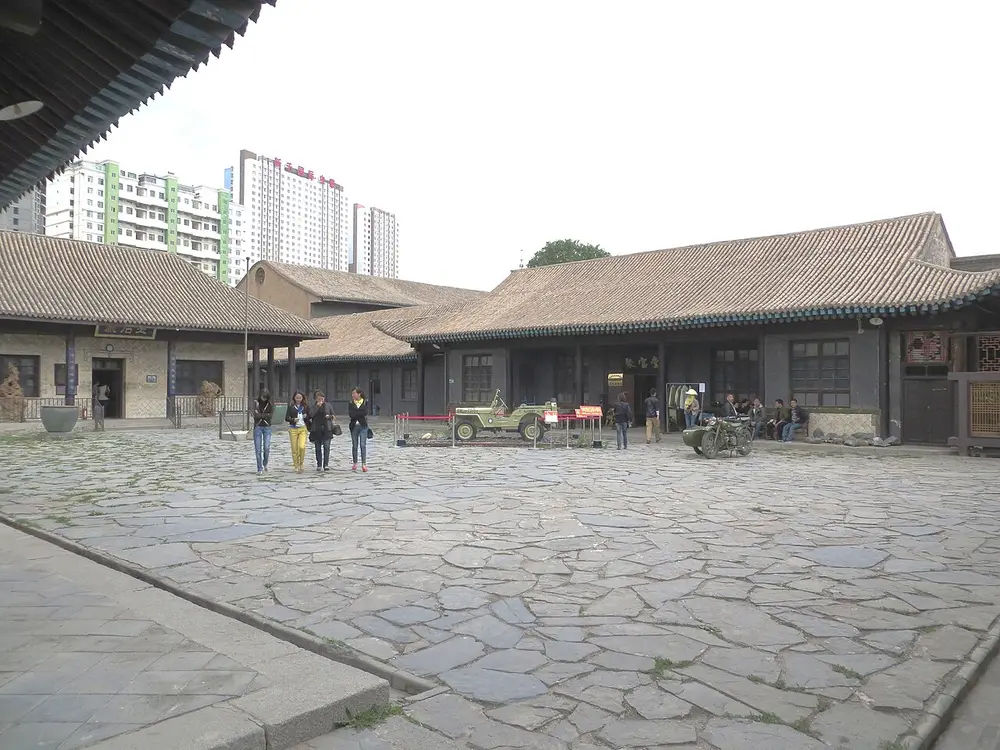
In the Republican era, a group of related Hui military families dominated northwestern China. Known as the Ma clique (马家军), they controlled Qinghai, Gansu and Ningxia. Leading figures included Ma Qi (马麒, 1869 to 1931) and Ma Bufang (马步芳, 1903 to 1975), who ruled Qinghai. Ma Bufang’s former residence in Xining, pictured above, is now a museum.
Spellings of Ma
| Spelling | Where it comes from | Example |
|---|---|---|
| Ma | Pinyin, Wade-Giles and Hong Kong Cantonese alike | Ma Ying-jeou, Taiwan |
| Mah, Mar | Older Cantonese and Taishanese spellings in North America and Singapore | Mah Bow Tan, Singapore |
| Beh, Bey, Baey, Be | Hokkien and Teochew | |
| Mo, Mu | Wu Chinese (Shanghai area) | |
| Mã | Vietnamese | |
| Ma (마) | Korean | |
| Ba | Japanese on’yomi |
Because pinyin, Wade-Giles and Cantonese agree, the spelling Ma reveals little about where a family came from, unlike Zhou or Guo. The Hokkien form Beh comes from the b- that southern Min uses where Mandarin has m-; the Hokkien and Teochew spellings guide explains the pattern.
Pinyin Ma also writes the rare surname 麻 (má, hemp), which has a different tone and origin.
Ma in the United States
The 2010 US Census gives:
- Ma: 28,452 people (rank 1,240, 93.5% Asian or Pacific Islander).
- Mar: 5,375 (49.1%), an old Cantonese-American spelling also used by families of other backgrounds.
- Mah: 2,571 (75.8%).
- Mo: 3,983 and Mu: 1,803, spellings shared with other surnames such as 莫 and 穆.
- Bey: 5,453, but only 2.8% Asian or Pacific Islander: almost all American Beys have no Chinese link.
The low shares for Mar and Bey are a reminder that a spelling in the census is not a character. The US census surname lookup shows the shares for any spelling, and the census analysis explains how to read them.
Famous people named Ma
- Ma Yuan (马援, 14 BC to 49 AD), Eastern Han general known as the “Wave-Calming General” (伏波将军).
- Ma Chao (马超, 176 to 222), general of the Three Kingdoms period, serving Shu Han.
- Zheng He (1371 to 1433 or 1435), Ming admiral, born Ma He.
- Ma Bufang (马步芳, 1903 to 1975), Hui warlord and governor of Qinghai.
- Ma Ying-jeou (马英九, born 1950), president of the Republic of China (Taiwan) from 2008 to 2016.
- Yo-Yo Ma (born 1955), Paris-born American cellist of Chinese parents.
- Jack Ma (马云, born 1964), co-founder of Alibaba.
- Ma Huateng (马化腾, born 1971), known as Pony Ma, co-founder of Tencent.
Distribution in China
A 2013 study cited by English Wikipedia counted about 17.2 million Mas, 1.29% of China’s population, with Henan the province with the most. The share is far higher in the northwest, where Hui communities are concentrated. Ma is the 52nd name of the Hundred Family Surnames. For the national ranking, see the 100 most common surnames in China.
Related surnames and confusions
- Sima 司马: a compound surname that sometimes contracted to Ma; see compound surnames.
- Zhao 赵: the clan of Zhao She, Lord Mafu.
- Ma 麻: same pinyin without tones, a different surname.
- The surname finder lists the characters behind Ma, Mah or Mar.
Frequently asked questions
What does the surname Ma mean?
The character 马 (traditional 馬) means horse. Tradition, however, derives the surname from a place name, Mafu, the fief of the Warring States general Zhao She, not from horses.
How do you pronounce Ma?
It is mǎ, like mah with a low dipping third tone. In isolation the voice falls and then rises a little; in a full name such as Ma Yun the tone is usually just low.
Why do so many Chinese Muslims have the surname Ma?
Ma was used to transcribe names such as Muhammad and Mahmud, and many Hui, Salar, Bonan and Dongxiang families adopted it. A Chinese saying, nine out of ten Hui are Ma (十回九马), exaggerates but reflects the pattern.
Is Ma a Chinese or Korean surname?
It is Chinese in origin. The same character is read Ma (마) in Korean and Mã in Vietnamese, but in English the spelling Ma usually points to a Chinese family.
Sources and open data
- Unihan database entry for U+9A6C 马, Unicode Consortium
- Frequently Occurring Surnames from the 2010 Census, US Census Bureau
- Ma (surname), English Wikipedia
- 马姓 (Ma surname), Chinese Wikipedia
- Ma clique, English Wikipedia
- Hui people, English Wikipedia
- Ma, family name (Q1931708), Wikidata