Key facts
- Type up to four characters, such as a surname and a given name, to see each one drawn stroke by stroke, with its stroke count.
- A practice mode lets you draw the character yourself; the tool checks the direction and order of each stroke.
- Stroke data covers about 9,500 common characters, from the open Make Me a Hanzi project, drawn with the open-source Hanzi Writer library.
- Simplified and traditional forms have different stroke counts: 陈 has 7 strokes and 陳 has 10, 张 has 7 and 張 has 11.
- The animations follow the mainland Chinese standard; Taiwan, Hong Kong and Japan write a few characters in a different order.

Writing your own surname in Chinese is often the first thing people want to do with characters, whether for a family tree, a gift, a seal or a calligraphy class. The tool above draws each character stroke by stroke, in the order a Chinese pupil learns it, and gives its number of strokes. Type a surname alone, such as 陈, or a full name of up to four characters, such as 乔羽.
How to use the tool
- Type or paste the characters. You can enter up to four characters. If you only know the spelling of the name, find the character first with the surname finder.
- Watch the animation. Press “Animate” to see each stroke drawn in order. The stroke count appears under each character, for example “陈: 7 strokes”.
- Practice. Press “Practice (draw it yourself)” and trace the strokes with a mouse, a finger or a stylus. The tool accepts a stroke when its shape, direction and position are close enough, and shows a hint after repeated mistakes.
- Open the tool on a name. Add the characters to the address with
?c=, for example/tools/stroke-order/?c=陈, to send someone a link that opens directly on their name.
The basic rules of stroke order
Chinese characters are built from a small set of stroke types, and a few general rules decide in which order they are written. English Wikipedia’s article on stroke order summarises them as follows:
| Rule | Examples |
|---|---|
| Top to bottom, and left to right | 三, 校, 品 |
| Horizontal strokes before vertical strokes that cross them | 十, 大 |
| Strokes that cross the whole character come last | 聿, 毋 |
| A right-to-left diagonal before a left-to-right diagonal | 文 |
| The centre before the two sides, when they are symmetrical | 水 |
| The outside before the inside; a closing bottom stroke last | 日, 回, 国 |
| Enclosures open at the top-right come last | 道, 建 |
| Small dots and minor strokes come last | 玉 |
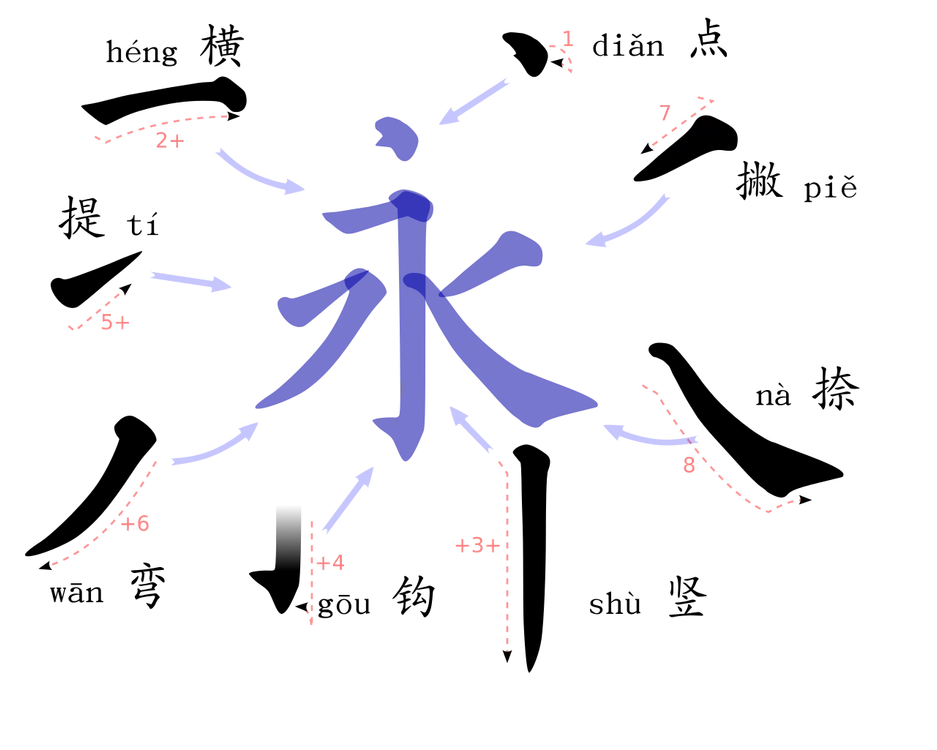
The character 永 (yǒng, “forever”), shown above, is the classic teaching example. According to the tradition known as the Eight Principles of Yong, its strokes contain the eight basic movements of Chinese writing, so calligraphy students practise it before anything else.
Stroke counts of common surnames
The number of strokes depends on the form of the character. Mainland China uses simplified characters, while Taiwan, Hong Kong and many overseas families use traditional ones. The counts below are those of the stroke data used by the tool, which agree with the Unihan database.
| Surname | Simplified | Strokes | Traditional | Strokes |
|---|---|---|---|---|
| Wang | 王 | 4 | 王 | 4 |
| Li | 李 | 7 | 李 | 7 |
| Zhang | 张 | 7 | 張 | 11 |
| Chen | 陈 | 7 | 陳 | 10 |
| Huang | 黄 | 11 | 黃 | 12 |
| Qiao | 乔 | 6 | 喬 | 12 |
Wang and Li have a single form, so their count is the same everywhere. For Huang, the two forms differ only in the middle part, but the difference is enough to change the count and to make 黄 and 黃 two separate entries in Taiwan’s surname statistics. Some differences are much larger: the character 龙 (long, dragon) has 5 strokes, while its traditional form 龍 has 16. The guide to simplified and traditional surname characters explains which surnames changed and why.
Stroke counts are not only for writing. Chinese dictionaries and many name lists sort characters by number of strokes, and some traditional practices of choosing a Chinese name count the strokes of the surname and given name. If you want to know the readings of a name as well, the Chinese name to pinyin converter gives its pinyin with tones.
Different standards in China, Taiwan, Hong Kong and Japan
Stroke order is mostly the same across the Chinese-speaking world, but it is not completely uniform. Each place publishes its own reference:
- Mainland China uses a national standard for the stroke order of modern Chinese characters, issued in 1997.
- Taiwan follows a manual of standard stroke order published by its Ministry of Education.
- Hong Kong uses lists published by its Education Bureau.
- Japan teaches its own orders for the characters used in Japanese.
The differences affect a minority of characters. English Wikipedia gives 必 as an example written in different orders by different standards, and notes that the grass component 艹 at the top of many characters is written differently in Hong Kong. Some orders are shared by several standards, such as the horizontal stroke first in 成. The stroke data was built to follow the mainland (PRC) order, so the animations here follow it. If you learned to write in Taiwan or Hong Kong, a few characters may look “wrong” to you, without either order being a mistake.
Where the data comes from
The tool combines two open-source projects:
- Make Me a Hanzi provides the stroke data: the outline and the central line of each stroke for about 9,500 common characters. Its author built it from fonts released by Arphic Technology in 1999 under the Arphic Public License, which allows free reuse.
- Hanzi Writer, a JavaScript library by David Chanin under the MIT licence, draws the animations and runs the practice mode.
The data files are served by this site, not by a third-party server, and the tool runs entirely in your browser: the characters you type are not sent anywhere. The methodology page lists all the datasets and libraries used on qiaoyu.info.
Limits
- Rare characters. Characters outside the common set, including some rare surname characters such as 𢒉 (Shan), have no stroke data. The tool says when a character is missing. See rare characters in names for why these characters cause problems in computers and identity documents.
- Variant forms. Some characters have several accepted shapes. The data uses one shape per code point, which may differ slightly from a font, a textbook or a family’s own handwriting.
- Calligraphy is not print. Brush writing and cursive scripts join or drop strokes. The animations show the standard printed form, which is the right starting point for learning, not a model of artistic style.
- Only up to four characters. That covers almost all Chinese names, including those with a compound surname such as 欧阳 Ouyang and a two-character given name.
Frequently asked questions
How many strokes are in my Chinese surname?
Type the character in the tool and it shows the count. Some common examples: 王 Wang has 4 strokes, 李 Li 7, 张 Zhang 7 (張 11), 陈 Chen 7 (陳 10) and 黄 Huang 11 (黃 12). Simplified characters usually have fewer strokes than their traditional forms.
Is there one correct stroke order?
Mostly, but not completely. The general rules are the same everywhere, yet mainland China, Taiwan, Hong Kong and Japan each publish their own standard, and a few characters, such as 必, are written in a different order in each. The animations here follow the mainland standard.
Why does stroke order matter?
Following the usual order makes characters faster to write and better balanced, and it is how handwriting input on phones and dictionaries by stroke count work. It is also the basis of calligraphy.
Can I see a character that is not in the tool?
The stroke data covers about 9,500 common characters. Very rare characters, such as the surname character 𢒉 Shan, are not included; the tool says so when a character is missing.
Can I write the traditional form of a surname?
Yes. Type the traditional character, for example 陳 instead of 陈 or 黃 instead of 黄. Both forms are in the data for common surnames.
Sources and open data
- Stroke order, English Wikipedia
- Eight Principles of Yong, English Wikipedia
- Hanzi Writer (MIT licence), David Chanin, GitHub
- Make Me a Hanzi: stroke data for Chinese characters, skishore, GitHub
- Unihan database, Unicode Consortium