Key facts
- Chinese surnames have more than 3,000 years of history; before the Warring States only ruling and aristocratic families had them.
- Early Chinese distinguished the clan name 姓 (xing) from the branch name 氏 (shi); most modern surnames descend from shi.
- The Han-dynasty work 風俗通姓氏篇 lists nine origins, including state names, official positions, occupations and places of residence; modern scholars propose 18 or 24.
- Commoners acquired surnames after the Qin unification of 221 BC, and Han household registration required every commoner to have one.
- Around 494 Emperor Xiaowen of Northern Wei ordered Xianbei surnames to be changed to one-character Chinese ones, for example 拓拔 to 元.
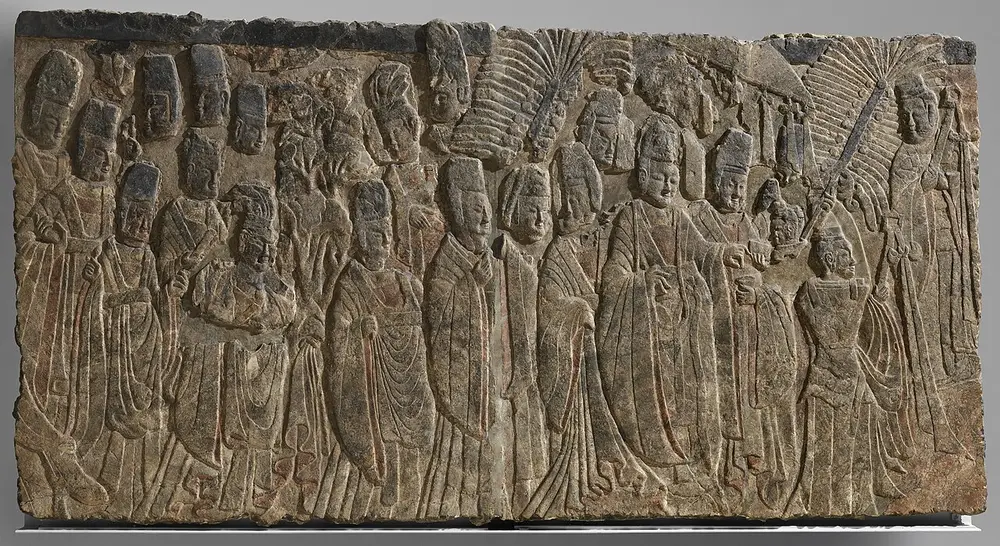

Chinese surnames have a documented history of more than 3,000 years. At first only ruling and aristocratic families had them, and two different kinds of name existed: 姓 (xìng), the name of the ancestral clan, and 氏 (shì), the name of a branch of it. Most surnames in use today go back to the second kind, and they were formed in a handful of ways: from a state, a fief, an office, a trade, an ancestor or a non-Han people.
姓 and 氏: two names for two things
English Wikipedia’s article on Chinese surnames explains that the old 姓 was at first the name of the ancestral clan, and that many of the oldest ones have a 女 (woman) radical: 姬, 姜, 姚, 嬴. This has led to a theory that early Chinese society was matrilineal, though the article notes that the sinologist Edwin Pulleyblank doubts the matriarchy theory, and that an alternative explains the pattern by exogamy under the Zhou. The 氏 denoted a branch lineage. For example, the descendants of the Shang family name 子 split into branches called 殷, 宋, 空, 同 and others.
The distinction blurred in the Warring States period. After the Qin unification of 221 BC commoners acquired surnames, and by the Han dynasty only 姓 or 姓氏 as a combined term remained. The same article says that most modern surnames come from 氏.
The sources differ slightly on the definition. The English article summarizes 姓 as the matrilineal and 氏 as the patrilineal name, while the Chinese Wikipedia article on 氏 describes 姓 as the common title of all descendants of one ancestor, and 氏 as derived from a branch. The Chinese article adds that before the Qin, nobles took a 氏 from a state, a fief, an official position, an occupation, a residence, a seniority rank or a courtesy name, that from the Warring States 氏 gradually turned into 姓, and that in the middle and later Western Han, household registration required every commoner to have a surname.
The ancient 姓
The Eight Great Xing of High Antiquity are 姜, 姬, 姚, 嬴, 姒, 妘, 媯 and 妊. English Wikipedia says only Jiang and Yao survive in their original form, while Ji, Yun and Ren survive as 吉, 云 and 任. The surname Jiang page covers the modern surname.
The origins of surnames
The Han-dynasty text 風俗通姓氏篇 lists nine origins, according to English Wikipedia: dynasty names, posthumous titles, ranks of nobility, state names, official positions, style names, places of residence, occupations and events. Modern scholars have proposed longer lists of 18 (Kiang Kang-Hu) or 24. The table gives examples of the main kinds that the same article offers.
| Origin | Examples |
|---|---|
| State names | 吳, 周 |
| Fief or place of origin | 歐陽: descendants of Di, Marquis of Ouyang Village |
| Ancestor’s courtesy name | Yuan Taotu took the second character of his grandfather’s courtesy name Boyuan (伯爰) |
| Seniority | 孟, 仲, 叔, 季 (Meng, as in Mencius) |
| Official position | 史, 籍, 倉, 庫, 上官, 太史, 司馬, 司徒, 司空 |
| Occupation | 陶 (potter), 屠, 卜, 匠, 巫, 廚 |
| Titles of nobility | 王, 侯, 夏侯, 公孫 |
| Imperial decree | 鄺 |
| Ethnic names | 胡, 金, 滿, 狄, 回, 慕容 |
A few cases deserve a note. The surname Kuang (鄺) comes from an imperial decree in the Song dynasty: the article says Kuang Yuping was formerly Fang Yuping, under Emperor Xiaozong of Song. Compound surnames such as 歐陽, 司馬 and 上官 are discussed in compound surnames. English Wikipedia also says that the Li surname is claimed to come from Laozi, which is a tradition and not a documented fact.
Names from other peoples
Surnames that came from non-Han peoples are another source. The article lists 胡, 金, 滿, 狄, 回 and 慕容 among ethnic names, and says that Hui Muslims took 馬 in the Ming dynasty, since it resembles the first syllable of Mohammad. The Ma surname page covers this.
Sinicization under Northern Wei
The largest single change of this kind took place under Emperor Xiaowen of Northern Wei. English Wikipedia says he followed a policy of sinicization, compelled the Xianbei and other peoples to adopt Chinese surnames, changed the imperial name Tuoba to Yuan, and moved the capital from Pingcheng to Luoyang in 494. The Xianbei elite resisted, with plots in 496 and 497. The relief in the image at the top of this page shows the emperor and his entourage at the Binyang Cave at Longmen.
Chinese Wikipedia’s article on the reforms lists the changes: Xianbei surnames, which were usually compound, were replaced with single characters.
| Xianbei name | Changed to |
|---|---|
| 拓拔 | 元 |
| 獨孤 | 劉 |
| 丘穆棱 | 穆 |
| 丘敦 | 丘 |
| 步六孤 | 陸 |
| 侯莫陳 | 陳 |
| 賀賴 | 賀 |
| 賀樓 | 樓 |
| 忽忸于 | 于 |
| 達奚 | 奚 |
| 尉遲 | 尉 |
| 紇骨 | 胡 |
| 普氏 | 周 |
| 伊婁 | 伊 |
The same article says the emperor also banned the Xianbei language for those under 30 and ordered burial south of the Yellow River. A surname such as 陳 may therefore have two unrelated histories, a Han one and a Xianbei one, which is one reason why the count of surnames is hard to fix; see how many Chinese surnames exist.
Imposed and registered surnames
Chinese Wikipedia’s article on surnames says that in some periods rulers imposed surnames, and that from the Han dynasty the household registration system required them. The surname became a fixed administrative label, which also helps explain why a few surnames dominate: the most common surnames in China are far more concentrated than the long tail of rare names. The Song primer Hundred Family Surnames fixed a list of ordinary names for teaching.
How to read an origin story
Origin accounts in genealogies and in Tang-era books are traditional. They are useful, but a tradition that a surname descends from a famous ancestor, a king or a legendary figure is not the same as a documented line. When a family says that it comes from a commandery, see clan associations and hall names for how those claims were recorded.
Frequently asked questions
What is the difference between 姓 and 氏?
In antiquity, 姓 (xing) was the name of the ancestral clan and 氏 (shi) denoted a branch lineage. The two merged after the Qin and Han dynasties, and most modern surnames come from shi.
Where do most Chinese surnames come from?
They come from a small set of sources: state names, fiefs, official positions, occupations, places of residence, ancestors' names, imperial decrees and the names of ethnic groups. The Han-dynasty list names nine.
When did ordinary people get surnames?
English Wikipedia says that before the Warring States only ruling and aristocratic families had them, and that commoners acquired surnames after the Qin dynasty of 221 BC. Chinese Wikipedia adds that Han household registration required it.
Why did Xianbei surnames change?
Emperor Xiaowen of Northern Wei pursued a policy of sinicization and compelled the Xianbei and others to adopt Chinese surnames. The imperial name Tuoba became Yuan.
Why do Hui Muslims often have the surname Ma?
English Wikipedia says that in the Ming dynasty Hui Muslims took 馬 (Ma), which resembles the first syllable of Mohammad.
Sources and open data
- Chinese surname, English Wikipedia
- 氏, Chinese Wikipedia
- 姓氏, Chinese Wikipedia
- Emperor Xiaowen of Northern Wei, English Wikipedia
- 孝文帝改革, Chinese Wikipedia