Key facts
- Wade-Giles was developed from Thomas Wade's 1867 textbook and completed by Herbert Giles's 1892 dictionary; it was the standard English romanization of Chinese until pinyin took over in the late 20th century.
- An apostrophe marks aspiration: T'ang (唐) has the puff of air, while Teng (邓) does not; when the apostrophe is dropped, j, q, zh and ch all become ch.
- In the 2010 US Census, Wade-Giles-style spellings are common: Chang 81,939, Hsu 16,907, Tsai 10,968, Chiang 8,841.
- Taiwan used Wade-Giles as its de facto standard and most Taiwanese still spell their legal names in Wade-Giles or other older systems.
- Dropping the apostrophes creates collisions: Chang can be 张 Zhang or 常 Cháng, and Cheng can be 郑 Zheng or 程 Chéng.

Wade-Giles is the older English romanization of Mandarin. It is the reason Xu appears as Hsu, Zhang as Chang, Cai as Tsai and Jiang as Chiang in the names of many Taiwanese and Chinese American families. It was the standard system in English until pinyin replaced it, and it remains the system behind many personal names today.
Where Wade-Giles comes from
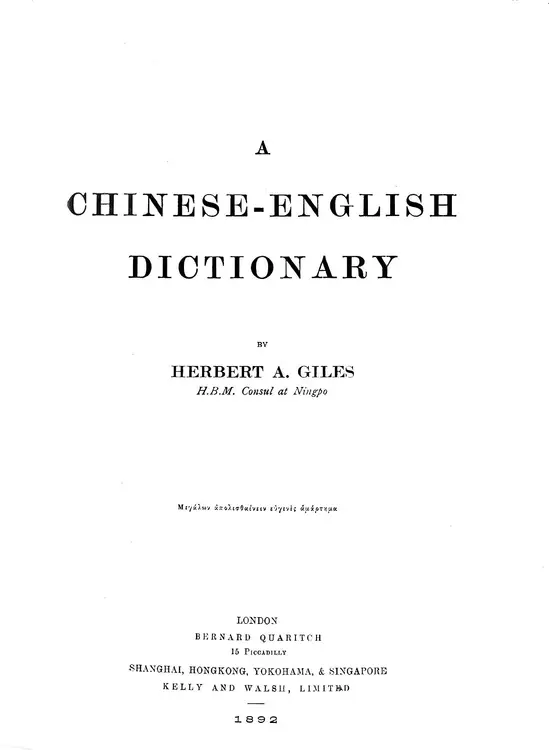
English Wikipedia traces the system to Thomas Wade, whose Mandarin textbook Yü-yen Tzŭ-erh Chi appeared in 1867, and says it was completed in Herbert Giles’s A Chinese-English Dictionary (1892), which is the book shown above. Because Giles’s dictionary became a standard reference, the combined system took both names.
Pinyin was officially adopted in mainland China in 1958. According to the same article, British Library catalogues moved to pinyin in 1966 and the International Organization for Standardization adopted it in 1982. Taiwan followed a different path: Wade-Giles was the de facto standard there, and several official systems were tried (Gwoyeu Romatzyh in 1928, MPS II in 1986, Tongyong Pinyin in 2000) before pinyin was officially adopted in 2009. Most Taiwanese people still spell legal names in Wade-Giles or other systems, which gives forms such as Chiang Ching-kuo and the city of Kaohsiung. See pinyin for names for the mainland rules.
How the system works
Wade-Giles differs from pinyin mainly in its consonants. Three features matter for surnames.
Apostrophes mark aspiration. English Wikipedia explains that aspiration, a puff of air after the consonant, is written with an apostrophe-like mark (ʻ, ‘ or ‘). So p’ and p are different sounds, as are t’ and t, k’ and k. The surname 唐 (Táng) is T’ang, while 邓 (Dèng) is Teng.
The mark is often dropped. On passports, in databases and in e-mail addresses the apostrophe is typically lost. When that happens, the sounds pinyin writes as j, q, zh and ch all collapse to ch, as English Wikipedia notes. That is the source of most confusion about Wade-Giles surnames.
Hyphens and tones. In the full system, tones are marked with superscript numbers and the syllables of a given name are joined with a hyphen: Chiang Ching-kuo. English Wikipedia adds that overseas Taiwanese often write a name as “Tai Lun” or “Tai-Lun”. Pinyin, by contrast, writes the given name as one word.
The main initial correspondences are:
| Pinyin initial | Wade-Giles | Example |
|---|---|---|
| zh, ch | ch, ch’ | Zhāng 张 = Chang, Chéng 程 = Ch’eng |
| j, q, x | ch, ch’, hs | Jiǎng 蒋 = Chiang, Qiū 邱 = Ch’iu, Xiè 谢 = Hsieh |
| z, c | ts, ts’ | Zēng 曾 = Tseng, Cài 蔡 = Ts’ai |
| b, d, g | p, t, k | Dèng 邓 = Teng, Kǒng 孔 = K’ung |
| p, t, k | p’, t’, k’ | Pān 潘 = P’an, Táng 唐 = T’ang |
| r | j | not common in surnames |
Surname correspondences
The table gives the strict Wade-Giles form, the usual form without apostrophes, and the 2010 US Census count of the spelling people actually use. Counts include every bearer of the spelling, whatever its origin.
| Character | Pinyin | Strict Wade-Giles | Common spelling | Census 2010 |
|---|---|---|---|---|
| 许, 徐 | Xǔ, Xú | Hsü | Hsu | 16,907 |
| 张 | Zhāng | Chang | Chang | 81,939 |
| 蒋 | Jiǎng | Chiang | Chiang | 8,841 |
| 周 | Zhōu | Chou | Chou | 9,834 |
| 赵 | Zhào | Chao | Chao | 10,398 |
| 谢 | Xiè | Hsieh | Hsieh | 6,382 |
| 蔡 | Cài | Ts’ai | Tsai | 10,968 |
| 萧 | Xiāo | Hsiao | Hsiao | 2,666 |
| 曹 | Cáo | Ts’ao | Tsao | 2,508 |
| 孔 | Kǒng | K’ung | Kung | 3,113 |
| 曾 | Zēng | Tseng | Tseng | 4,994 |
| 郑 | Zhèng | Cheng | Cheng | 32,982 |
| 陈 | Chén | Ch’en | Chen | 169,580 |
| 朱 | Zhū | Chu | Chu | 28,508 |
| 唐 | Táng | T’ang | Tang | 34,961 |
| 潘 | Pān | P’an | Pan | 12,664 |
| 彭 | Péng | P’eng | Peng | 10,575 |
| 钱 | Qián | Ch’ien | Chien | 3,756 |
| 邓 | Dèng | Teng | Teng | 3,433 |
Some of these spellings coincide with pinyin: Chen, Tang, Pan, Peng and Chu look the same in both systems, so a family that writes Chen may be using either one. Other counts are shared with other systems, as described below. Individual pages such as Zhang 张, Xu 徐 and Cai 蔡 give the full spelling lists.
Where Wade-Giles creates collisions
Without apostrophes, several different surnames share one spelling:
- Chang stands for 张 Zhāng (strictly Chang) and 常 Cháng (strictly Ch’ang). The 2010 Census counts 81,939 people named Chang, more than the 70,125 named Zhang.
- Cheng stands for 郑 Zhèng (strictly Cheng) and 程 Chéng (strictly Ch’eng). Cheng is therefore not a single name.
- Chu and Chiu are used for 朱 Zhū and 邱 Qiū, and Chiu is also a Cantonese spelling.
The converter lists each of these cases and shows famous examples such as Chou En-lai and Mao Tse-tung. For the wider pattern of one character and several spellings, see one surname, many spellings.
Wade-Giles in the Chinese American record
Spellings such as Chang, Hsu, Tsai and Chiang appear in the US Census file in large numbers and typically belong to families that came from Taiwan, while pinyin spellings such as Zhang, Xu and Cai belong mostly to recent arrivals from the mainland. The Census does not record origin, so this is an interpretation, not a statistic. The US Census guide shows the same split in numbers, and surnames in Taiwan gives the home-country ranking.
Converting a name yourself
For a quick check, apply the rules in the first table: change the pinyin initial, keep the final, and remember that ü is usually written u in Wade-Giles outside dictionaries (Hsü becomes Hsu). To avoid manual errors, use the pinyin to Wade-Giles converter, which also flags the ambiguous syllables. If you are unsure which system a family uses, look at an old passport or at how a sibling spells the name: the spelling printed there is the one that counts, whatever the pinyin form says. See also Chinese names on passports.
Frequently asked questions
Why is the surname Xu spelled Hsu?
In Wade-Giles the sounds that pinyin writes as x are written hs, and the vowel ü is written without its dots in everyday use. Xu (徐 or 许) therefore becomes Hsu (strictly Hsü). Hsu is held by 16,907 people in the 2010 US Census, against 25,622 for Xu.
Is Chang the same as Zhang?
Often, but not always. Chang is the Wade-Giles spelling of 张 Zhang and of 常 Cháng, and it is also used for some Cantonese-derived names. The Census counted 81,939 people named Chang and 70,125 named Zhang in 2010.
What do the apostrophes in Wade-Giles mean?
They mark aspirated consonants, those pronounced with a puff of air. T'ang (唐) has the puff, while Tang without an apostrophe stands for the unaspirated sound that pinyin writes d. Because the mark is frequently dropped, the original distinction is often lost.
Do people in Taiwan still use Wade-Giles?
Yes, for personal names. Taiwan officially adopted pinyin in 2009, but most Taiwanese still write their legal names in Wade-Giles or another older system, which is why Chiang Ching-kuo and Kaohsiung look nothing like their pinyin forms.
How do I convert a pinyin surname to Wade-Giles?
Apply the initial rules: j, q and x become ch, ch' and hs, zh and ch become ch and ch', z and c become ts and ts', and b, d, g become p, t, k. The pinyin to Wade-Giles converter on this site does it automatically and flags the ambiguous cases.
Sources and open data
- Wade-Giles, English Wikipedia
- Pinyin, English Wikipedia
- 汉语拼音, Chinese Wikipedia
- Frequently Occurring Surnames from the 2010 Census, US Census Bureau