Key facts
- A clan association (宗親會 zōngqīnhuì) links people of one surname; it keeps genealogies, organizes ancestor worship and offers mediation and mutual aid.
- A hall name (堂號 tánghào) is the name of an ancestral hall, often a place name that points to the clan's commandery of origin, such as 太原堂 for Wang or 隴西堂 for Li.
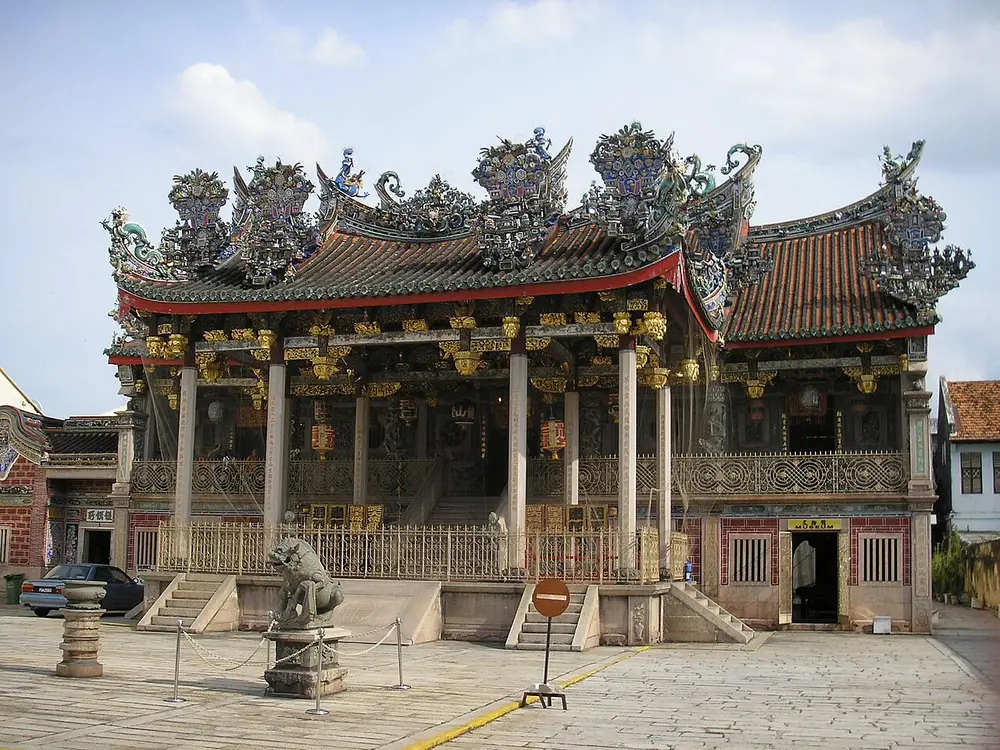
- In Penang the Leong San Tong Khoo Kongsi was burnt in 1901, rebuilt in 1902 and completed in 1906.
- In overseas Chinatowns, membership in a benevolent association depended on shared surname, clan, dialect or village.
- The link between surname and commandery is the 郡望 (junwang), a system that began in the Wei, Jin and Northern and Southern dynasties.

A Chinese clan association is an organization that brings together people of one surname, and a hall name (堂號 tánghào) is the name carried by that surname’s ancestral hall. Both express the same idea: a surname is not only a label but a group with a shared origin, which can be named, housed in a building and, overseas, organized as a society.
What a hall name is
Chinese Wikipedia defines the 堂號 as the name of an ancestral hall, used to distinguish surnames, clans and families. It is also called 郡號, “commandery name”. The article lists four origins: place names, usually the place the clan came from; anecdotes; family maxims; and the names of ancestors. Hall names appear on houses, in genealogies, on lanterns, tablets and tombstones.
The article says that nobody knows how many hall names exist. A cultural committee (中華文化復興運動推行委員會) claims 82 halls and 267 surnames, and this should be read as that committee’s claim rather than an established count.
Common hall names
The same committee’s list, quoted by Chinese Wikipedia, gives some well-known halls with their surnames:
| Hall name | Surnames listed | Note |
|---|---|---|
| 太原堂 Tàiyuán | 王 Wang, 羊, 祁, 易, 武, 祝, 宮, 溫, 霍, 閻, 尉遲 | Commandery seat of the Wang of Taiyuan |
| 隴西堂 Lǒngxī | 牛, 辛, 李 Li, 時, 彭, 董 | Qin commandery in Gansu |
| 潁川堂 Yǐngchuān | 陳 Chen, 鄔, 賴, 鍾 | Qin commandery in the Ying River basin |
| 清河堂 Qīnghé | 房, 傅, 張 Zhang | |
| 滎陽堂 Xíngyáng | 昌, 潘, 鄭 Zheng | |
| 弘農堂 Hóngnóng | 楊 Yang | |
| 江夏堂 Jiāngxià | 費, 黃 Huang | |
| 蘭陵堂 Lánlíng | 蕭 | |
| 東魯堂 Dōnglǔ | 孔 Kong |
Some halls are named for other things than places. The article gives 愛蓮堂 and 濂溪堂 for the surname Zhou (周), and 四書堂 for Mao (毛). The table shows that one surname can have several halls and one hall can serve several surnames: the Wang hall also lists 羊 and 武. For the surnames themselves, see the pages on Wang, Li and Chen.
The link to 郡望
A hall name often repeats a commandery, and the commandery goes back to the 郡望 (jùnwàng). In this term 郡 is an administrative division and 望 means a prominent family. Chinese Wikipedia says it began in the Wei, Jin and Northern and Southern dynasties, during the era of the 門閥 (aristocratic family) system. Families put the home commandery before the surname to mark status and to distinguish themselves from families of the same surname elsewhere. Examples are 瑯琊王氏 and 太原王氏, 清河崔氏 and 博陵崔氏, 趙郡李氏 and 隴西李氏.
The 太原王氏 article says that, with 隴西李氏, 趙郡李氏, 清河崔氏, 博陵崔氏, 范陽盧氏 and 滎陽鄭氏, the family forms the “seven surnames, ten families” (七姓十家). Its traditional ancestry runs to Prince Jin of Zhou and others, but the article says that scholars trace documented ancestry only to the Eastern Han brothers Wang Rou and Wang Ze.
The 隴西李氏 article quotes a Tang genealogy that says “the Li have thirteen wang, and Longxi is first”. It adds that the Tang imperial family claimed this origin and that the historian Chen Yinque doubted it, and that many declining Li families claimed Longxi too. So a hall name tells where a clan says it comes from, not always where it came from. The origin of surnames in general is covered in where Chinese surnames come from.
Clan associations
Chinese Wikipedia’s article on 宗親會 describes it as an organization that links clans of the same surname. It keeps genealogies, supports ancestor worship and offers mediation and mutual aid. A genealogy is also where a generation poem is recorded, so an association helps relatives of distant branches recognize each other.
Kongsi and the Khoo Kongsi in Penang
English Wikipedia says that kongsi is the Hokkien transcription of 公司, “company”. Overseas, the word named both clan organizations and clubs of people who shared a district or dialect, later called huiguan. In western Borneo, Hakka mining communities organized as kongsi republics, a different use of the same word.
The best-known clan kongsi is the Leong San Tong Khoo Kongsi (龍山堂邱公司) in Cannon Square, George Town, the largest Hokkien clanhouse in Malaysia. English Wikipedia says the Khoo clan came from Xin’an village in Haicang, Xiamen. The temple was burnt in 1901, rebuilt in 1902 and completed in 1906. It holds ancestral tablets, and operas are staged in the seventh lunar month. It is no longer the center of social life it was, and today it is an attraction. It represents only the Khoo whose ancestry goes to that village, not all Khoo.
The name of the hall, 龍山堂, is itself a hall name. The photograph at the top of this page shows the building.
Huiguan and district associations in Chinatowns
A huiguan (會館) is an association hall for people from the same area. English Wikipedia dates the first to the Yongle era (1403 to 1424) in Beijing and counts at least 532 in Beijing and 2,000 in 300 other cities around 1900. In Singapore, dialect groups (bang) coexisted with clan associations. In San Francisco, the Chinese Consolidated Benevolent Association, known as the Six Companies, was founded in 1862.
According to the article on Chinatown, the family benevolent association provides aid and its membership depends on shared surname, clan, dialect or village. Members’ names are enshrined on tablets. Overseas members often wrote their surnames in Hokkien and Teochew or Cantonese spellings, which differ from pinyin.
Why the surname matters in these groups
A clan association is built on the surname, not on a formal register of descent. Chinese Wikipedia’s article on 宗親會 says it links clans of the same surname, and the Khoo example shows the limit: the Leong San Tong represents only Khoo whose ancestry goes to one village. Two people with the same spelling of a surname, such as Khoo in Penang, may therefore belong to different groups. That is why a hall name or a village matters more than the surname alone, and why the many spellings of one surname cannot be used to prove kinship.
Reading a hall name
When you meet a hall name on a lantern, a tombstone or a genealogy, a few rules help:
- Read the first two characters as a place, often a commandery such as 太原 or 隴西.
- Match it to the surname, but remember that one hall may serve several surnames.
- Treat the connection as the family’s own account, a tradition and not a proven descent.
- Use the surname finder to find the surname’s pinyin and other spellings.
Frequently asked questions
What is a Chinese clan association?
It is an organization linking clans of the same surname. According to Chinese Wikipedia it keeps genealogies, organizes ancestor worship and provides mediation and mutual aid.
What is a 堂号 (hall name)?
It is the name of an ancestral hall, used to tell surnames, clans and families apart. Chinese Wikipedia says hall names come from place names, anecdotes, family maxims or ancestors' names.
What is a kongsi?
Kongsi is the Hokkien pronunciation of 公司, which means company. Overseas the word was applied to clan organizations and to dialect-based clubs.
Which hall name belongs to the Wang, Li and Chen surnames?
A list from a cultural committee, quoted by Chinese Wikipedia, gives 太原堂 for Wang, 隴西堂 for Li and 潁川堂 for Chen. Other families with the same surname may use a different hall name.
How does a hall name relate to the commandery of a surname?
Many hall names reuse the name of the commandery from which a clan claims descent, the 郡望. A name such as 隴西李氏 and a hall such as 隴西堂 point to the same place.