Key facts
- A compound surname (複姓 fùxìng) is a family name written with two characters, such as 欧阳 Ouyang, 司马 Sima or 诸葛 Zhuge.
- Most come from ancient offices, titles, fiefs and places of residence; others are the clan names of non-Han peoples such as the Xianbei.
- They are rare: Ouyang, by far the largest, has about 1.1 million bearers in mainland China; Shangguan, second, fewer than 90,000.
- The Hundred Family Surnames lists 60 of them, but many clans later shortened their name to a single character.
- In pinyin a compound surname is one word: Ouyang Xiu, Sima Qian. Cantonese spellings often split it, as in Au Yeung or Szeto.

Almost every Chinese surname is a single character: 王 Wang, 李 Li, 张 Zhang. A small group of families, however, carry a surname of two characters, such as 欧阳 Ouyang, 司马 Sima or 诸葛 Zhuge. These are the compound surnames (複姓 fùxìng), familiar from history and fiction through figures such as the historian Sima Qian and the strategist Zhuge Liang, and still borne today by more than a million people.
What a compound surname is
English Wikipedia defines Chinese compound surnames as surnames using more than one character. The two characters form one name: Ouyang is not “Ou” plus “Yang”, and a person called 欧阳修 Ouyang Xiu has the surname Ouyang and the given name Xiu. A Chinese reader who knows the compound recognises it at once; a reader who does not may take the second character for the start of the given name. This is one reason why, as the guide to surname-first order explains, names with a compound surname and a single given name are among the easiest to misread.
Two other kinds of name look similar but are different:
- a double-barrelled surname (雙姓) joins the surnames of two families and is passed down, like the Taiwanese surname Fan-Jiang 范姜 described below;
- a married name (冠夫姓), used in Hong Kong and once in Taiwan, puts a husband’s surname in front of a woman’s own; it is not passed to her children.
Where compound surnames come from
According to English Wikipedia, many compound surnames come from the noble titles and official posts of the Zhou dynasty, from professions and from place names; some come from non-Han tribes, and a few join two single surnames. Chinese Wikipedia sorts them into a dozen types:
| Origin | Example | Meaning |
|---|---|---|
| Office | 司马 Sima, 司空 Sikong, 司徒 Situ | Zhou ministries: horses, works, the people |
| Given name of an ancestor | 轩辕 Xuanyuan | the name of the Yellow Emperor |
| Title | 安平 Anping | a noble title |
| Fief | 令狐 Linghu | a city granted to a noble |
| Place of residence | 东郭 Dongguo | “east of the outer wall” |
| Courtesy name of an ancestor | 皇甫 Huangfu | |
| Birth order | 太叔 Taishu | |
| Order of branches | 第五 Diwu | “the fifth” |
| Non-Han people | 宇文 Yuwen | a sinicised Xianbei clan name |
| Fief plus office | 沈尹 Shenyin | |
| Residence plus lineage | 诸葛 Zhuge | the Ge family from Zhu county |
The surname of an office was usually taken by the descendants of the man who held it. English Wikipedia explains that 司马 Sima means “master of the horse”, a Zhou military office, and that the descendants of Cheng Bo Xiufu, who held it, took the title as their surname. 司徒 Situ, “minister over the masses”, and 司空 Sikong, minister of works, were formed the same way.
Many clans later dropped one character and kept a single-character surname, which is why compound surnames are far rarer today than in the old texts. The Hundred Family Surnames, compiled under the Song dynasty, still lists 60 of them at the end of the text, from 万俟 Moqi, 司马 Sima, 上官 Shangguan and 欧阳 Ouyang to 第五 Diwu. For the wider picture of how surnames were formed, see where Chinese surnames come from.
The most common today
Chinese Wikipedia gives the ten largest compound surnames in mainland China, from figures of the Ministry of Public Security:
| Rank | Surname | Pinyin | Bearers |
|---|---|---|---|
| 1 | 欧阳 | Ōuyáng | about 1,117,000 |
| 2 | 上官 | Shàngguān | about 89,000 |
| 3 | 皇甫 | Huángfǔ | about 65,000 |
| 4 | 令狐 | Línghú | about 55,000 |
| 5 | 诸葛 | Zhūgě | about 49,000 |
| 6 | 司徒 | Sītú | about 47,000 |
| 7 | 司马 | Sīmǎ | about 23,000 |
| 8 | 申屠 | Shēntú | about 19,000 |
| 9 | 夏侯 | Xiàhóu | about 11,000 |
| 10 | 贺兰 | Hèlán | about 10,000 |
Ouyang is in a class of its own: English Wikipedia notes that in a 2013 study of the 400 most common surnames in China it was the only compound surname to appear. Even Shangguan, second, is shared by fewer people than many single-character surnames that few Westerners have heard of.
Taiwan has its own order. Chinese Wikipedia lists 欧阳 Ouyang (7,653 people) first, then 范姜 Fan-Jiang (4,300), 司徒 Situ, 上官 Shangguan, 端木 Duanmu and 诸葛 Zhuge, each with a few hundred bearers. The page on the most common surnames in Taiwan gives the official figures.
Some well-known compound surnames
Ouyang 欧阳. English Wikipedia reports a family tradition, recorded by the Song statesman Ouyang Xiu, tracing the name to Ti, a prince of the state of Yue, who lived on the south side (陽 yáng) of Mount Ouyu, today Mount Sheng near Huzhou. Spellings include Au Yeung in Hong Kong, Auyong, Owyang and Eoyang in the diaspora, and Âu Dương in Vietnamese.
Sima 司马. The surname of the historian Sima Qian and of the Jin dynasty emperors, taken from the Zhou office of master of the horse.
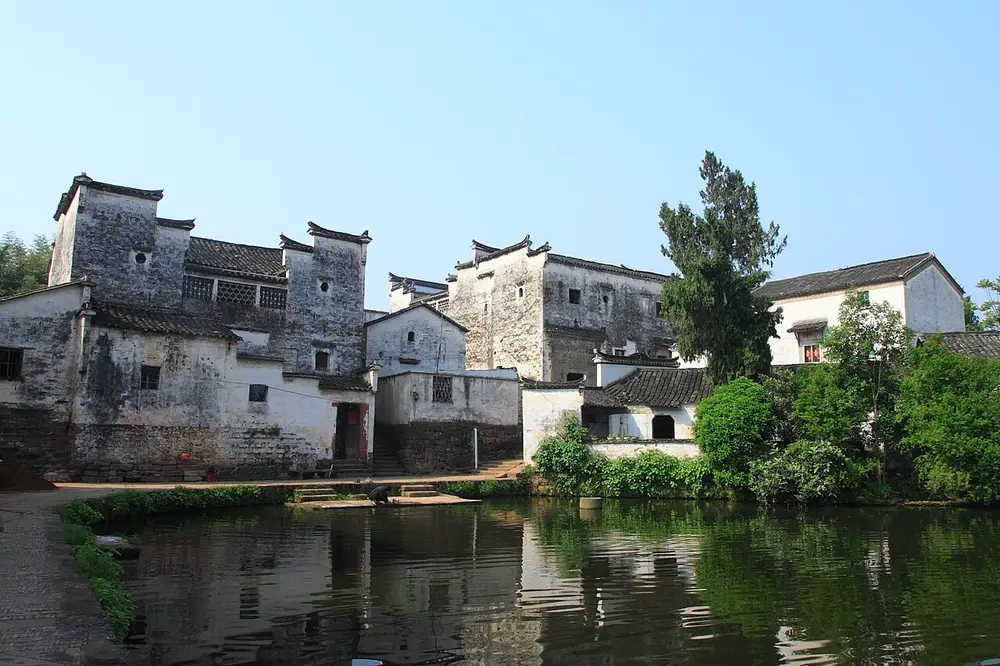
Zhuge 诸葛. Best known through Zhuge Liang, the chancellor of Shu Han in the 3rd century, whose courtesy name was Kongming. According to English Wikipedia, the people of Zhuge Village in Lanxi, Zhejiang, claim descent from him; the village, shown at the top of this page, was renamed after the surname under the Ming because so many of its inhabitants bore it, and its buildings are laid out on the pattern of the eight trigrams. The photograph shows houses around one of its ponds, named 钟池 in the Commons caption.
Situ 司徒. English Wikipedia notes that almost 80% of people named Situ live in Kaiping, Guangdong, which explains spellings such as Szeto, Seto and Soohoo in Hong Kong and North America. The 2010 census counted about 45,000 bearers.
Shangguan 上官. Traced by English Wikipedia to Zilan, a son of King Huai of Chu, who settled at Shangguan. Its best-known bearer is Shangguan Wan’er (664 to 710), poet and official of the Tang court.
Surnames from the northern peoples
Several compound surnames are the clan names of peoples from the northern steppe who ruled parts of China. 慕容 Murong, 宇文 Yuwen and 拓跋 Tuoba were Xianbei clans. The Tuoba founded the Northern Wei dynasty, and English Wikipedia records that in 496 Emperor Xiaowen, as part of a policy of sinicisation, changed the clan’s surname to 元 Yuan. That reform is one example of the many routes by which a compound surname could become a single character.
A double-barrelled surname from Taiwan: Fan-Jiang
Chinese Wikipedia describes 范姜 Fan-Jiang as a surname found only in Taiwan. In the early Qing dynasty, a widow of the Fan family of Haifeng, in Guangdong, remarried a man named Jiang Tongying 姜同英, bringing two sons. The elder son’s children took the surname Jiang. The younger son, Fan Wenzhi 范文質, grateful to his stepfather but unwilling to divide his five sons between the two names, gave all five both surnames. The five brothers later settled in today’s Taoyuan, and in 1854 the clan built the Fan-Jiang ancestral hall in Xinwu, which still stands. The name had about 4,300 bearers in 2018.
Writing compound surnames in English
In pinyin, a compound surname is written as a single word with one capital letter: Ouyang Xiu, Sima Qian, Zhuge Liang, Shangguan Wan’er. Writing “Ou Yang Xiu” or “Si Ma Qian” breaks the name in the wrong place.
Other systems are less consistent. Hong Kong Cantonese spellings often write each character as a word, as in Au Yeung for Ouyang and Szeto for Situ, so that a form may take “Au” for the whole surname. The guide to one surname, many spellings shows how to trace such variants back to the characters. When you fill in or design a form, put the full compound in the surname field; when you meet a name like Au Yeung Wing, the name order formatter helps to set out its parts. To check a spelling, use the Chinese name to pinyin tool or the surname finder.
Frequently asked questions
What is a Chinese compound surname?
It is a surname written with two characters instead of one, such as 欧阳 Ouyang, 司马 Sima, 诸葛 Zhuge or 上官 Shangguan. The two characters form a single, indivisible family name. Most Chinese surnames have only one character, and compound surnames are now a small minority.
What is the most common compound surname?
Ouyang 欧阳, by a wide margin. Chinese Wikipedia cites figures from China's Ministry of Public Security giving about 1.11 million people named Ouyang in 2020, against about 88,000 for Shangguan, the second. In a 2013 study of the 400 most common surnames, Ouyang was the only compound surname in the list.
Is Zhuge Liang's surname Zhuge or Zhu?
Zhuge. 诸葛 is a compound surname and Liang 亮 his given name. His descendants still bear the name, and many of them live in Zhuge Village in Lanxi, Zhejiang, shown at the top of this page.
Is a compound surname the same as a double-barrelled surname?
No. A compound surname is one name that happens to have two characters and cannot be split. A double-barrelled surname joins the surnames of two families, as in the Taiwanese surname Fan-Jiang 范姜, and a married name adds a husband's surname in front of a woman's own, without being passed on.
How do I write a compound surname in English?
In pinyin, as one word with a capital at the start: Ouyang, Sima, Zhuge, Shangguan. Hong Kong spellings often write it as two words, Au Yeung or Szeto, and Southeast Asian spellings vary. On forms, enter the whole compound in the surname field.
Sources and open data
- Chinese compound surname, English Wikipedia
- 複姓, Chinese Wikipedia
- Ouyang (surname), English Wikipedia
- Sima (Chinese surname), English Wikipedia
- Situ (surname), English Wikipedia
- 范姜姓, Chinese Wikipedia
- Zhuge Village, English Wikipedia
- Tuoba, English Wikipedia