Key facts
- Chen is written 陈 in simplified and 陳 in traditional characters (8 and 10 strokes). The character means to display or set out.
- It ranked fifth in mainland China in the Ministry of Public Security's 2019 report, but first in Taiwan, Hong Kong, Macau and Singapore, and first in Guangdong, Fujian and Zhejiang.
- Tradition traces it to the state of Chen (today's Huaiyang, Henan), given around 1046 BC to Gui Man, a descendant of the sage king Shun.
- It is spelled Chan (Cantonese), Tan (Hokkien), Tang (Teochew), Chin (Hakka, Taishanese) and Trần (Vietnamese).
- The 2010 US Census counted 188,498 Trans, 169,580 Chens and 76,664 Chans, each over 89% Asian or Pacific Islander.
陈
陳
Pinyin: Chén
Simplified / traditional: 陈 / 陳
Rank in mainland China: 5 of the top 100 (Ministry of Public Security, 2019 report)
Characters and spellings of 陈
| Unicode code point | U+9648 (traditional 陳: U+9673) |
|---|---|
| Stroke count | 8 (traditional: 10) |
| Radical (simplified form) | No. 170 ⾩, plus 5 strokes |
| Dictionary meaning (Unihan) | exhibit, display; plead; surname |
Romanizations by Chinese language
| Language | System | Spelling |
|---|---|---|
| Mandarin | Hanyu Pinyin (PRC standard) | Chén |
| Mandarin | Wade-Giles (Taiwan, older English texts) | Ch'en |
| Cantonese | Jyutping (Unihan) | can4 |
| Cantonese | Hong Kong / common spellings | Chan, Chun, Chean, Chin |
| Hokkien (Min Nan) | Pe̍h-ōe-jī and common spellings | Tân, Tan, Tang, Ting |
| Hakka | Pha̍k-fa-sṳ and common spellings | Chhìn, Chin |
| Gan | Romanization and common spellings | Thín, Thin, Chin |
| Wu (Shanghainese) | Romanization and common spellings | Zen, Tchen |
Equivalent surnames in other languages
| Language | Form |
|---|---|
| Vietnamese | Trần |
| Korean | Jin (진) |
| Filipino | Tan, Chan, Tantoco |
| Japanese | Chin |
These spellings in the 2010 US Census
| Spelling | People | US rank | Asian / Pacific Islander |
|---|---|---|---|
| TRAN | 188,498 | 132 | 96% |
| CHEN | 169,580 | 150 | 96.12% |
| CHAN | 76,664 | 425 | 89.32% |
| TANG | 34,961 | 999 | 93.31% |
| TAN | 32,120 | 1,090 | 92.37% |
| CHIN | 27,487 | 1,279 | 76.08% |
| CHUN | 13,141 | 2,740 | 81% |
| TING | 3,103 | 10,382 | 87.59% |
| CHHIN | 309 | 64,388 | 95.15% |
| ZEN | 264 | 73,464 | 51.52% |
Counts are people recorded with each spelling among the 265,667,228 people with a surname shared by at least 100 people (US Census Bureau, 2010, public domain). A spelling is not proof of Chinese origin: the last column shows the share of bearers who identified as Asian or Pacific Islander. Together these spellings total 546,761 people, but some of them belong to unrelated surnames (for example English Lee, Hmong Vang or Vietnamese Ly). Search any spelling with the US census surname lookup.
Stroke order
Animation by the open-source Hanzi Writer library (MIT) with stroke data from Make Me a Hanzi (Arphic Public License). Stroke order tool for any character.

Chen (陈, traditional 陳) is the fifth most common surname in mainland China and the first in Taiwan, Hong Kong, Macau and Singapore. The character means “to display, set out”, but the surname comes from the ancient state of Chen in Henan. It is pronounced chén, roughly “chun” with a rising tone. It has more spellings than almost any other Chinese name: Chan (Cantonese), Tan (Hokkien), Tang (Teochew, in Thailand and Cambodia), Chin (Hakka and Taishanese), Ting (Fuzhou), Zen (Shanghainese) and Trần (Vietnamese). With all of them counted, Wikipedia estimates 80 to 100 million people worldwide.
Meaning of the character 陈 / 陳
Unihan glosses 陳 as “exhibit, display; plead; surname”. The character is built from the mound radical 阝 (a form of 阜) and 東, “east”. The simplified form keeps the structure and simplifies 東 to 东, going from 10 strokes to 8.
To spell it out loud, speakers say 耳东陈, “ear-east Chen”, because the left-hand 阝 looks like 耳 (ear). That distinguishes it from 程 Cheng and 谌 Chen, which can sound similar in southern speech.
Origin: the state of Chen
The traditional account is unusually consistent.
- Descendants of Shun. The sage king Shun is said to be the ancestor of the Gui (妫) clan. After King Wu of Zhou overthrew the Shang (around 1046 BC), he looked for Shun’s heirs and enfeoffed one of them, Gui Man, at Chen, in today’s Huaiyang district of Zhoukou, Henan. Gui Man is remembered as Duke Hu of Chen (陈胡公), and Chen families treat him as their founding ancestor.
- The state becomes a name. In 479 BC Chen was annexed by Chu. Its people took the name of their lost state as a surname, which was common practice.
- The Tian of Qi. A Chen prince, Chen Wan, fled to the state of Qi in the 7th century BC; his descendants took the name Tian (田) and eventually seized the throne of Qi. After Qin destroyed Qi, some of their descendants became Wang (see Wang 王).
- Changes and adoptions. The Xianbei compound surname Houmochen (侯莫陈) was shortened to Chen under the Northern Wei. Chinese Wikipedia also records Liu, Bai and Cheng families who became Chen.
As with every surname, these are traditional genealogies, not documented descent.
The Chen dynasty and the move south
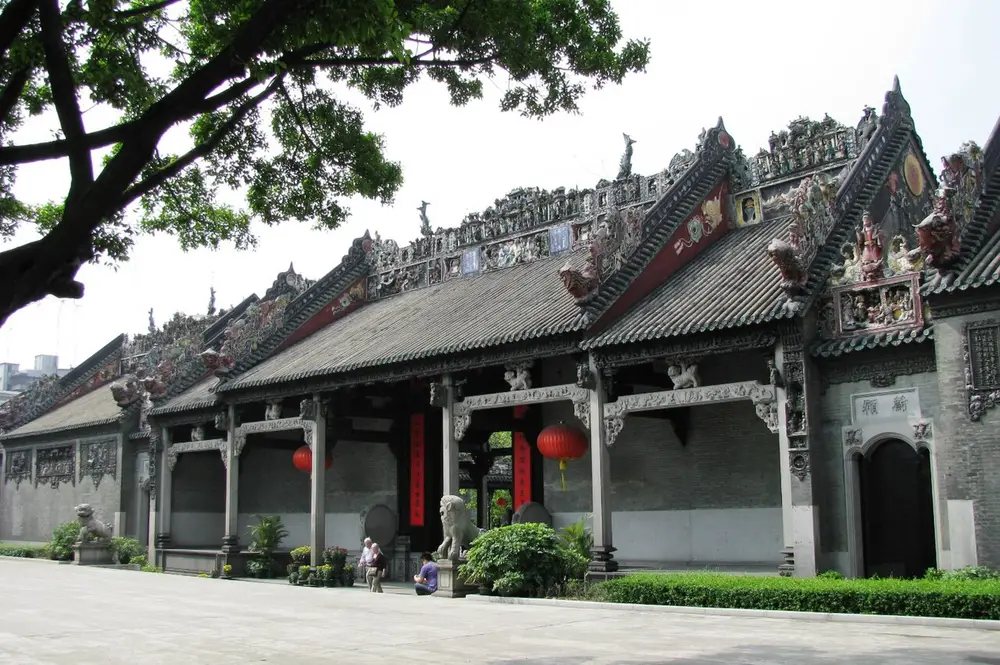
Chen Baxian founded the Chen dynasty (557 to 589), the last of the Southern Dynasties. More decisive for today’s numbers was migration: Chen was one of the eight clans said to have entered Fujian during the troubles of 308, and later waves carried the name along the coast of Fujian and Guangdong. That is why Chen is the top surname in the southeast and among the overseas Chinese, most of whom came from those provinces. In 1894, the Chen clans of Guangdong built the Chen Clan Academy in Guangzhou, shown above: a joint ancestral hall and school for candidates to the imperial examinations, now the Guangdong Folk Art Museum. See clan associations and hall names.
Chen, Chan, Tan, Trần: the spellings
| Spelling | Language | Where |
|---|---|---|
| Chen / Ch’en | Pinyin / Wade-Giles | Mainland China, Taiwan |
| Chan | Cantonese (can4) | Hong Kong, Macau, Malaysia (Jackie Chan) |
| Tan | Hokkien (Tân) | Singapore, Malaysia, Indonesia, the Philippines |
| Tang, Taing | Teochew | Thailand, Cambodia |
| Chin, Gin | Hakka, Taishanese | Malaysia, older Chinese American families |
| Ting, Ding | Fuzhou | Fuzhou and its diaspora |
| Zen, Tchen | Shanghainese, French-era spellings | Shanghai |
| Trần | Vietnamese | Vietnam |
| Jin (진) | Korean | Korea |
The Hokkien and Teochew spellings guide explains why Tan, and the Hong Kong Cantonese spellings guide why Chan. In Hong Kong about 700,000 people spell their name Chan, against some 61,000 Chen, which makes 陳 the city’s first surname by far. In Indonesia, many Chen families took Indonesian surnames such as Chandra or Hartanto; see Chinese Indonesian names.
Trần, the Vietnamese Chen
In Vietnam, Trần is the second most common surname, after Nguyễn, borne by about 11% of the population according to Chinese Wikipedia. The Trần dynasty (1225 to 1400) traced its origin to a Chen family from Fujian. Its most famous member, the general Trần Hưng Đạo (陳興道, 1228 to 1300), repelled the Mongol invasions. The Vietnamese surnames guide shows how Vietnamese readings map to characters.
Chen in the United States
The 2010 census shows that the Vietnamese form is the largest:
- Tran: 188,498 people (rank 132), 96.0% Asian or Pacific Islander.
- Chen: 169,580 (rank 150), 96.1%.
- Chan: 76,664 (rank 425), 89.3%.
- Tan: 32,120 (92.4%), Southeast Asian Chinese and Filipino Chinese.
- Chin: 27,487 (76.1%) and Chun: 13,141 (81.0%). Both are mixed: Chin is also a Korean spelling, and Chun is the usual spelling of Korean 전 Jeon.
- Tang: 34,961 (93.3%) is mostly 唐 or 邓, not Chen.
Tran, Chen and Chan alone total 434,742 people. The census lookup tool gives the figures for each spelling, and the US census analysis compares surnames.
Distribution in China
Chen is a southern surname. In 2019 it was the top surname in Guangdong, Fujian and Zhejiang. A 2013 study counted 61.3 million bearers on the mainland (4.61%), with Guangdong the province with the most. It is the first surname of Taiwan (2010 data) and of Xiamen, the ancestral city of many Hokkien emigrants. See the most common surnames in Taiwan and the mainland top 100.
In the Hundred Family Surnames, Chen is tenth, in the line 馮陳褚衛.
Famous people named Chen
- Chen Sheng (陳勝, died 208 BC), leader of the first uprising against the Qin dynasty.
- Xuanzang (玄奘, 602 to 664), the Buddhist monk and traveler to India, born Chen Yi (陳禕).
- Trần Hưng Đạo (1228 to 1300), Vietnamese prince and general.
- Tan Kah Kee (陳嘉庚, 1874 to 1961), Singapore businessman and philanthropist, founder of Xiamen University, an example of the Hokkien spelling.
- Chen Duxiu (陳獨秀, 1879 to 1942), co-founder and first general secretary of the Chinese Communist Party.
- Jackie Chan (born Chan Kong-sang 陳港生, 1954), Hong Kong actor and martial artist.
- Steve Chen (陳士駿, born 1978), Taiwanese-American co-founder of YouTube.
Related surnames and confusions
- 程 Cheng: sometimes romanized Chen and easily confused in the south. See Cheng 程.
- 谌 Chen (Shen): a rare surname with the same pinyin in some readings.
- Chin may be 陳 (Hakka) or 钱 Qian (Cantonese); Tang is usually 唐 Tang. The surname finder lists every candidate.
Frequently asked questions
Is Chan the same surname as Chen?
Yes, in most cases. Chan is the Hong Kong Cantonese spelling of 陳, the character pinyin writes Chen. Jackie Chan's family name is 陳. Only a few Chans have another character.
Is Tran a Chinese surname?
Trần is the Vietnamese reading of the same character 陳 and the second most common surname in Vietnam. It was the surname of the Trần dynasty. Vietnamese Trầns are not necessarily of Chinese descent; the name came with the Chinese writing system.
How do you pronounce Chen?
It is chén, roughly chun as in the English word chunk, with a rising second tone. The e is a short neutral vowel, not the e of hen.
Why is Tan the same surname as Chen?
Tan comes from the Hokkien and Teochew reading of 陳, Tân. Families from southern Fujian and Chaozhou who emigrated to Singapore, Malaysia, Indonesia and the Philippines registered under that sound.
What does the surname Chen mean?
The character means to display, set out or state, and also old. The surname itself comes from the name of the ancient state of Chen, not from that meaning.
Sources and open data
- Unihan database entry for U+9648 陈, Unicode Consortium
- Frequently Occurring Surnames from the 2010 Census, US Census Bureau
- Chen (surname), English Wikipedia
- 陈姓 (Chen surname), Chinese Wikipedia
- Chen Clan Ancestral Hall, English Wikipedia
- Trần Hưng Đạo, English Wikipedia
- Chen, family name (Q804988), Wikidata