Key facts
- Li is written 李 (7 strokes, same form in simplified and traditional script). The character means plum, plum tree.
- It ranked second among mainland surnames in the Ministry of Public Security's 2019 report, after Wang, with over 90 million bearers.
- Tradition derives it from 理, the title of a legendary judge; Laozi (Li Er) is its first famous bearer, and the Tang emperors spread it by granting it to allies.
- It is spelled Lee in Hong Kong, Taiwan and Singapore, Lie in Indonesia, Lý in Vietnam and Yi, Lee, Rhee or Ri in Korea.
- The 2010 US Census counted 693,023 people named Lee (rank 21, only 42.2% Asian or Pacific Islander) and 111,786 named Li (96.8%).
李
Pinyin: Lǐ
Same character in simplified and traditional: 李
Rank in mainland China: 2 of the top 100 (Ministry of Public Security, 2019 report)
Characters and spellings of 李
| Unicode code point | U+674E |
|---|---|
| Stroke count | 7 |
| Radical (simplified form) | No. 75 ⽊, plus 3 strokes |
| Dictionary meaning (Unihan) | plum; judge; surname |
Romanizations by Chinese language
| Language | System | Spelling |
|---|---|---|
| Mandarin | Hanyu Pinyin (PRC standard) | Lǐ |
| Mandarin | Wade-Giles (Taiwan, older English texts) | Li |
| Cantonese | Jyutping (Unihan) | lei5 |
| Cantonese | Hong Kong / common spellings | Lee, Li, Ly |
| Hokkien (Min Nan) | Pe̍h-ōe-jī and common spellings | Lí, Lee |
| Hakka | Pha̍k-fa-sṳ and common spellings | Lí, Lee |
| Gan | Romanization and common spellings | Lî, Lee |
| Wu (Shanghainese) | Romanization and common spellings | Li, Lee |
Equivalent surnames in other languages
| Language | Form |
|---|---|
| Vietnamese | Lý |
| N. Korean | Ri (리) |
| S. Korean | Yi, Lee, Rhee (이) |
| Japanese | Ri |
| Filipino | Dy, Dee, Lee, Li |
These spellings in the 2010 US Census
| Spelling | People | US rank | Asian / Pacific Islander |
|---|---|---|---|
| LEE | 693,023 | 21 | 42.22% |
| LI | 111,786 | 273 | 96.78% |
| LY | 29,891 | 1,176 | 94.59% |
| DEE | 6,275 | 5,535 | 10.2% |
| DY | 1,932 | 15,232 | 88.82% |
Counts are people recorded with each spelling among the 265,667,228 people with a surname shared by at least 100 people (US Census Bureau, 2010, public domain). A spelling is not proof of Chinese origin: the last column shows the share of bearers who identified as Asian or Pacific Islander. Together these spellings total 842,907 people, but some of them belong to unrelated surnames (for example English Lee, Hmong Vang or Vietnamese Ly). Search any spelling with the US census surname lookup.
Stroke order
Animation by the open-source Hanzi Writer library (MIT) with stroke data from Make Me a Hanzi (Arphic Public License). Stroke order tool for any character.

Li (李) is the second most common surname in mainland China, after Wang, with more than 90 million bearers. The character means “plum” or “plum tree”, has 7 strokes and is identical in simplified and traditional script. It is pronounced lǐ, like the English word “lee” with a low dipping tone. Outside the mainland it is usually spelled Lee (Hong Kong, Taiwan, Singapore), but also Lie in Indonesia, Lei in Macau, Lý in Vietnam and Yi, I, Lee, Rhee or Ri in Korea.
Meaning of the character 李
Unihan gives “plum; judge; surname”. The character is a tree 木 over a child 子, which is how Chinese speakers name it aloud: 木子李, “wood-child Li”, to tell it apart from homophones such as 黎, 理 or 厉. The “judge” sense comes from its old use for 理 and is the key to the traditional origin story below.
Origins of the Li surname
Genealogies and the 9th-century Yuanhe Xingzuan (元和姓纂) give a layered account:
- The judge’s title. Gao Yao, a legendary minister of the sage king Yao, served as dali (大理), master of law. His descendants took 理 as their surname.
- The plum tree. At the end of the Shang, the minister Li Zheng was put to death by the tyrant Di Xin. His son Li Lizhen fled with his mother and survived by eating plums. In gratitude, and to hide from the king, he wrote the name with the homophone 李. The family is said to have settled at Ku county, in today’s Luyi, Henan.
- Laozi. Li Er (李耳), better known as Laozi, the reputed author of the Daodejing, is the first well-known person named Li and is honored as the founding ancestor. Modern scholars treat his biography as largely legendary, and the linguist Gao Heng argued that 李 grew out of the near-homophone 老, Laozi’s own name.
- The Ba people. In the southwest, the non-Han Ba of today’s Chongqing and western Hubei adopted Li, said to echo their word for tiger. The Ba leader Li Xiong founded Cheng Han in 304, the first state ruled by a Li.
All of these are traditional accounts. The early steps cannot be documented.
The Tang dynasty effect
What made Li a giant was politics. The Tang emperors (618 to 907) were Li, claimed descent from Laozi, and granted their surname to loyal generals, officials and allied rulers: Turkic, Khitan, Mohe and Goguryeo leaders among them. Later Li-ruled states (Later Tang, Southern Tang, Western Xia) kept the custom. Chinese Wikipedia counts the Longxi Li (陇西李氏, Gansu) and the Zhaojun Li (赵郡李氏, Hebei) as the most prestigious choronyms. Among China’s 55 official minorities, 33 are known to use the name, including the Bai, Yao and Miao.
Lee, Li, Ly, Lie, Rhee: why so many spellings
| Spelling | Language or system | Example |
|---|---|---|
| Li | Hanyu Pinyin, Wade-Giles | Li Na, tennis player |
| Lee | Cantonese and Hokkien custom (lei5, lí) | Bruce Lee, Lee Kuan Yew |
| Lei | Portuguese-based spelling in Macau | Macau ID cards |
| Lie | Dutch-based spelling in Indonesia | Chinese Indonesians |
| Lý / Ly | Vietnamese | Lý Thái Tổ |
| Yi, I, Lee, Rhee | South Korean (이) | Syngman Rhee |
| Ri | North Korean (리) | North Korean officials |
The variety has three causes. First, the Cantonese and Hokkien readings (lei5, lí) are close to the English word “lee”, and since Lee was already a familiar English surname, clerks and families chose it. Second, the colonial spelling systems of Macau (Portuguese) and the Dutch East Indies gave Lei and Lie. The Chinese Indonesian names guide covers the second case.
Third, Korean phonology. South Korean drops an initial r/l before i, so 李 is pronounced and written 이, I. Families kept older English spellings that remember the l: Lee, and Rhee, a spelling famously used by Syngman Rhee. North Korea keeps the r: 리, Ri. The Korean surnames and Chinese characters guide explains the rule, and the Jeonju Yi clan, the royal house of Joseon, is the best-known Korean line. In Vietnam the Lý dynasty (1009 to 1225) used the same character; see the Vietnamese surnames guide.
Li and Lee in the United States
The 2010 census file shows the effect of the English Lee:
- Lee: 693,023 people, rank 21 of all US surnames, but only 42.2% Asian or Pacific Islander. Roughly 290,000 American Lees are Asian (Chinese, Korean and others); the majority are of English, Irish or African American heritage, carrying the unrelated English name.
- Li: 111,786 people (rank 273), 96.8% Asian or Pacific Islander, mostly recent mainland immigrants.
- Ly: 29,891 (94.6%), mostly Vietnamese and Sino-Vietnamese.
- Dy: 1,932 (88.8%), a Filipino Chinese spelling from Hokkien. The spelling Dee (6,275) is listed as a variant but is only 10.2% Asian, so most Dees are not Li.
In other words, a person named Lee in the US is more likely not to have Chinese ancestry at all. The one surname, many spellings guide and the US census analysis give the method.
Distribution in China
Li dominates the north and southwest. In 2019 it was the most common surname in Chongqing, Hubei, Hunan, Sichuan and Yunnan, and Henan has more Lis than any other province. It is much rarer along the southeast coast: in Fujian, Hainan, Jiangxi, Zhejiang and Taiwan only 2.2 to 6.6% of the population bear it. It is also the most common surname among the Hakka. In Taiwan, Li (usually spelled Lee) ranks fifth. A 2013 analysis of 1.33 billion records confirmed that Li is second, not first as long believed.
In the Hundred Family Surnames, Li is fourth (趙錢孫李) because it was the surname of the Southern Tang kings. See the Hundred Family Surnames page.
Famous people named Li
- Laozi (老子), traditionally Li Er (李耳), legendary founder of Daoism.
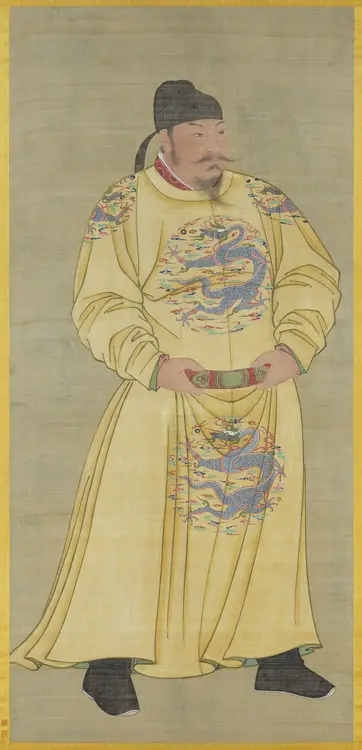
- Li Shimin (李世民, 598 to 649), Emperor Taizong of Tang, shown above.
- Li Bai (李白, c. 701 to 762), Tang poet, one of the most celebrated in Chinese literature.
- Li Qingzhao (李清照, 1084 to c. 1155), Song poet and essayist.
- Lý Thái Tổ (李太祖, 974 to 1028), founding emperor of Vietnam’s Lý dynasty.
- Syngman Rhee (이승만 李承晩, 1875 to 1965), first president of South Korea.
- Bruce Lee (李小龍, 1940 to 1973), Hong Kong and American martial artist and actor, born Lee Jun-fan.
- Lee Kuan Yew (李光耀, 1923 to 2015), first prime minister of Singapore.
- Li Na (李娜, born 1982), the first Asian tennis player to win a Grand Slam singles title.
Related surnames and confusions
- 黎 Li and 理 Li: other surnames romanized Li. 黎 is read Lai in Cantonese and Lê in Vietnamese, so Lê is not Lý.
- Lee can hide several characters in the diaspora; the surname finder lists them.
- Compare with the other “big three”: Wang 王 and Zhang 张, or read where Chinese surnames come from.
Frequently asked questions
What does the surname Li mean?
The character 李 means plum or plum tree. Tradition says the family name was first written 理, the title of a judge, and switched to the homophone 李 at the end of the Shang dynasty.
Is Lee a Chinese or Korean surname?
Both, and English too. Lee is the usual spelling of Chinese 李 in Hong Kong, Taiwan and Singapore, and of Korean 이 (the same character), while the English surname Lee is unrelated. In the US census about 42% of Lees are Asian or Pacific Islander.
How do you pronounce Li?
In Mandarin it is lǐ, like the English word lee, said with a low dipping third tone. The Cantonese reading lei5 is the source of the spelling Lee.
Why do Koreans spell Lee as Yi or Rhee?
In South Korea the character 李 is pronounced i (이) because an initial r or l is dropped before i. Yi and I follow that pronunciation, while Lee and Rhee are older spellings that keep a trace of the original l. North Korea writes it 리 Ri.
Is Ly the same surname as Li?
Yes. Lý is the Vietnamese reading of 李, the surname of the Lý dynasty (1009 to 1225). Some Chinese families from Cambodia or Laos also write Ly.
Sources and open data
- Unihan database entry for U+674E 李, Unicode Consortium
- Frequently Occurring Surnames from the 2010 Census, US Census Bureau
- Li (surname 李), English Wikipedia
- 李姓 (Li surname), Chinese Wikipedia
- Laozi, English Wikipedia
- Syngman Rhee, English Wikipedia
- Li, family name (Q686223), Wikidata