Key facts
- Hong Kong surnames follow the Cantonese pronunciation, not the Mandarin one: 陳 is Chan (pinyin Chen), 林 is Lam (Lin), 吳 is Ng (Wu).
- The government's romanization is an unpublished system: departments check names against the Chinese Commercial Code book, which carries no tone marks.
- The 2010 US Census counted Wong 111,371, Chan 76,664, Lam 55,554, Ho 49,817 and Ng 31,210 people, the legacy of early immigration from Guangdong and Hong Kong.
- Jyutping, created by the Linguistic Society of Hong Kong in 1993, is a separate, fully specified scheme: Chan is can4, Cheung is zoeng1, Yeung is joeng4.
- One spelling can hide several characters: Wong is both 黃 Huang and 王 Wang, and Cheung is 張 Zhang and in Hong Kong also 蔣.
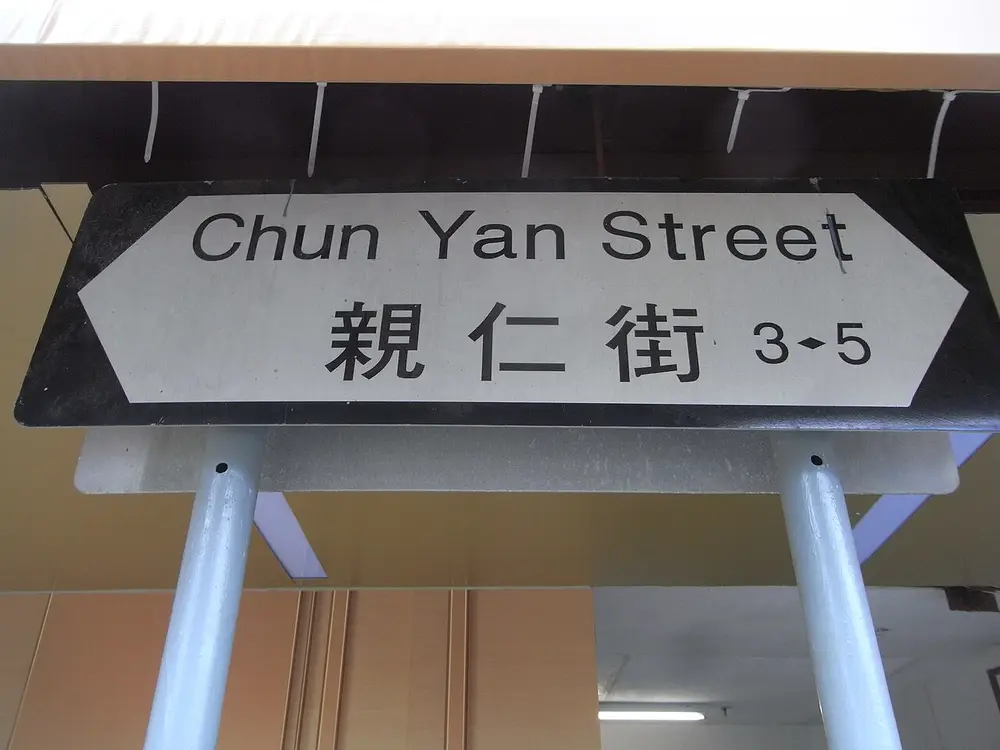

Hong Kong, Macau and the Cantonese-speaking diaspora spell Chinese surnames according to the Cantonese pronunciation of the character. That is why 陳 is Chan and not Chen, 黃 and 王 are both Wong, and 林 is Lam and not Lin. The spellings come from the romanization used by the Hong Kong government, not from pinyin, and they became the first large group of Chinese surnames in English-speaking countries.
The main spellings
The table pairs each common Hong Kong spelling with its characters, the Mandarin pinyin, the Jyutping reading and the number of people with that spelling in the 2010 US Census. The Jyutping and Mandarin readings are the standard dictionary readings from the Unicode Unihan database.
| Hong Kong spelling | Characters | Mandarin pinyin | Jyutping | US Census 2010 |
|---|---|---|---|---|
| Chan | 陳 | Chen | can4 | 76,664 |
| Wong | 黃, 王 | Huang, Wang | wong4 | 111,371 |
| Lam | 林 | Lin | lam4 | 55,554 |
| Ng | 吳 | Wu | ng4 | 31,210 |
| Cheung | 張 | Zhang | zoeng1 | 18,765 |
| Lau | 劉 | Liu | lau4 | 29,792 |
| Ho | 何 | He | ho4 | 49,817 |
| Leung | 梁 | Liang | loeng4 | 20,496 |
| Yeung | 楊 | Yang | joeng4 | 7,782 |
| Tsang | 曾 | Zeng | zang1 | 6,860 |
| Chow | 周 | Zhou | zau1 | 17,059 |
The Census file records spellings, not characters, so each count includes every person with that spelling. Chow, for example, is held by 17,059 people and Chau, a common variant, by 16,667. Individual pages explain each name: Chen 陈, Lin 林, Wu 吴, Zhang 张, Liu 刘, He 何, Liang 梁, Yang 杨, Zeng 曾 and Zhou 周.
Why they differ from pinyin
Pinyin writes the Mandarin pronunciation. Hong Kong spellings write the Cantonese pronunciation of the same character, and the two sound systems differ in ways that no spelling rule can bridge. Some examples from the table:
- Final consonants. Cantonese keeps an m ending in 林, so it is Lam, while Mandarin has Lin.
- Syllabic ng. 吳 is simply ng4 in Cantonese, a nasal with no vowel, while Mandarin says Wu.
- Different vowels. 陳 begins with a ch sound in both languages, but the vowel is a in Cantonese (Chan) and e in Mandarin (Chen).
- Mergers. Two characters that are separate in Mandarin can sound the same in Cantonese: 黃 (Huang) and 王 (Wang) are both wong4, which is why Wong is the largest Cantonese spelling in the table.
So Chan is not a misspelling of Chen. It is a transcription of a different reading of the same character, and the two spellings belong to different families of languages. For the same logic applied to other southern languages, see the guides to Hokkien and Teochew and Hakka spellings, and one surname, many spellings.
The government system
English Wikipedia describes the Hong Kong government romanization as an unpublished system that has never been formally disclosed. It is called the Government System, or the Dyer-Ball or Eitel system, and it has changed over time. Chinese Wikipedia adds that it is based on the older Standard Romanization and is closely related to Cantonese postal romanization.
Several points are documented:
- Departments check names against the Chinese Commercial Code book, the 1971 edition produced by the Royal Hong Kong Police Special Branch, which has no tone indications.
- The system is the default for names on identity cards, handled by the Registration of Persons Office, although people may choose their own spelling.
- The system leaves out tones, the distinction between aspirated and unaspirated consonants, and the contrast between the long a and the short a vowel.
- The older distinctions ch and ts, sh and s, and j and z have merged in present-day speech.
The practical consequence for researchers is that no document gives the complete rules. The spelling that appears on a person’s papers is the fact; it cannot be derived by applying a published conversion table, and this site does not offer one for the government system. Chinese Wikipedia notes that, in practice, parents registering a birth have the clerk look up the English spelling in a book.
Other Hong Kong spellings
Not every surname has one spelling. The Unihan and census data used on this site show that Hong Kong spellings vary even within a single character, for example 蔡 as Choi, Choy or Tsoi, 蕭 as Siu or Shiu, 曹 as Cho or Tso, 羅 as Lo or Law, and 彭 as Pang. Each surname page lists the spellings that apply to it, with the census counts. The spelling Cheung is also used for 蔣, whose Cantonese reading is zoeng2, which is why Cheung can stand for 張 or 蔣.
Jyutping versus the government system
Jyutping is a different scheme and should not be confused with the government system. Published in 1993 by the Linguistic Society of Hong Kong (LSHK), it takes its name from the first characters of 粵語拼音, “Cantonese romanization”. It is fully specified: z and c stand for the sounds /ts/ and /tsʰ/, j is a y sound, eo and oe mark two vowel finals, and the six tones are written with the numbers 1 to 6 after the syllable. The LSHK says the tone numbers should be written as ordinary digits.
| Name | Government spelling | Jyutping |
|---|---|---|
| 張 | Cheung | zoeng1 |
| 楊 | Yeung | joeng4 |
| 曾 | Tsang | zang1 |
| 周 | Chow | zau1 |
The Cantonese readings in the table above are given in Jyutping. Personal names on identity cards and passports stay in the government’s traditional spellings, so a visitor or a family researcher should expect to see Cheung on the document and zoeng1 only in a dictionary.
Hong Kong spellings in the diaspora
The first large Chinese communities in the United States and other English-speaking countries came mostly from Guangdong and Hong Kong, and their Cantonese spellings stayed. In the 2010 US Census, Wong, Chan, Lam, Ho and Ng were all among the largest Chinese spellings, while pinyin forms such as Chen, Wang and Li reflect later arrivals from the mainland. The US Census guide tabulates the pattern, and the US census surname lookup shows the count and Asian or Pacific Islander share of each spelling. For mainland spellings, see pinyin for names.
Frequently asked questions
Is Chan the same surname as Chen?
Yes, in the common case. Both are romanizations of the character 陳, Chen in Mandarin pinyin and Chan from its Cantonese pronunciation (can4 in Jyutping). The US Census counted 76,664 people named Chan and 169,580 named Chen in 2010.
Why is the surname Wong used for two different characters?
Cantonese pronounces both 黃 (Huang in Mandarin) and 王 (Wang) as wong4, so the Hong Kong spelling is the same for both. The surname finder on this site lists both characters behind Wong, and the census counts 111,371 people named Wong.
What is the Hong Kong government romanization system?
It is the spelling scheme that Hong Kong departments use for names on identity cards and other records, and it has never been formally published. It is based on older systems such as Standard Romanization, it has varied over time, and it omits tones. People may also choose their own spelling.
Is Jyutping used for Hong Kong surnames?
Not on documents. Jyutping, published by the Linguistic Society of Hong Kong in 1993, is a scholarly scheme, while personal names on identity documents keep the traditional spellings: 張 is Cheung on an identity card and zoeng1 in Jyutping.
How do you pronounce Ng, Cheung and Leung?
Ng is a single nasal sound, like the ng at the end of 'sing', said on its own. Cheung is roughly 'chung' and Leung roughly 'lyoong', although the exact sounds are not English, so treat these as approximations.
Sources and open data
- Hong Kong Government Cantonese Romanisation, English Wikipedia
- 香港政府粵語拼音, Chinese Wikipedia
- Jyutping, English Wikipedia
- Frequently Occurring Surnames from the 2010 Census, US Census Bureau