Key facts
- Yang is written 杨 in simplified and 楊 in traditional characters (7 and 13 strokes). The character means poplar, willow, aspen.
- It ranked sixth in mainland China in the Ministry of Public Security's 2019 report and is the most common surname of Guizhou province.
- Tradition traces it to the small Zhou-era state of Yang, in today's Hongdong county, Shanxi, and to Boqiao, a son of Duke Wu of Jin.
- Other spellings: Yeung (Cantonese), Yeo, Yeoh (Hokkien), Yong (Hakka), Dương (Vietnamese), Young (anglicized).
- The 2010 US Census counted 106,033 people named Yang, 96.8% Asian or Pacific Islander, and 24,870 Duongs.
杨
楊
Pinyin: Yáng
Simplified / traditional: 杨 / 楊
Rank in mainland China: 6 of the top 100 (Ministry of Public Security, 2019 report)
Characters and spellings of 杨
| Unicode code point | U+6768 (traditional 楊: U+694A) |
|---|---|
| Stroke count | 7 (traditional: 13) |
| Radical (simplified form) | No. 75 ⽊, plus 3 strokes |
| Dictionary meaning (Unihan) | willow, poplar, aspen; surname |
Romanizations by Chinese language
| Language | System | Spelling |
|---|---|---|
| Mandarin | Hanyu Pinyin (PRC standard) | Yáng |
| Mandarin | Wade-Giles (Taiwan, older English texts) | Yang |
| Cantonese | Jyutping (Unihan) | joeng4 |
| Cantonese | Hong Kong / common spellings | Yeung, Yeong, Ieong, Young |
| Hokkien (Min Nan) | Pe̍h-ōe-jī and common spellings | Iûⁿ (X, Q, K, T), Iôⁿ (Z), Yeoh, Yeo, Yo, Nyo |
| Hakka | Pha̍k-fa-sṳ and common spellings | Yòng, Yong, Yeong |
| Gan | Romanization and common spellings | Iōng, Yeong |
| Wu (Shanghainese) | Romanization and common spellings | Yan, Yang Ian |
Equivalent surnames in other languages
| Language | Form |
|---|---|
| Vietnamese | Dương |
| Korean | Yang (양) |
| Filipino | Yu, Young, Yung, Yang, Yongco, Yuchengco |
| Japanese | Yō |
| Misc | Yana |
These spellings in the 2010 US Census
| Spelling | People | US rank | Asian / Pacific Islander |
|---|---|---|---|
| YOUNG | 484,447 | 32 | 3.03% |
| YANG | 106,033 | 290 | 96.81% |
| YU | 52,035 | 658 | 96.1% |
| DUONG | 24,870 | 1,431 | 96.69% |
| YAN | 11,354 | 3,182 | 94.06% |
| YEUNG | 7,782 | 4,556 | 95.68% |
| YUNG | 4,218 | 7,849 | 75.13% |
| YONG | 3,123 | 10,316 | 77.46% |
| YEO | 2,805 | 11,272 | 55.97% |
| YO | 707 | 32,524 | 86.42% |
Counts are people recorded with each spelling among the 265,667,228 people with a surname shared by at least 100 people (US Census Bureau, 2010, public domain). A spelling is not proof of Chinese origin: the last column shows the share of bearers who identified as Asian or Pacific Islander. Together these spellings total 698,847 people, but some of them belong to unrelated surnames (for example English Lee, Hmong Vang or Vietnamese Ly). Search any spelling with the US census surname lookup.
Stroke order
Animation by the open-source Hanzi Writer library (MIT) with stroke data from Make Me a Hanzi (Arphic Public License). Stroke order tool for any character.
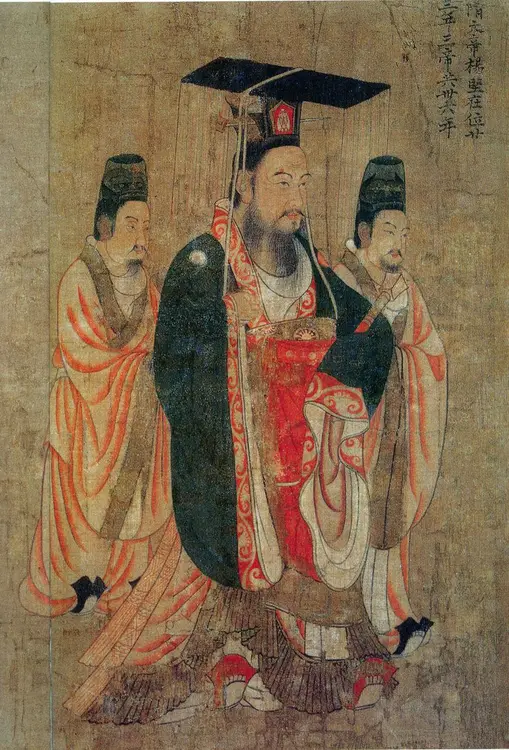

Yang (杨, traditional 楊) is the sixth most common surname in mainland China and the most common in Guizhou province. The character means “poplar” or “willow”. It is pronounced yáng, roughly “yahng” with a rising tone. Its other spellings are Yeung (Hong Kong Cantonese), Yeo, Yeoh or Yo (Hokkien), Yong (Hakka), Dương (Vietnamese), Yang (양, Korean) and sometimes Young, an anglicization. It was the imperial surname of the Sui dynasty (581 to 618).
Meaning of the character 杨 / 楊
Unihan glosses 楊 as “willow, poplar, aspen; surname”. It is a classic phonetic compound: the tree radical 木 gives the meaning, and 昜 (yáng) gives the sound. Simplification turned 昜 into a cursive shape, reducing the character from 13 strokes to 7.
When introducing themselves, speakers often say 木易杨, “wood-yi Yang”. Chinese Wikipedia points out that this is technically wrong: the right side is 昜, not 易 (yì), but the two look alike and the phrase has stuck. A second surname, 揚 Yang, written with the hand radical, was used interchangeably in ancient texts and merged into 楊.
Origin: the state of Yang in Shanxi
Genealogical tradition, summarized by the English and Chinese Wikipedia articles, links the name to Jin, the great state of the Spring and Autumn period in Shanxi:
- The fief of Yang. A small state called Yang lay in what is now Hongdong county, Shanxi. Chinese Wikipedia dates its first grant to around 1040 BC, to a son of Shu Yu of Tang, founder of Jin.
- Boqiao and the Yangshe clan. The main line descends from Boqiao (伯侨), a son of Duke Wu of Jin, of the royal Ji (姬) clan. His descendants formed the Yangshe (羊舌, “sheep’s tongue”) lineage. Shuxiang, a famous Jin minister of that lineage, held the town of Yang, and his line took Yang as its surname. When Jin was partitioned and later conquered, they scattered.
- Southern and non-Han Yangs. Peoples of the south and southwest adopted the name as Han migrants moved south, which helps explain its strength in Guizhou, Yunnan and Sichuan. The sociologist Wolfram Eberhard noted a totemic legend, recorded in the Soushenji, that made the Yangs of southwestern Shu descendants of monkeys.
These are traditional accounts drawn from genealogies, not proven lineages.
Hongnong and the hall of the Four Knowings
The most prestigious branch was the Hongnong Yang (弘农杨氏), based at Huayin in today’s Shaanxi. Its hero is Yang Zhen (楊震), an Eastern Han official. When a visitor tried to bribe him at night with gold, saying no one would know, Yang Zhen answered: “Heaven knows, Earth knows, you know and I know.” Many Yang ancestral halls are still called the Hall of the Four Knowings (四知堂). The Sui imperial family claimed descent from the Hongnong Yang. On hall names in general, see clan associations and hall names.
How Yang is spelled around the world
| Spelling | Source | Example |
|---|---|---|
| Yang | Pinyin and Wade-Giles (identical) | Yang Liwei, Jerry Yang |
| Yeung | Hong Kong Cantonese (joeng4) | Hong Kong families |
| Ieong | Macau (Portuguese-based) | Macau ID cards |
| Yeo, Yeoh, Yo | Hokkien and Teochew | Michelle Yeoh (Malaysia) |
| Yong, Yeong | Hakka | Malaysia, Singapore |
| Dương | Vietnamese | Vietnam |
| Yang (양) | Korean | Korea |
| Young, Yu, Yung | Anglicized and Filipino Chinese spellings | Diaspora |
The Hokkien and Teochew spellings guide explains Yeoh (Iûⁿ in Pe̍h-ōe-jī); the Cantonese forms are in the Hong Kong Cantonese spellings guide. In Korea, the name 양 Yang covers two characters, 楊 and 梁; see Korean surnames and Chinese characters.
Yang in the United States
The 2010 census file:
- Yang: 106,033 people (rank 290), 96.8% Asian or Pacific Islander. Besides Chinese families, this count includes Korean Americans named 양.
- Duong: 24,870 (96.7%), the Vietnamese form.
- Yeung: 7,782 (95.7%); Yung: 4,218; Yong: 3,123; Yeo: 2,805; Yeoh: 321.
- Young: 484,447 people (rank 32), but only 3.0% Asian or Pacific Islander. That is about 14,700 Asian Youngs, some of them Chinese families who anglicized Yang or Yeung; the rest bear the English surname.
- Yu (52,035) and Yan (11,354) appear in the data as variants, but most of them are other surnames, such as 余, 于 or 颜.
Mixed spellings like Young and Yu are why a spelling cannot be turned into a character without context: the US census analysis and the surname finder explain how to handle them.
Distribution in China
Yang is spread across the country but strongest in the southwest: according to Chinese Wikipedia, citing the national ID system, it is the first surname of Guizhou. Nationally it ranked sixth in the 2019 report. See the 100 most common surnames in China for the full list. In the Hundred Family Surnames it is 16th.
Famous people named Yang
- Yang Zhen (楊震, 59 to 124), Eastern Han official of the “Four Knowings”.
- Yang Jian (楊堅, 541 to 604), Emperor Wen of Sui, who reunified China in 589; shown above in Yan Liben’s Thirteen Emperors Scroll.
- Yang Guifei (楊玉環, 719 to 756), consort of Emperor Xuanzong of Tang, counted among the Four Beauties of ancient China.
- Chen-Ning Yang (楊振寧, 1922 to 2025), theoretical physicist, Nobel Prize in Physics 1957.
- Michelle Yeoh (楊紫瓊, born 1962), Malaysian actress and Academy Award winner, an example of the Hokkien spelling.
- Yang Liwei (楊利偉, born 1965), the first person sent into space by China’s space program, in 2003.
- Jerry Yang (楊致遠, born 1968), Taiwanese-born co-founder of Yahoo.
Related surnames and confusions
- 阳 / 陽 Yang and 羊 Yang are separate, much rarer surnames. Vietnamese Dương can also stand for 陽.
- 梁 Liang is written the same way as Korean 양 Yang in one of its two forms.
- Compare with Huang 黄 and Liu 刘, its neighbors in the national ranking, or look up the stroke order of 杨.
Frequently asked questions
What does the surname Yang mean?
The character 楊 means poplar or willow: a tree radical 木 with a phonetic part 昜. As a surname it comes from the name of an ancient state, Yang, in Shanxi, not from the tree.
How do you pronounce Yang?
It is yáng, roughly yahng with the a of father and a rising second tone. It does not rhyme with the English word bang.
Is Yang the same as Yeoh or Yeung?
Yes, when the character is 楊. Yeung is the Hong Kong Cantonese spelling and Yeo or Yeoh the Hokkien one, as in the Malaysian actress Michelle Yeoh, 楊紫瓊.
Is Yang a Korean surname?
Yes, but Korean Yang (양) is written with two different characters: 楊 (poplar), the Chinese Yang, and 梁, which in Chinese is a different surname, Liang. The large Jeju Yang clan uses 梁.
Is the surname Young Chinese?
Usually not. Young is a common English surname: only about 3% of the 484,447 Youngs in the 2010 US Census were Asian or Pacific Islander. Some Chinese families did anglicize Yang or Yeung as Young.
Sources and open data
- Unihan database entry for U+6768 杨, Unicode Consortium
- Frequently Occurring Surnames from the 2010 Census, US Census Bureau
- Yang (surname), English Wikipedia
- 杨姓 (Yang surname), Chinese Wikipedia
- Emperor Wen of Sui, English Wikipedia
- Yang, family name (Q845069), Wikidata