Key facts
- Traditionally a Chinese woman keeps her own surname after marriage; this is still the norm in mainland China and Taiwan.
- The custom of 冠夫姓 guànfūxìng puts the husband's surname in front of the wife's own: Carrie Lam's Chinese name 林鄭月娥 joins Lam and Cheng.
- Mainland China's 1950 Marriage Law gave each spouse the right to use their own name; the prefixed form now survives mainly in genealogies and on tombstones.
- Taiwan's Civil Code required the prefix from 1929 until 1998; since then it is optional, and a 2017 survey found it in about 5% of the population, mostly elderly.
- In Hong Kong, under British influence, some women take the husband's surname in English, as in Anson Chan, born Fang.

In much of the English-speaking world, a woman who marries has long been expected to take her husband’s surname. Chinese custom works the other way. A Chinese woman traditionally keeps her own surname for life, and that is still the norm in mainland China and Taiwan today. A minority add the husband’s surname in front of their own, which produces names such as Lam Cheng Yuet-ngor, but a wife who simply drops her own surname is rare outside Hong Kong and the West.
The traditional rule: husband and wife keep separate surnames
English Wikipedia’s articles on Chinese names and on maiden and married names agree: traditionally, unlike in Anglophone Western countries, a married Chinese woman keeps her name unchanged, without adopting her husband’s surname. Chinese Wikipedia calls this system 夫婦別姓, “husband and wife with different surnames”, and describes it as the Han tradition.
The reason lies in what a surname meant. A surname marked descent from an ancestor, and marriage did not change a woman’s ancestry. Chinese Wikipedia notes that in the earliest period, women were the ones identified by their 姓: names such as 齊姜 and 莊姜 combined a state or title with the woman’s own clan name 姜 Jiang. In later centuries a married woman was referred to by her father’s surname followed by 氏 shì, “née”, as in 王氏 “a woman of the Wang”, or as 某夫人, “Madam so-and-so”.
The husband’s surname could still appear in how she was addressed. From the Wei and Jin dynasties, Chinese Wikipedia explains, a wife could be called by her husband’s surname plus 夫人 as a social title. The poet 謝道韞 Xie Daoyun, married to 王凝之 Wang Ningzhi, was called 王夫人 Lady Wang. This was a form of address, not a change of name: she remained Xie Daoyun.
冠夫姓: adding the husband’s surname
The custom that does change the written name is 冠夫姓 guàn fū xìng, literally “to cap with the husband’s surname”. The wife keeps her own surname and given name and puts her husband’s surname in front of them. Chinese Wikipedia describes older forms written as AB氏 or A門B氏, with A the husband’s surname and B the woman’s own.
| Woman’s own name | Husband’s surname | Married form | Reading |
|---|---|---|---|
| 鄭月娥 Cheng Yuet-ngor | 林 Lam | 林鄭月娥 | Lam Cheng Yuet-ngor |
| 方安生 Fang On-sang | 陳 Chan | 陳方安生 | Chan Fang On-sang |
Both examples come from Hong Kong and are documented by English Wikipedia: Carrie Lam, née Cheng, Chief Executive of Hong Kong from 2017 to 2022, and Anson Chan, née Fang, Chief Secretary from 1993 to 2001. The result looks like a compound surname but is not one. 林鄭 is two family names side by side, and it is not passed on to children, who take a single surname.
Mainland China
The People’s Republic set the principle early. Chinese Wikipedia quotes article 11 of the 1950 Marriage Law: “husband and wife each have the right to use their own surname and given name” (夫妻有各用自己姓名的權利). The present Civil Code keeps a general right of every person to decide, use and change their own name.
As a result, Chinese Wikipedia says, the prefixed form has almost disappeared in mainland China except in genealogies and on tombstones, where a wife may still be recorded under her husband’s surname. It mentions one well-known exception, 薄谷開來 Bo Gu Kailai, a name used on one of the identity cards of Gu Kailai, wife of the politician 薄熙來 Bo Xilai.
English Wikipedia adds two points. Children in mainland China take the father’s surname as a norm, but the marriage law explicitly states that a child may use either parent’s surname, and combining both is possible though far less common; see whose surname a child takes. Among the Chinese diaspora, especially in Southeast Asia, women rarely legally adopt their spouse’s surname.
Taiwan
Taiwan has the clearest legal history, because the Republic of China once made the prefix compulsory. Chinese Wikipedia gives the wording of article 1000 of the Civil Code promulgated in 1929 (民國18年):
- “The wife puts her husband’s surname before her own surname. A husband who marries into the wife’s family puts the wife’s surname before his own. Unless the parties agree otherwise.”
The rule even covered the rarer case of a 贅夫, a man who moved into his wife’s family, whose name then took her surname as a prefix. On 17 June 1998 the article was amended to its current form:
- “Husband and wife each keep their own surname. They may agree in writing to put the spouse’s surname before their own and register it with the household registration office.”
- “The spouse who has added a surname may return to their own surname at any time, but only once during the same marriage.”
The change turned an obligation into an option, and few couples now use it. Chinese Wikipedia cites a 2017 survey that found about 5% of Taiwan’s population with a prefixed surname, mostly older people; 99.8% of them had added the husband’s surname and 0.2% the wife’s. English Wikipedia describes the same pattern: Taiwanese women generally keep their surnames, while some older women have the husband’s surname tagged on to theirs, as was common in the early to mid-20th century. Chinese Wikipedia gives 胡石清, 厲耿桂芳 and 連方瑀 as examples of women with a prefixed surname.
Hong Kong and Macao
Hong Kong is where the custom is most visible today. English Wikipedia attributes it to British influence: some women in Hong Kong change their English last name, or put their husband’s Chinese surname in front of their own on official occasions or business cards, but rarely on identity cards or travel documents.
Chinese Wikipedia observes that the women who use the prefix on formal occasions are mostly government officials, wives of Chief Executives, former public servants and women of prominent families. In English, it adds, these women follow British practice and use the husband’s surname alone, with the title 太太 “Mrs” in Chinese. That explains the double form of the two names above:
- Chinese: 林鄭月娥, both surnames, the husband’s first.
- English: Carrie Lam, an English given name and the husband’s surname only.
For the Cantonese spellings themselves, such as Cheng for 鄭 and Chan for 陳, see Hong Kong Cantonese spellings. For which name a woman uses on official documents, see Chinese names on passports.
Korea, Vietnam and Japan
Chinese Wikipedia states that in East Asia, only Japan has a policy of taking the husband’s surname. Korean and Vietnamese wives traditionally keep their own surnames, like Chinese wives. In Vietnam, Chinese Wikipedia notes, a wife was traditionally addressed as “Madame” plus her husband’s given name, never his surname.
Japan went the other way in the 19th century. Chinese Wikipedia explains that Japan had no such custom before the Meiji era, but its 1898 family register law required every household to have one fixed surname, with the wife taking the husband’s. The postwar Civil Code lets a couple choose either spouse’s surname, but they must share one, and Chinese Wikipedia reports that 96% of women take the husband’s. Japan’s Supreme Court upheld the single-surname rule in 2015. This is why a Japanese wife’s name usually changes at marriage and a Chinese wife’s does not.
Addressing a married Chinese woman
In practice, the safest form follows from the customs above:
- Use her own surname. A woman from mainland China or Taiwan is Ms Zhang or Dr Zhang under her own surname, whatever her husband’s name. “Mrs” plus the husband’s surname is wrong unless she uses it.
- Follow her own usage. A Hong Kong woman who signs Mrs Chan, or a woman abroad who has taken her husband’s surname, should be called by that name.
- Read a double surname correctly. In a Hong Kong name like Lam Cheng Yuet-ngor, the first surname is the husband’s and the second her own. Index her under the name she uses in English.
The general rules for the order of names and for titles are on the page surname first, and the name order formatter shows the forms a name can take in English.
About the image
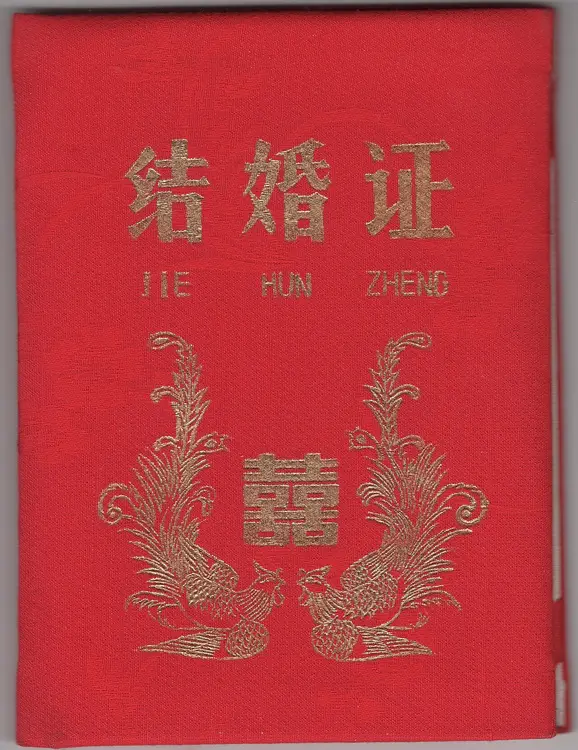
The image at the top of this page is the cover of a marriage certificate from mainland China, issued around 1984, according to its Commons description. The red cloth cover bears the words 结婚证, with the pinyin JIE HUN ZHENG, “marriage certificate”, and the character 囍, “double happiness”, used at weddings. In mainland China, the law cited above leaves each spouse their own name after the wedding.
Frequently asked questions
Do Chinese women change their surname when they marry?
Usually not. Traditionally a married woman keeps her name unchanged, and this is still the norm in mainland China and Taiwan. Some women add their husband's surname in front of their own, a custom called 冠夫姓, but it has become rare except in Hong Kong and among older women in Taiwan.
Why is Carrie Lam called Lam Cheng Yuet-ngor?
Her own surname is Cheng 鄭 and her given name Yuet-ngor 月娥. When she married Lam Siu-por, she put his surname Lam 林 in front of hers, giving 林鄭月娥 Lam Cheng Yuet-ngor. In English she is Carrie Lam, with her husband's surname only, following British usage.
Should I call a Chinese married woman Mrs plus her husband's surname?
Not by default. A woman from mainland China or Taiwan normally keeps her own surname, so Ms plus her own surname is correct. Use her husband's surname only if she uses it herself, as some women do in Hong Kong or in Western countries.
What surname do children take in China?
In practice the father's surname, but the law in mainland China explicitly allows a child to take either parent's surname, and combining both is possible though rare. Taiwan also lets parents choose. The guide to a child's surname covers the rules in more detail.
Is a Chinese woman's prefixed surname a compound surname?
No. 林鄭 in 林鄭月娥 is two separate surnames, the husband's and the wife's, joined by marriage. A compound surname such as 歐陽 Ouyang is a single inherited family name passed down from parent to child.
Sources and open data
- Chinese name, English Wikipedia
- 婚後姓名, Chinese Wikipedia
- Maiden and married names, English Wikipedia
- Carrie Lam, English Wikipedia
- Anson Chan, English Wikipedia