Key facts
- Mark B. Wise was born in Montreal on 9 November 1953 and died on 10 July 2026, aged 72, according to Caltech.
- He took his PhD at Stanford in 1980 and joined Caltech in 1982, becoming a full professor in 1985 and the John A. McCone Professor of High Energy Physics in 1992.
- His best-known work is the 1989 heavy quark effective theory, developed with Nathan Isgur, which simplifies calculations in quantum chromodynamics.
- In 1983 he proposed with John Preskill and Frank Wilczek that axions could make up dark matter.

Mark B. Wise was a theoretical particle physicist at the California Institute of Technology (Caltech) for four decades. Born in Montreal on 9 November 1953, he died on 10 July 2026 at the age of 72, according to Caltech’s obituary. He is best known for work on how quarks bind into particles, in particular heavy quark effective theory, and for an early proposal that axions could be dark matter. This note summarizes his career from the Caltech obituary, a remembrance by his colleague John Preskill, and Wikipedia. It is part of the science notes.
Early life and education
Caltech’s obituary says Wise was raised in Montreal by his mother, with a brother and a sister, and that he grew up poor. He was a poor student until he turned things around in grade nine. He earned a BSc in 1976 and an MSc in 1977 at the University of Toronto, then a PhD at Stanford in 1980 under Fred Gilman at SLAC.
Preskill’s post adds a detail: Wise was rejected by US PhD programs on his first attempt, and then did a master’s in Toronto, where he was influenced by Nathan Isgur. Isgur later became his most important collaborator.
Career at Caltech
After the PhD, Wise was a junior fellow of the Harvard Society of Fellows from 1980 to 1983. Caltech says Murray Gell-Mann and David Politzer recruited him in 1982. Wikipedia gives 1983 for the start of his assistant professorship, while Caltech and Preskill say 1982, and this note follows Caltech.
| Year | Step |
|---|---|
| 1953 | Born in Montreal, 9 November |
| 1976 and 1977 | BSc and MSc, University of Toronto |
| 1980 | PhD, Stanford |
| 1980 to 1983 | Junior fellow, Harvard Society of Fellows |
| 1982 | Assistant professor, Caltech |
| 1984 | Associate professor |
| 1985 | Professor |
| 1992 | John A. McCone Professor of High Energy Physics |
| 2026 | Died, 10 July |
Caltech notes that he was tenured at 31. He served as principal investigator of Caltech’s high energy physics program for 16 years, and sat on the US Department of Energy’s P5 panel in 2013, which advises on particle physics priorities. Wikipedia credits him with supervising more than three dozen PhD students.
Heavy quark effective theory
Caltech calls his work with Nathan Isgur in 1989 his greatest legacy. The problem was how to calculate the properties of hadrons that contain a heavy quark, such as the bottom or charm quark, using quantum chromodynamics (QCD), the theory of the strong interaction. QCD is difficult to solve directly. The insight was that when a quark is very heavy, its motion barely changes as it interacts with the light quarks and gluons around it, so heavy quarks can be lumped together, which simplifies the calculation.
Wikipedia’s article on the subject describes the theory as the limit of QCD in which the quark mass is taken to infinity at fixed four-velocity. It was formalized in 1990 by Georgi, Eichten and Hill, building on the work of Isgur and Wise and of Voloshin and Shifman. Wise later co-wrote a textbook, Heavy Quark Physics, with Aneesh Manohar, published by Cambridge University Press in 2000.
Axions and cosmology
In 1983, Wise, Preskill and Frank Wilczek proposed that axions, hypothetical light particles, could be produced in the early universe in amounts large enough to account for dark matter. Wikipedia adds two related items: a 1981 paper on the invisible axion with Howard Georgi and Sheldon Glashow, and a 1984 paper with Larry Abbott on constraints on inflation.
Wikipedia lists a 1998 paper on nuclear effective field theory with David Kaplan and Martin Savage, which applied the effective-theory approach to the forces between nucleons.
Outside physics
From 2000, Wise consulted for the investment firm PIMCO with Vineer Bhansali. He wrote a paper on mortgage prepayments there, and Wikipedia lists a book on fixed income finance with Bhansali (McGraw Hill, 2010). Wikipedia also records that he was a consultant on the film Iron Man 2, released in 2010.
Teaching
Caltech describes a distinctive teaching style. He gave students quarters for correct answers in class. A student account on X, @MarkWiseSays, started in 2010, collected his sayings, which were known as the “Wisecracks”. Preskill, who knew him as a colleague for decades, calls him “one of the most influential figures in theoretical particle physics of his generation”. The American Institute of Physics interviewed him for its oral history collection in 2021.
Honors
Wikipedia lists the following recognitions:
- the 2001 J. J. Sakurai Prize of the American Physical Society, shared with Isgur and Voloshin;
- fellowship of the AAAS in 2002, fellowship of the APS in 2003 and the National Academy of Sciences in 2007;
- the Julius Wess Award in 2021.
Caltech’s obituary says he was survived by his wife Jackie and sons Barry and Jonathan.
Where his ideas show up
Wise’s field connects to several other notes on this site. The mathematics of heavy quarks belongs to the same tradition of simplifying hard problems that runs back to the Florentine experimenters in the physicists of Florence. Preskill, the author of the remembrance cited here, introduced the term “quantum supremacy”, discussed in has quantum advantage been achieved? and its second part. A different statistical idea of how order arises from many particles appears in the note on entropy.
What is not covered
This note relies on two sources written within two weeks of his death, the Caltech obituary and Preskill’s post, plus Wikipedia. It does not describe his research results beyond the level those sources give, and it leaves out personal details they do not report. Where Wikipedia and Caltech disagree, as with the year he started at Caltech, the Caltech version is used.
About the image
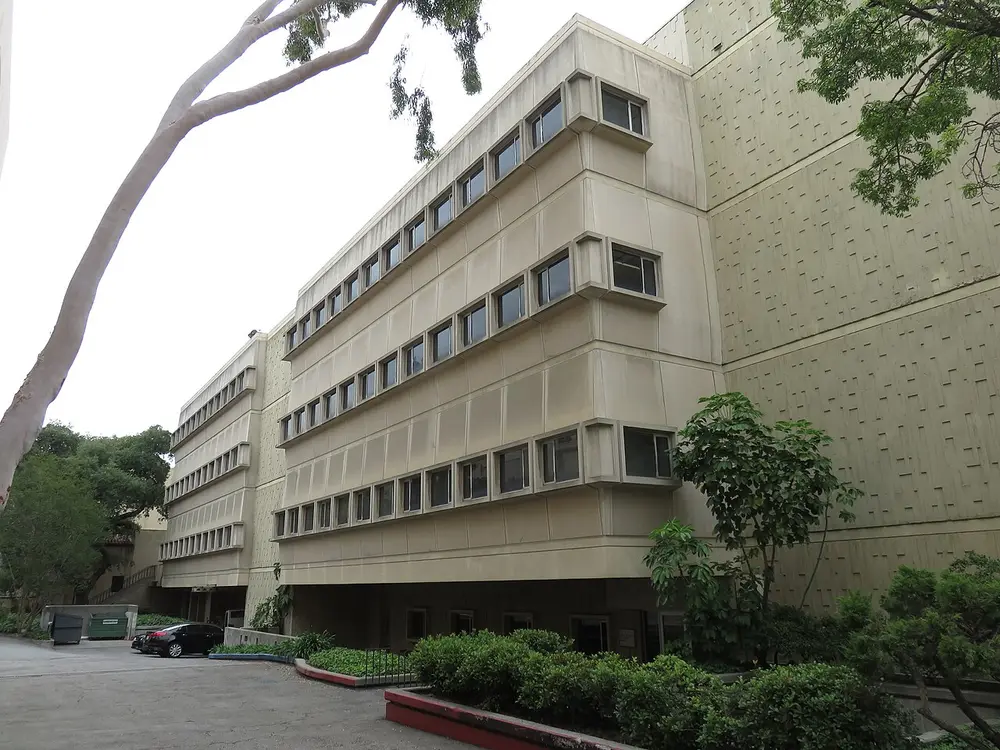
The image shows the Downs and Lauritsen Laboratories at Caltech in Pasadena, California, a building of the campus where Wise worked from 1982. It was chosen as a neutral view of the institution rather than a portrait.
Frequently asked questions
Who was Mark Wise?
Mark B. Wise was a Canadian-born theoretical physicist at the California Institute of Technology, where he held the John A. McCone Professorship of High Energy Physics. He worked on the strong interaction, flavor physics and dark matter.
What is heavy quark effective theory?
It is a simplification of quantum chromodynamics for hadrons containing a heavy quark such as bottom or charm. The heavy quark mass is taken to be very large at fixed velocity, so the quarks can be lumped together and calculations become tractable. Wise and Nathan Isgur developed the key results in 1989.
When did Mark Wise die?
Caltech reports that he died on 10 July 2026 at the age of 72. His former colleague John Preskill also published a remembrance on 18 July 2026.
What prizes did Mark Wise win?
Wikipedia lists the 2001 J. J. Sakurai Prize of the American Physical Society, shared with Nathan Isgur and Mikhail Voloshin, fellowship of the AAAS in 2002, APS fellowship in 2003, the National Academy of Sciences in 2007 and the Julius Wess Award in 2021.
Sources and open data
- Caltech mourns the passing of Mark B. Wise (1953 to 2026), Caltech
- My friend Mark Wise, Quantum Frontiers
- Mark B. Wise, English Wikipedia
- Heavy quark effective theory, English Wikipedia