Key facts
- A Chinese name is written surname first: in 王秀英 Wang Xiuying, Wang is the family name and Xiuying the given name.
- Western publications usually keep this order for people from mainland China, Taiwan and Hong Kong: Xi Jinping, not Jinping Xi.
- In pinyin the name is two words: Wang Xiuying, not Wang Xiu Ying; Taiwan and Hong Kong hyphenate the given name, as in Ma Ying-jeou.
- A title goes with the surname: Mr Wang, Ms Chen, Teacher Li. In Chinese, Lao Wang and Xiao Zhang are friendly forms built on the surname.
- When the order is uncertain, write the surname in capitals, as in WANG Xiuying, or use the name order formatter.
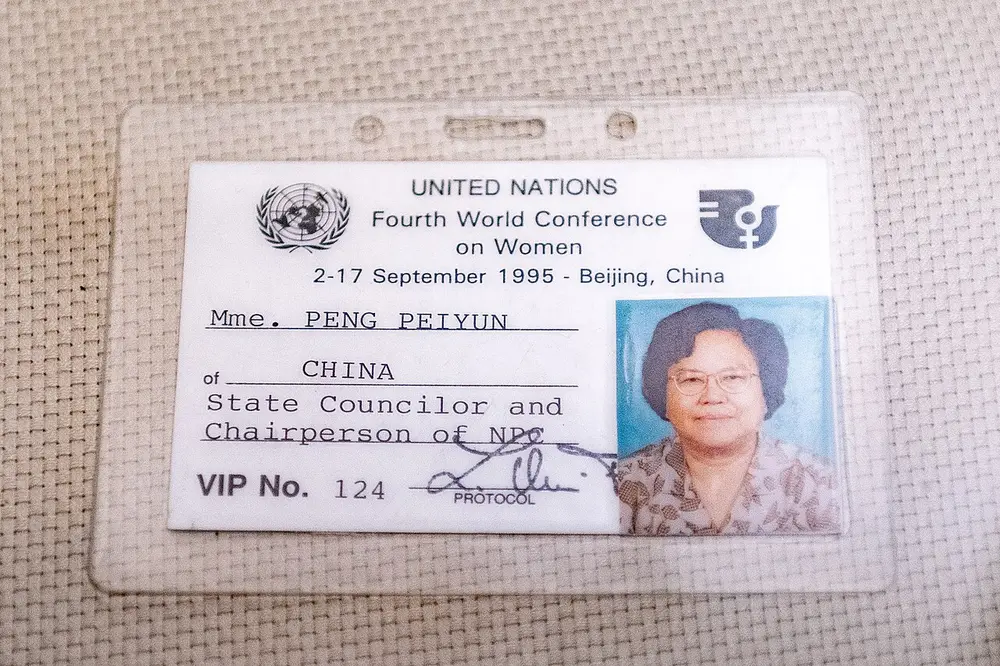

Every Chinese name starts with the family. In 王秀英, read Wang Xiuying, 王 Wang is the surname and 秀英 Xiuying the given name; in 毛泽东 Mao Zedong, Mao is the surname. The order never changes in Chinese, and it is the same in Korean and Vietnamese. In English, however, the same person may appear as Wang Xiuying, Xiuying Wang, WANG Xiuying or Wang, X., and that variety is the source of most mistakes with Chinese names.
The order in Chinese
A Chinese name has two parts:
- the surname (姓 xìng), almost always one character, sometimes two in compound surnames such as 欧阳 Ouyang or 司马 Sima;
- the given name (名 míng), usually one or two characters.
The surname comes first because it identifies the family, and the given name then distinguishes the person within it. The same logic appears in other East Asian names, and in Europe in Hungarian names. English Wikipedia’s article on personal names describes the given name as coming “after the family name” in “some East Asian cultures and Hungary”, while most European cultures put it before.
Because a three-character name has no spaces in Chinese, the boundary between the two parts is clear to a Chinese reader, who knows the common surnames. A reader of English does not, which is why the written form matters.
How Western publications write Chinese names
English Wikipedia notes that Western publications usually keep the Chinese order for people from mainland China: Xi Jinping, Li Keqiang, Wang Yi. The same applies to Taiwan (Ma Ying-jeou, Tsai Ing-wen) and to Korea (Moon Jae-in). Japanese names were long an exception, reversed to put the surname last. In May 2019, Japan’s foreign minister Taro Kono asked foreign media to write the prime minister’s name as Abe Shinzo, arguing that “if you can write Moon Jae-in and Xi Jinping in correct order, you can surely write Abe Shinzo the same way”. Japan’s education ministry adopted the surname-first order for its official English documents in September 2019, and in 2020 The Economist and NHK World-Japan followed.
People who live abroad often make the opposite choice. Many Chinese students, researchers and emigrants put their given name first on Western forms, publications and business cards, and some adopt an English given name. English Wikipedia notes that among the Chinese diaspora in Western countries it is becoming common for parents to register a Western first name and keep the Chinese given name as a middle name. The name order formatter shows all these forms side by side.
Writing the name correctly
One word for the given name
The pinyin rules treat a name as two words: Wang Xiuying, not Wang Xiu Ying, Wang XiuYing or Wangxiuying. A compound surname is also one word: Sima Qian, not Si Ma Qian. English Wikipedia points out that many Chinese people do not know these rules and put a space between every character, so that Western readers take the name for three words and may treat the middle syllable as a middle name.
Hyphens in Taiwan and Hong Kong
Taiwan and Hong Kong traditionally join the syllables of the given name with a hyphen, the second one in small letters: Ma Ying-jeou, Tony Leung Chiu-wai. The hyphen comes from the Wade-Giles system, where Mao Zedong was written Mao Tse-tung. Hong Kong identity cards, on the other hand, separate the syllables with a space, as in “KUO, Chi Yung Peter”. Singapore and Malaysia also often use spaces: Goh Chok Tong, Lee Chong Wei. For the person in question, the passport spelling is the one to follow; see Chinese names on passports.
The surname in capitals
Writing the surname in capitals shows which part it is, whatever the order: WANG Xiuying or Xiuying WANG. The practice is common on conference badges, in international organisations and in French usage. The delegate card shown at the top of this page, from the United Nations Fourth World Conference on Women held in Beijing in 1995, is made out to “Mme. PENG PEIYUN”: Peng is the surname, written first, and Peiyun the given name. Peng Peiyun (彭珮云) was then a member of China’s State Council, as the card states.
Addressing a Chinese person
The title always goes with the surname:
| Situation | Correct | Incorrect |
|---|---|---|
| Letter or meeting | Mr Wang, Ms Chen, Dr Liu | Mr Xiuying, Ms Wei |
| A married woman from mainland China or Taiwan | Ms plus her own surname | Mrs plus her husband’s surname, unless she uses it |
| Chinese, formal | 王老师 Wang Laoshi, “Teacher Wang” | |
| Chinese, friendly | 老王 Lao Wang, 小张 Xiao Zhang |
English Wikipedia notes that, in Chinese, “Teacher Surname” is often considered more respectful than “Mr”, “Mrs” or “Miss” plus the surname, and that Lǎo (“old”) and Xiǎo (“young”) followed by the surname are common ways to call acquaintances; lǎo carries no disrespect. Unlike English speakers, Chinese speakers often call friends by their full name, surname included, especially when it has only two or three syllables.
Women in mainland China and Taiwan normally keep their own surname after marriage. Hong Kong and Macau show some Western influence: English Wikipedia gives the example of Lam Cheng Yuet-ngor, whose own surname was Cheng and who added her husband’s surname Lam in front of it. The guide to married women and surnames covers these customs. Historical figures may also be known by other names, such as a courtesy name, which never replaces the surname.
Indexing, sorting and citing
Lists, indexes and bibliographies sort people by surname, so the surname must be identified before anything else.
- Indexes. The Chicago Manual of Style, as summarised by English Wikipedia, indexes Chinese names under the family name with no inversion and no comma: “Mao Zedong”, not “Zedong, Mao” or “Mao, Zedong”. A person with a Western given name is inverted like a Western name: “Leung, Tony”.
- Reference lists. APA and MLA invert every author’s name, so a Chinese author appears as Wang, X. (APA) or Wang, Xiuying (MLA). The risk is inverting a name that was already printed surname first, which gives “Xiuying, W.”.
- Databases and forms. Use separate fields for the surname and the given name rather than one “full name” field, and do not assume that the last word is the surname.
When the order is unclear
Some names cannot be read without knowing the person. Wang Li and Li Wang are both possible names, since Wang and Li are both very common surnames, and a single-character given name makes the problem worse. English Wikipedia notes that names with a single given name, or a compound surname and a single given name, are the most easily confused. In practice:
- Look for a clue: capitals, a comma, a hyphen in the given name (it marks the given name), or a known surname. The surname finder tells you whether a spelling is a common Chinese surname.
- Check the person’s own usage: their signature, website, publications or passport.
- If you write the name yourself, put the surname in capitals or say which part is the surname.
- If you have the characters, the first character is the surname, or the first two for a compound surname. The Chinese name to pinyin tool gives the spelling of each part.
Frequently asked questions
Is the first word of a Chinese name the surname?
In a name written the Chinese way, yes: in Zhang Wei, Zhang is the surname. But many Chinese people living or studying abroad reverse their name to fit Western forms, so Wei Zhang is also common. A surname in capitals, a comma (Zhang, Wei) or the person's own usage settles the question.
Why do newspapers write Xi Jinping but used to write Shinzo Abe?
English-language publications have long kept the Chinese and Korean order, surname first, but reversed Japanese names. Japan asked for the change in 2019, and from 2020 several media, such as The Economist and NHK World-Japan, began writing Japanese names surname first as well.
How should I address a Chinese colleague?
Use a title with the surname: Mr Liu, Ms Huang, Dr Zhao. Do not combine a title with the given name. Women in mainland China and Taiwan normally keep their own surname after marriage, so Ms plus her own surname is correct. In Chinese, Teacher plus surname is often more respectful than Mr or Ms.
Should I write Wang Xiu Ying or Wang Xiuying?
In pinyin the given name is one word: Wang Xiuying. Many Chinese people put a space between every syllable, which makes Western readers think the name has three parts. Taiwan and Hong Kong traditionally use a hyphen instead: Wang Hsiu-ying in Wade-Giles. Follow the spelling on the person's passport.
How do I index or cite a Chinese name?
Sort it under the surname. The Chicago Manual of Style indexes Chinese names under the family name with no inversion and no comma, for example Mao Zedong, unless the person uses a Western given name. APA and MLA reference lists put the surname first followed by a comma: Wang, X. or Wang, Xiuying.
Sources and open data
- Chinese name, English Wikipedia
- Personal name, English Wikipedia
- Japanese name, English Wikipedia
- Peng Peiyun, English Wikipedia