Key facts
- Korean surnames are written in hangul but have hanja (Chinese characters): Kim 金, Lee 李, Park 朴, Choi 崔, Jung 鄭.
- In the 2015 census Kim, Lee and Park together were 44.6% of South Koreans; Kim alone was 10,689,959 people (21.5%).
- A Korean clan is a surname plus a bon-gwan (ancestral seat): Gyeongju Kim and Gimhae Kim are different families.
- Romanization is not fixed: a 2007 study of 63,000 passports found Lee 98.5%, Yi 1%, Rhee 0.2%, and Jung split between Jung, Jeong and Chung.
- Several Korean surnames are also Chinese surnames: 崔 is Choi in Korean and Cui in Chinese, 鄭 is Jung or Jeong and Zheng.
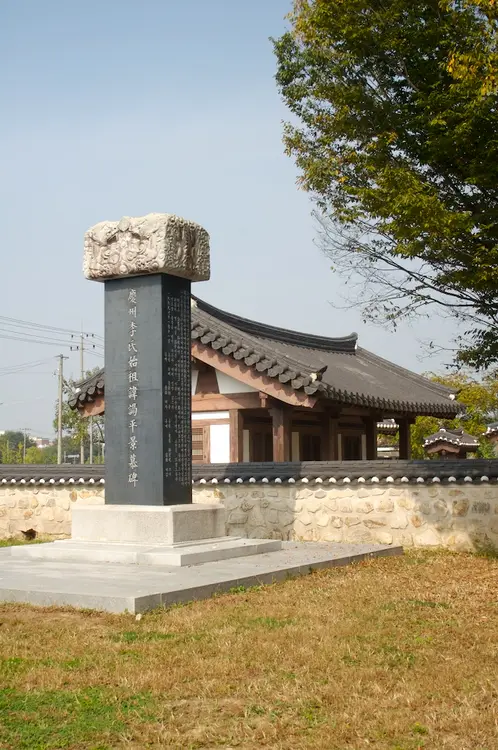

Korean surnames are written in the hangul alphabet, but nearly all common ones also have a hanja form, a Chinese character. The five most common are Kim (金), Lee (李), Park (朴), Choi (崔) and Jung (鄭). Their English spellings vary, and the same character can be a Chinese surname with a different sound: 李 is Lee or Yi in Korean and Li in Mandarin, and 崔 is Choi in Korean and Cui in Mandarin.
Common Korean surnames and their hanja
Counts come from the 2015 South Korean census as given on the English Wikipedia pages for each surname.
| Hangul | Hanja | Common romanizations | People (2015) |
|---|---|---|---|
| 김 | 金 | Kim | 10,689,959 (21.5%) |
| 이 | 李 | Lee, Yi, Rhee | 7,306,828 (14.7%) |
| 박 | 朴 | Park, Pak, Bak | 4,192,074 (8.4%) |
| 최 | 崔 | Choi, Choe, Chwe | about 2.3 million (4.7%) |
| 정 | 鄭, 丁, 程 | Jung, Jeong, Chung | 2,407,601 (4.84%) |
Jung is the one with several characters. English Wikipedia counts 2,151,879 people for 鄭, 243,803 for 丁 and 11,683 for 程. The first, 鄭, is Zheng in Mandarin. Together Kim, Lee and Park made up 44.6% of the population in 2015, and the top ten were Kim, Lee, Park, Choi, Jeong, Kang, Jo, Yoon, Jang and Lim.
How many Korean surnames are there?
Far fewer than in China. English Wikipedia reports 286 surnames and 4,179 clans in the 2000 census. The 2015 census recorded 5,582 distinct surnames, 73% of them with no corresponding hanja. For the Chinese comparison, see how many Chinese surnames exist.
Surnames were not universal. English Wikipedia says that before 1910 more than half of Koreans had no surname, and that the class system was abolished in 1894.
What is a bon-gwan (clan seat)?
A Korean clan is the combination of a bon-gwan (본관, also spelled bongwan) and a surname. The bon-gwan is the clan’s ancestral seat, usually a place name. It passes through the father.
English Wikipedia gives a clear example: Gyeongju Kim and Gimhae Kim are different families that share a surname. The Gimhae Kim trace their descent to Kim Suro. The system was adapted from the Chinese one and began at the end of the Silla period and the start of Goryeo. For the Chinese list of common names, see the Hundred Family Surnames.
Marriage within the same clan was illegal in South Korea until 2005, according to English Wikipedia.
Kim 金, Lee 李, Park 朴: the big three
Kim (金). 21.5% of South Koreans, and 99.3% of them romanize it Kim in the passport study below. The character also means gold.
Lee (李). About 14.7%. English Wikipedia says the surname was once Ni (니) and became I (이) in 1933. It lists about 241 clans, with Jeonju and Gyeongju among the largest. The Jeonju Yi produced Yi Seong-gye, founder of the Joseon dynasty, which lasted 518 years from 1392 to 1910. The Gyeongju Yi appear in the photo at the top of this page, where the monument names a clan founder in hanja.
Park (朴). About 8.4%. The same source ties the surname to the legend of King Hyeokgeose of Silla, and says that 70 to 80% of Parks belong to the Miryang clan. It counts 314 clans in 2015.
Why Lee is also Yi or Rhee: romanization systems
South Korea’s official system is Revised Romanization, published on 7 July 2000 by the Ministry of Culture. It replaced a variant used from 1984 to 2000. McCune-Reischauer, published in 1939, is the other major system, and a variant is official in North Korea. The Revised system would write 이 as I; passport spellings in the table below show that many people use other forms.
A 2007 National Institute of Korean Language examination of 63,000 passports, summarized on English Wikipedia, shows how much variation survives:
| Surname | Main spelling | Other spellings |
|---|---|---|
| 김 | Kim 99.3% | Gim 0.6%, Ghim 0.01% |
| 이 | Lee 98.5% | Yi 1%, Rhee 0.2% |
| 박 | Park 95.9% | Bak 1.8%, Pak 1.7% |
| 최 | Choi 93.1% | Choe 6.5%, Choy 0.09% |
| 정 | Jung 48.6% | Jeong 37%, Chung 9.2% |
The same article says passports use a modified Revised Romanization (Shin rather than Sin), and that since December 2004 given names are written joined by default. English Wikipedia adds that the institute recommended Yi for 이 in 2001. Other variants such as Ri (North Korean McCune-Reischauer) and Tsoi or Tsoy for Choi in the former Soviet Union also exist. For passports in general, see Chinese names on passports.
Korean, Chinese and Vietnamese readings of one character
A single hanja is read differently in each language. 黃 is Hwang in Korean, Huáng in Mandarin and Hoàng or Huỳnh in Vietnamese. 范 is Beom (or Pom) in Korean and Fàn in Mandarin. The Vietnamese page shows the same mapping from the Vietnamese side, and pinyin for names covers the Mandarin side.
The Korean reading of a character is not a guide to the Chinese one. Use the character to move between languages, and use the surname finder when you have only a spelling.
Hanja and hangul
English Wikipedia says hangul was promulgated in 1446 by King Sejong. Hangul is the everyday script, yet a Korean surname still has a hanja form, which is what ties it to the Chinese character and to the other languages that use it.
Names and marriage in Korea
Korean women keep their own surname after marriage, and since 1 January 2008 children may take the surname of either parent, according to English Wikipedia. The usual order is surname first, as in China (name order).
Checklist for a Korean name
- Identify the hangul and hanja before choosing an English spelling.
- Ask for the clan seat (bon-gwan) if you are doing genealogy: the surname alone is not enough.
- Keep the spelling on the passport for official forms, even if it is not the Revised Romanization.
- Do not assume a Korean surname is Chinese because it has a hanja.
Frequently asked questions
What is the Chinese character for the Korean surname Kim?
Kim is written 김 in hangul and 金 in hanja. The character also means gold, and it can be read geum in Korean when it is not a surname, according to English Wikipedia.
Is Lee the same as Yi or Rhee?
Yes, all three are romanizations of 이 (李). A 2007 study of passports found 98.5% used Lee, 1% Yi and 0.2% Rhee, according to English Wikipedia.
What is a bon-gwan?
A bon-gwan (bongwan) is the ancestral seat of a Korean clan, placed before the surname to name the clan, such as Gimhae Kim. English Wikipedia says two clans with the same surname but different seats are different families.
Are Korean surnames Chinese?
They are written with Chinese characters, and the clan system was adapted from the Chinese one, but they are read in Korean. English Wikipedia says that 73% of the 5,582 distinct surnames counted in 2015 had no corresponding hanja.
Do Korean women change surname when they marry?
No. English Wikipedia says Korean women keep their own surname after marriage. Since 1 January 2008 children may also take the surname of either parent.
Sources and open data
- Korean name, English Wikipedia
- Korean clans, English Wikipedia
- Kim (Korean surname), English Wikipedia
- Lee (Korean surname), English Wikipedia
- Jeong (Korean surname), English Wikipedia
- Revised Romanization of Korean, English Wikipedia