Key facts
- Cui is written 崔 (11 strokes, mountain radical 山) in both simplified and traditional Chinese; it means high, lofty.
- It is pronounced cuī, roughly "tsway", and ranked 55th in mainland China in 2019.
- The Cui clans of Boling and Qinghe were among the most prestigious families of Tang China.
- In Korea the same character is Choi (최), held by about 2.3 million people in 2015, roughly 4.7% of South Koreans.
- The 2010 US Census counted 50,786 people named Choi (mostly Korean), 3,520 Cui and 3,168 Tsui.
崔
Pinyin: Cuī
Same character in simplified and traditional: 崔
Rank in mainland China: 55 of the top 100 (Ministry of Public Security, 2019 report)
Characters and spellings of 崔
| Unicode code point | U+5D14 |
|---|---|
| Stroke count | 11 |
| Radical (simplified form) | No. 46 ⼭, plus 8 strokes |
| Dictionary meaning (Unihan) | high, lofty, towering; surname |
Romanizations by Chinese language
| Language | System | Spelling |
|---|---|---|
| Mandarin | Hanyu Pinyin (PRC standard) | Cuī |
| Mandarin | Wade-Giles (Taiwan, older English texts) | Ts'ui |
| Cantonese | Jyutping (Unihan) | ceoi1 |
| Cantonese | Hong Kong / common spellings | Chui, Choi |
| Hokkien (Min Nan) | Pe̍h-ōe-jī and common spellings | Chhui, Chui, Chwee |
| Hakka | Pha̍k-fa-sṳ and common spellings | Tshûi, Chooi |
| Gan | Romanization and common spellings | Chhoi |
| Wu (Shanghainese) | Romanization and common spellings | Tsoe, Tseu |
Equivalent surnames in other languages
| Language | Form |
|---|---|
| Vietnamese | Thôi |
| Korean | Choi (최) |
| Japanese | Sai |
| Misc | Tseui |
These spellings in the 2010 US Census
| Spelling | People | US rank | Asian / Pacific Islander |
|---|---|---|---|
| CHOI | 50,786 | 674 | 96.09% |
| CUI | 3,520 | 9,251 | 94.77% |
| TSUI | 3,168 | 10,180 | 94.48% |
| CHUI | 1,420 | 19,138 | 92.89% |
| THOI | 252 | 76,275 | 93.25% |
Counts are people recorded with each spelling among the 265,667,228 people with a surname shared by at least 100 people (US Census Bureau, 2010, public domain). A spelling is not proof of Chinese origin: the last column shows the share of bearers who identified as Asian or Pacific Islander. Together these spellings total 59,146 people, but some of them belong to unrelated surnames (for example English Lee, Hmong Vang or Vietnamese Ly). Search any spelling with the US census surname lookup.
Stroke order
Animation by the open-source Hanzi Writer library (MIT) with stroke data from Make Me a Hanzi (Arphic Public License). Stroke order tool for any character.

Cui (崔) is a Chinese surname meaning “high, lofty, towering”. It is pronounced cuī, roughly “tsway” on a high level tone. It is spelled Tsui (from Wade-Giles Ts’ui) or Chui in Hong Kong, Thôi in Vietnamese, and Choi (최) in Korean, where it is one of the most common surnames of all. It ranked 55th in mainland China in 2019, with the largest numbers in Shandong, Henan and the northeast.
Meaning of the character 崔
崔 has 11 strokes: the mountain radical 山 (radical 46) above 隹, the “short-tailed bird” component. Unihan glosses it “high, lofty, towering; surname”. It was not simplified, so the same form is used everywhere.
Pinyin c is the most misread letter in Chinese names. It is not a k or an s: it is the ts of “cats”, with a puff of air. That is why Wade-Giles wrote the name Ts’ui and why older English spellings are Tsui or Tsway. The pinyin guide for names covers these traps.
Origin: the Cui estate in Qi
English and Chinese Wikipedia agree on the traditional account. Jizi (季子), the eldest son of Duke Ding of Qi and grandson of Jiang Ziya, was the heir apparent but gave up his claim in favor of his younger brother, later Duke Yi. He retired to the estate of Cui (崔邑), in today’s Zhangqiu, Shandong, and his descendants took its name. The surname is therefore counted among the branches of the ancient Jiang 姜 clan, like Lu 卢.
Under the Qing dynasty, Manchu clans such as the Cuigiya (崔佳氏) and a Mongol clan adopted Cui as their Chinese surname, and it is also found among the Tujia, Yi and Hui peoples. These are traditional and genealogical accounts.
The great Cui clans of the Tang
Two Cui lineages became symbols of aristocratic status: the Cui of Boling (博陵崔氏) and the Cui of Qinghe (清河崔氏), both in today’s Hebei. Under the Tang dynasty they ranked among the “seven great surnames”, with the Lu of Fanyang, the Zheng of Xingyang, the Wang of Taiyuan and the Li of Zhao and Longxi. In 659 Emperor Gaozong banned marriages between these families to curb their power. English Wikipedia notes that the ban was quietly flouted: the poet Wang Wei was the son of a Boling Cui mother and a Taiyuan Wang father.
The two clan names survive as hall names (堂号), Qinghe Tang and Boling Tang; see clan associations and hall names.
Choi: Cui in Korea
The Korean surname Choi (최) uses the same character. English Wikipedia gives about 2.3 million Chois in the 2015 South Korean census, roughly 4.7% of the population, making it the 4th most common Korean surname. There are about 160 clans (bon-gwan). The largest, the Gyeongju Choi (976,820 people in 2000), claims the Silla scholar Choe Chiwon (崔致遠, born 857) as its founder; Korean legend links the name to one of the six villages that formed Silla. Chinese and Korean Cui/Choi families have separate genealogies. See the Korean surnames guide.
How Cui is spelled
| Spelling | Where it comes from | Example |
|---|---|---|
| Cui | Hanyu Pinyin | Cui Jian, rock musician |
| Tsui / Ts’ui | Wade-Giles | Daniel Tsui, physicist |
| Chui | Hong Kong Cantonese | |
| Choi | Korean (최); also Cantonese in Macau and Malaysia | |
| Tsoi / Tsoy | Russian transcription, for Koreans of the former USSR | |
| Thôi | Vietnamese |
Choi is a trap in Hong Kong: there it usually means Cai 蔡, as in the singer Charlene Choi (蔡卓妍). Only the character settles it. Try the surname finder.
Cui in the United States
2010 US Census counts:
- Choi: 50,786 people, 96.1% Asian or Pacific Islander, overwhelmingly Korean, with some Cantonese 蔡.
- Cui: 3,520 people, 94.8%.
- Tsui: 3,168 people, 94.5%.
- Chui: 1,420 people, 92.9%.
- Thoi: 252 people, Vietnamese.
So for every American spelled Cui there are about 14 spelled Choi, a ratio that reflects Korean, not Chinese, immigration. The US census analysis has more comparisons.
Famous people named Cui
- Cui Hao (崔顥, 704? to 754), Tang poet of Yellow Crane Tower.
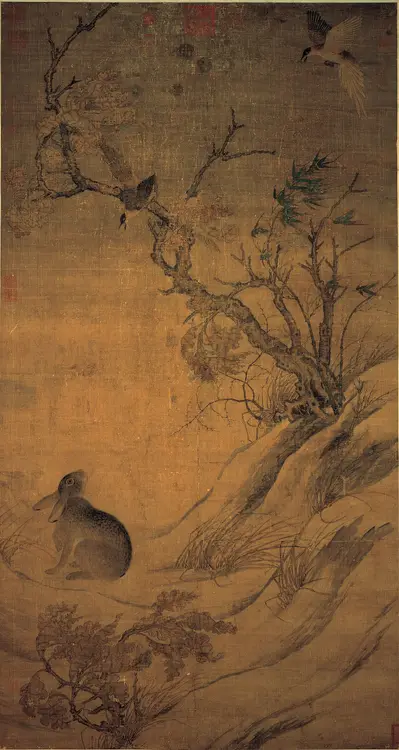
- Cui Bai (崔白, fl. 1050 to 1080), Northern Song painter; his Magpies and Hare illustrates this page.
- Choe Chiwon (崔致遠, born 857), Silla scholar who passed the Tang civil examinations.
- Daniel Tsui (崔琦, born 1939), American physicist, Nobel Prize in Physics 1998.
- Cui Jian (崔健, born 1961), “godfather of Chinese rock”.
- Cui Yongyuan (崔永元, born 1963), Chinese television host.
Frequently asked questions
How do you pronounce Cui?
Cuī is said roughly like tsway, rhyming with way, on a high level tone. The pinyin c is the ts sound at the end of cats, never a k.
Is Choi the same surname as Cui?
The Korean surname Choi (최) is written with the same character 崔. In Hong Kong, however, Choi is usually the Cantonese spelling of a different surname, 蔡 Cai.
What does the surname Cui mean?
The character 崔 means high, lofty or towering. As a surname it is traditionally traced to the Cui estate in today's Zhangqiu, Shandong.
Is Tsui the same as Cui?
Yes. Tsui comes from the Wade-Giles spelling Ts'ui, as in the Nobel laureate Daniel Tsui (崔琦).
Sources and open data
- Unihan database entry for U+5D14 崔, Unicode Consortium
- Frequently Occurring Surnames from the 2010 Census, US Census Bureau
- Cui (surname), English Wikipedia
- 崔姓 (Cui surname), Chinese Wikipedia
- Choi (Korean surname), English Wikipedia
- Cui, family name (Q4518438), Wikidata