Key facts
- Every figure on this site comes from a public, citable source, listed at the bottom of the page where it is used.
- Characters, readings and stroke counts come from the Unicode Unihan database (Unicode 18.0); dictionary readings from CC-CEDICT.
- Rankings for mainland China follow the 2019 ranking reported by English Wikipedia; Taiwan figures come from the 2023 Ministry of the Interior report.
- US counts come from the 2010 Census surname file, which records spellings, not characters.
- The tools run in your browser with open-source libraries; nothing you type is sent to a server.

qiaoyu.info is a reference on Chinese surnames: their characters, spellings, origins and how common they are. This page explains where the data comes from, how it is combined, and what it cannot tell you. The aim is that any figure on the site can be traced to its source.
Principles
- One source per figure. Each count, rank or percentage is taken from a named source and year. Figures from different surveys are not mixed in the same table.
- Sources at the bottom of every page. Each page lists the documents it relies on, with links. Wikipedia articles are cited as a secondary source, and the primary data they report is cited where it is public.
- Characters before spellings. A Chinese surname is a character, not a Latin spelling. One character has many spellings, and one spelling can stand for several characters, so pages start from the character.
- No invented history. Origin stories are reported as traditions, with the text or historian they come from. Where scholars disagree, the page says so.
The datasets
| Dataset | Used for | Version | Licence |
|---|---|---|---|
| Unicode Unihan database | code points, Mandarin and Cantonese readings, stroke counts, radicals, short definitions, Korean, Vietnamese and Japanese readings | Unicode 18.0.0 (July 2026) | Unicode License |
| CC-CEDICT | dictionary readings and surname senses, the list of Mandarin syllables for the Wade-Giles table | release of 18 November 2026, 125,439 entries | CC BY-SA 4.0 |
| US Census 2010 surname file | US counts, ranks and the share of each race and Hispanic origin group | 162,253 surnames with 100 or more bearers | public domain |
| English Wikipedia, List of common Chinese surnames | 2019 mainland ranking and romanizations in other languages | consulted November 2026 | CC BY-SA 4.0 |
| Taiwan Ministry of the Interior | Taiwan ranking, counts and compound surnames | statistics of 30 June 2023 | official publication |
| Wikidata | identifiers linking each surname to other databases | consulted November 2026 | CC0 |
| Wikimedia Commons | images | per file | licence given in each caption |
How a surname page is built
- Selecting the surnames. The site has a page for each of the 60 most common surnames of the 2019 mainland ranking reported by English Wikipedia, plus six surnames important in Taiwan and the diaspora, such as Hong and Zhuang. Different characters that share a spelling get separate pages, such as Xu 许 next to Xu 徐. The surname finder searches a wider set of 112 surnames from the extended ranking.
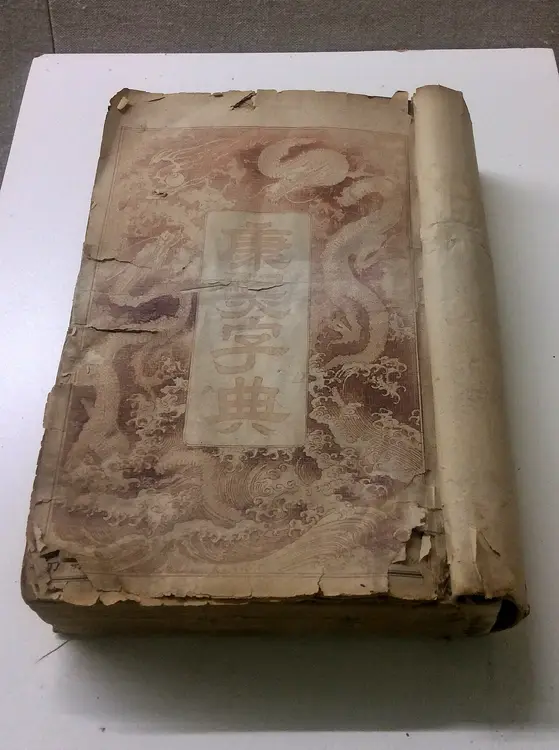
- Character data. For each character, the build script reads the Unihan files: readings, total strokes in simplified and traditional form, radical, and the Korean, Vietnamese and Japanese readings. These appear in the data panel at the top of each surname page. Radical numbers follow the 214 radicals of the Kangxi Dictionary of 1716, shown above, which Unihan uses for its radical-stroke index.
- Spellings. Romanizations in Cantonese, Hokkien, Hakka and other varieties come from the Wikipedia list, which gathers them from several sources. The one surname, many spellings guide explains how to read them.
- US counts. Each spelling is looked up in the 2010 Census file. Because the file records spellings only, a count for “Wong” or “Chang” includes every surname written that way; the page text explains which characters are behind it.
- Wikidata check. A Wikidata identifier is kept only if the item is a family name whose native label is the same character, to avoid linking a surname to a person or a place.
- Writing and review. The text is written from the sources listed on the page. Each origin story, date and figure must be found in a cited source.
Automatic checks
Before publication, a script checks every page: each internal link must point to a page in the site’s registry, titles and descriptions must stay within length limits, and every page must have a summary, a FAQ and at least three sources. Image metadata (author, licence and link to the original file) is fetched from Wikimedia Commons, and only freely licensed images are accepted. The built site is then audited for broken internal links, invalid structured data and pages with more than one main heading.
The tools
The tools run entirely in your browser:
- The surname finder searches the site’s surname data by spelling, pinyin or character.
- The Chinese name to pinyin converter uses the open-source library pinyin-pro (MIT licence), which has a dictionary of surname readings, so that 曾 is read Zēng and 单 Shàn when they are surnames.
- The pinyin to Wade-Giles converter uses the library use-wg (MIT licence) with a table of every Mandarin syllable in CC-CEDICT.
- The stroke order tool uses Hanzi Writer (MIT licence) with stroke data from the Make Me a Hanzi project, under the Arphic Public License. The data files are served from this site, not from a third-party server.
- The US census surname lookup downloads a public extract of the 2010 file: the 13,309 surnames of which at least 10% of bearers identified as Asian or Pacific Islander.
Limits of the data
- Spellings are not characters. The US Census, and most Western records, only keep Latin letters. A spelling can stand for several Chinese surnames, and for Korean or Vietnamese ones.
- Counts vary by source. Mainland figures come from household registration data published at different dates; the how many Chinese surnames page explains why totals range from about 3,100 to 4,100.
- Variant characters. Taiwan counts written forms separately, so 黃 and 黄 appear as two entries. Mainland statistics use simplified characters, which merge some forms.
- Traditions are not records. Most origin stories go back to texts written centuries after the events they describe. They tell what families believe about their ancestors, not what can be proved.
Corrections
If you find an error, write to the address given in the legal notice, with the page and, if possible, a source. Each correction is checked against the original data, and the page’s “updated” date changes when it is published. The site’s data and images are listed with their licences in the legal notice; see also the privacy policy.
Frequently asked questions
Where do the surname rankings come from?
For mainland China, from the 2019 ranking based on Ministry of Public Security data, as reported in English Wikipedia's list of common Chinese surnames. For Taiwan, from the Ministry of the Interior's 2023 name statistics. Each page names its sources and links to them.
Why do some figures differ from other websites?
Surname counts depend on the year, the population covered and how variant characters are counted. This site gives the year and source of each figure instead of mixing counts from different surveys.
Can I reuse the data?
The underlying datasets are open: Unihan under the Unicode License, CC-CEDICT under CC BY-SA 4.0, the US Census file in the public domain and Wikidata under CC0. Reuse them under their own terms and cite the original source. Images keep the licence shown in their caption.
How can I report an error?
Use the contact address in the legal notice. Give the page, the statement and, if possible, a source. Corrections are checked against the original data before the page is updated.
Sources and open data
- Unihan database, Unicode Consortium
- CC-CEDICT, MDBG and CC-CEDICT contributors
- Frequently Occurring Surnames from the 2010 Census, US Census Bureau
- List of common Chinese surnames, English Wikipedia
- 全國姓名統計分析 (National name statistics, 2023), Department of Household Registration, Ministry of the Interior (Taiwan)
- Wikidata, Wikimedia Foundation