Key facts
- Type a surname and a given name to see the name in Chinese order, Western order, with the surname in capitals and in hyphenated form.
- The tool also gives the formal address (Mr, Ms, Dr plus surname) and the forms used in APA, MLA and Chicago reference lists.
- Add an optional English name, such as Peter or Tony, to see the two orders used in Hong Kong, Singapore and Malaysia.
- In Chinese the surname always comes first; writing it in capitals, as in ZHANG Wei, removes any doubt for a foreign reader.
- Everything runs in your browser: the names you type are not sent to a server.

A Chinese name has two parts, a surname and a given name, but in English the same person can appear as Zhang Wei, Wei Zhang, ZHANG Wei, Zhang, W. or Mr Zhang. Choosing the wrong form is a common source of confusion in letters, forms, bibliographies and databases. The formatter above takes the two parts separately and shows every common way of writing them in English, so you can pick the one that fits your document.
How to use the formatter
- Enter the surname. Type the family name in Latin letters, such as Zhang, Chen or Ouyang. If you only have the characters, convert them first with the Chinese name to pinyin tool; if you have a spelling but are not sure it is a surname, check it in the surname finder.
- Enter the given name. Type it as you have it: Wei, Xueyou, Xue You or Ying-jeou. The tool recognises spaces and hyphens between syllables and builds both the joined form (Xueyou) and the hyphenated form (Xue-you).
- Add an English name if there is one. Many people from Hong Kong, Taiwan, Singapore and Malaysia, and many Chinese students abroad, use an English given name such as Peter or Michael. The field is optional.
- Copy the form you need. Each row of the result is one convention, explained below.
What each row means
| Row | Example for Zhang + Xue You | Where it is used |
|---|---|---|
| Chinese order | Zhang Xueyou | Chinese usage, news reports on China, most reference works |
| Western order | Xueyou Zhang | forms that ask for first name and last name, many people living abroad |
| Surname in capitals | ZHANG Xueyou | conferences, international organisations, French and other European usage |
| Hyphenated given name | Zhang Xue-you | Taiwan, Hong Kong, older publications |
| Formal address | Mr Zhang, Ms Zhang, Dr Zhang | letters, meetings, e-mails |
| APA reference list | Zhang, X. | psychology, education, social sciences |
| MLA or Chicago bibliography | Zhang, Xueyou | humanities |
| Sorted list | Zhang, Xueyou | indexes, directories, attendance lists |
With an English name, two more rows appear: the Hong Kong and Southeast Asian order, such as Peter Zhang Xueyou, and the fully Western order, Peter Xueyou Zhang.
Why the surname comes first
In Chinese, the family name always comes before the given name: in 张学友, 张 Zhang is the surname and 学友 Xueyou the given name. The same order is used in Taiwan, Japan, Korea and Vietnam, and in Europe by Hungarians. English Wikipedia notes that Western publications generally keep this order for names from mainland China, which is why newspapers write Xi Jinping and not Jinping Xi, while they used to reverse Japanese names. Japan asked in 2020 that its officials’ names be written surname first in English as well.
Problems start when a Chinese name enters a Western form. A field labelled “first name” makes many people write their given name first, while others keep the Chinese order out of habit. A reader who sees “Wang Li” cannot tell which part is the surname, since both Wang and Li are common surnames. The guide to surname and given name order explains the conventions in more detail.
Capitals and hyphens
Two simple conventions remove most of the ambiguity:
- The surname in capitals. Writing ZHANG Xueyou or Xueyou ZHANG shows the surname whatever the order. English Wikipedia notes that some communities, such as French users, write all surnames this way, and it is common on conference badges and in international organisations.
- The hyphenated given name. Taiwan and Hong Kong traditionally join the two syllables of a given name with a hyphen, with a small letter after it: Ma Ying-jeou, Tony Leung Chiu-wai. The hyphen marks the given name as one unit, so the surname is the part that stands alone. The same practice appears in older Wade-Giles spellings such as Mao Tse-tung, and in South Korean names.
Pinyin, the system of mainland China, writes the given name as a single word with no hyphen: Xi Jinping, not Xi Jin-ping. Hong Kong identity documents, on the other hand, separate the syllables with spaces, as in Chiu Yung, and English Wikipedia notes that some computer systems handle such spaces badly. The Hong Kong Cantonese spellings guide explains how these names are spelled.
English names
Many Chinese people use an English given name alongside their Chinese one. In Hong Kong, a 2015 survey of 2,049 people cited by English Wikipedia found that 25.8% had a legal English given name and 38.3% used one informally, 64.1% in all. There are two usual orders:
- English name, surname, Chinese given name: Peter Kuo Chi-yung, Tony Leung Chiu-wai. This is how Hong Kong newspapers usually print names.
- Surname, Chinese given name, English name: KUO, Chi Yung Peter, as on a Hong Kong identity card.
In Singapore and Malaysia the same choice exists. English Wikipedia gives the example of a former Singapore president who may appear as Tony Tan Keng Yam or as Tan Keng Yam Tony; either format can be registered. The current prime minister, Lawrence Wong Shyun Tsai (黄循财), is a well-known case of the hybrid order.
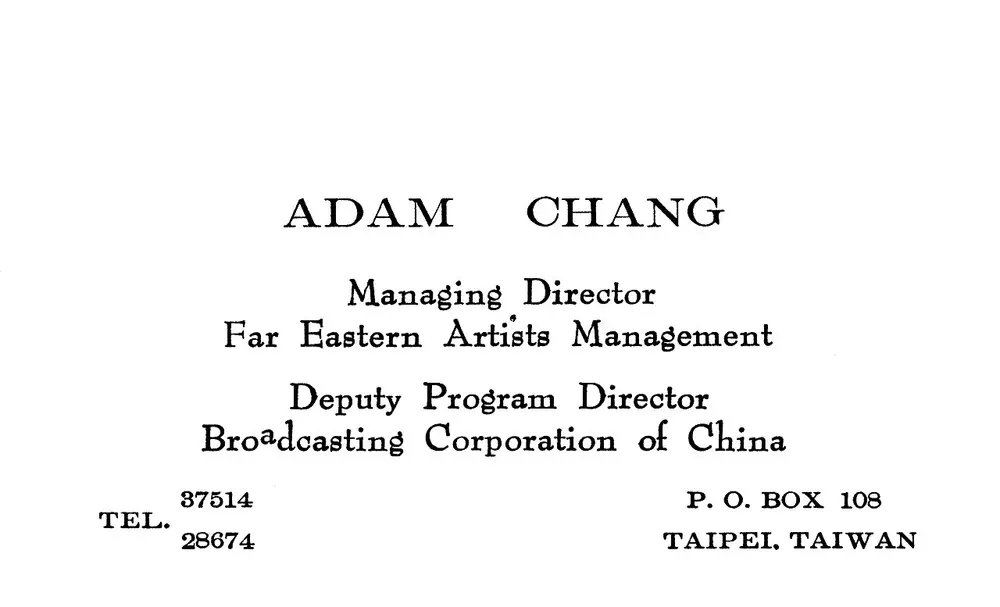
The business card shown at the top of this page is a typical example from Taiwan. It reads “ADAM CHANG”, an English given name followed by the surname in capitals. The owner, according to the description of the image on Wikimedia Commons, was 張繼高, Zhang Jigao in pinyin. Chang is the Wade-Giles spelling of 张 Zhang, the usual spelling of this surname in Taiwan.
Names in citations
Reference styles such as APA, MLA and Chicago list authors surname first, followed by a comma. For Chinese authors the rule is simple once the surname is known: Zhang Xueyou becomes Zhang, X. in APA and Zhang, Xueyou in MLA or Chicago. The difficulty is upstream, since an article may print the author’s name in either order. Check the author’s own pages or the journal’s metadata before deciding.
When the given name is hyphenated, as in Ying-jeou, some publishers keep both initials with a hyphen, Ma, Y.-J., and the formatter does this when you type a hyphen. Follow the instructions of your publisher or teacher if they differ. Never reduce a Chinese surname to an initial: in Chinese order, Zhang X. is correct, while X. Zhang is the Western form.
Limits
- The tool does not guess which part is the surname. You must enter it in the surname field. A name such as Wang Li or Li Wang cannot be resolved without knowing the person.
- Compound surnames such as Ouyang or Sima are kept whole when typed as one word. Do not split them into two parts; see compound surnames.
- Spelling is kept as typed. The formatter changes the order, capitals and hyphens, not the romanization. To convert between systems, use the pinyin to Wade-Giles converter; for official spellings, see Chinese names on passports.
- Tone marks are not added. Type them yourself if you need them, or get them from the pinyin converter.
Frequently asked questions
Should I write a Chinese name with the surname first or last?
In Chinese the surname always comes first, and many English-language publications keep that order for names from China, Taiwan and Hong Kong: Xi Jinping, Ma Ying-jeou. Chinese people living or studying abroad often reverse it to fit Western forms. When in doubt, write the surname in capitals, as in ZHANG Wei or Wei ZHANG, so that the reader cannot misread it.
How do I address a Chinese person formally?
Use the title with the surname: Mr Wang, Ms Chen, Dr Liu. Do not use the title with the given name, as in Mr Wei for Zhang Wei, because Wei is the given name. Women in mainland China and Taiwan usually keep their own surname after marriage, so Ms plus her own surname is correct.
Why do some names have a hyphen, like Ma Ying-jeou?
Most Chinese given names have two syllables. Taiwan and Hong Kong traditionally join them with a hyphen, and the second syllable starts with a small letter: Ying-jeou, Chiu-wai. Pinyin, used in mainland China, writes them as one word: Jinping, Xueyou. Both are correct in their own system; the passport spelling is the one to follow for a given person.
How do I cite a Chinese author in APA or MLA?
Put the surname first, followed by a comma: Zhang, W. in an APA reference list, Zhang, Wei in MLA or Chicago. The difficulty is knowing which part is the surname, since the author may have printed the name in Western order on the publication. The tool gives both forms once you have entered the surname and given name separately.
What about a name with an English given name, such as Tony Leung Chiu-wai?
In Hong Kong and Southeast Asia the English name usually comes first, followed by the Chinese surname and given name: Tony Leung Chiu-wai, Lawrence Wong Shyun Tsai. Official documents in Hong Kong may put the English name last: KUO, Chi Yung Peter. Enter the English name in the optional field to see both orders.
Sources and open data
- Chinese name, English Wikipedia
- Personal name, English Wikipedia
- Hongkonger name, English Wikipedia
- Wade-Giles, English Wikipedia