Key facts
- Jiang 姜 (9 strokes, woman radical) is pronounced jiāng, high level tone; it is a different surname from 蒋 Jiǎng (third tone).
- It is one of the eight great surnames of high antiquity, traced by tradition to the Yan Emperor Shennong and to Jiang Ziya, founder of Qi.
- It ranked 54th in mainland China in 2019; Chinese Wikipedia places about 57% of bearers in six northern provinces led by Shandong.
- In Korea the same character is Kang (강), the 6th most common surname, with over a million bearers.
- Spellings: Chiang (Wade-Giles), Keung (Hong Kong), Kiang, Khương (Vietnamese).
姜
Pinyin: Jiāng
Same character in simplified and traditional: 姜
Rank in mainland China: 54 of the top 100 (Ministry of Public Security, 2019 report)
Characters and spellings of 姜
| Unicode code point | U+59DC |
|---|---|
| Stroke count | 9 |
| Radical (simplified form) | No. 38 ⼥, plus 6 strokes |
| Dictionary meaning (Unihan) | surname; ginger |
Romanizations by Chinese language
| Language | System | Spelling |
|---|---|---|
| Mandarin | Hanyu Pinyin (PRC standard) | Jiāng |
| Mandarin | Wade-Giles (Taiwan, older English texts) | Chiang |
| Cantonese | Jyutping (Unihan) | goeng1 |
| Cantonese | Hong Kong / common spellings | Keung, Geung, Keong |
| Hokkien (Min Nan) | Pe̍h-ōe-jī and common spellings | Khiang (Z), Khiong (X, K, T), Khiuⁿ (Q), Kiang |
| Hakka | Pha̍k-fa-sṳ and common spellings | Kiông, Keong |
| Gan | Romanization and common spellings | Kiong |
| Wu (Shanghainese) | Romanization and common spellings | Cian, Jian |
Equivalent surnames in other languages
| Language | Form |
|---|---|
| Vietnamese | Khương |
| Korean | Kang (강) |
| Japanese | Kyō |
These spellings in the 2010 US Census
| Spelling | People | US rank | Asian / Pacific Islander |
|---|---|---|---|
| JIANG | 19,409 | 1,849 | 97.88% |
| CHIANG | 8,841 | 4,022 | 90.45% |
| JIAN | 788 | 29,822 | 91.5% |
| KIANG | 520 | 41,799 | 86.54% |
| KHUONG | 398 | 52,169 | 97.24% |
| KEUNG | 373 | 55,121 | 91.42% |
| CIAN | 104 | 156,044 | 7.69% |
Counts are people recorded with each spelling among the 265,667,228 people with a surname shared by at least 100 people (US Census Bureau, 2010, public domain). A spelling is not proof of Chinese origin: the last column shows the share of bearers who identified as Asian or Pacific Islander. Together these spellings total 30,433 people, but some of them belong to unrelated surnames (for example English Lee, Hmong Vang or Vietnamese Ly). Search any spelling with the US census surname lookup.
Stroke order
Animation by the open-source Hanzi Writer library (MIT) with stroke data from Make Me a Hanzi (Arphic Public License). Stroke order tool for any character.

Jiang (姜) is a Chinese surname pronounced jiāng, roughly “jyahng” on a high level tone. It is one of the oldest Chinese surnames: tradition traces it to the Jiang River, birthplace of the legendary Yan Emperor, and to Jiang Ziya, founder of the state of Qi. It is spelled Chiang in Wade-Giles, Keung in Hong Kong, Kiang in older Southeast Asian usage, Khương in Vietnamese and Kang (강) in Korean. It ranked 54th in mainland China in 2019. It is a different surname from 蒋 Jiǎng, which shares the pinyin spelling.
Meaning of the character 姜
姜 has 9 strokes and is filed under radical 38, 女 “woman”, with 羊 “sheep” on top. Unihan glosses it “surname; ginger”. The ginger meaning comes from simplification: the traditional character for ginger, 薑, was replaced by 姜 in simplified Chinese, while the surname was always 姜. In Taiwan and Hong Kong, 姜 is only the surname and ginger is still 薑. More cases like this in simplified and traditional surname characters.
Jiang 姜 or Jiang 蒋?
| 姜 | 蒋 / 蔣 | |
|---|---|---|
| Pinyin | Jiāng (1st tone) | Jiǎng (3rd tone) |
| Wade-Giles | Chiang | Chiang |
| Hong Kong | Keung | Cheung |
| Korean | Kang (강) | Jang (장) |
| Rank in China, 2019 | 54th | 39th |
| Best-known bearer | Jiang Ziya | Chiang Kai-shek |
Without characters or tone marks, “Jiang” and “Chiang” cannot be told apart. Another surname, 江, is also Jiāng in pinyin. The surname finder lists all of them.
Origin of the Jiang surname
English Wikipedia lists Jiang among the “eight great surnames of high antiquity” (上古八大姓), the clan names of the earliest Chinese tradition, most of which contain the woman radical: 姬 Ji, 姜 Jiang, 姚 Yao, 嬴 Ying, 姒 Si, 妘 Yun, 媯 Gui and 妊 Ren. Of these, only Jiang and Yao 姚 remain common surnames today.
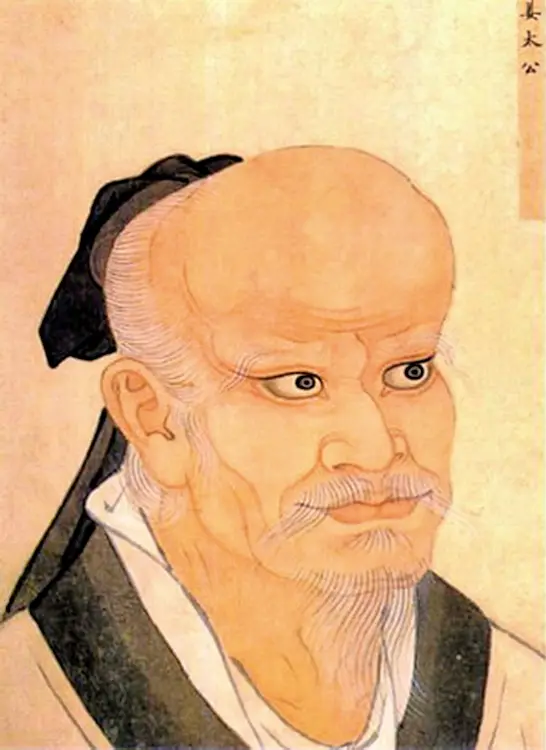
Tradition holds that the Yan Emperor, identified with Shennong, the divine farmer, was born by the Jiang River (姜水) and took its name. His most famous descendant is Jiang Ziya (姜子牙, also called Jiang Taigong or Lü Shang), the strategist who helped the Zhou overthrow the Shang and was given the state of Qi in today’s Shandong. Qi was ruled by the Jiang family until the Tian clan took power in the 4th century BC.
The Jiang family of Qi is the claimed ancestor of many later surnames. Genealogies trace Lu 卢 (through the minister Gao Xi), Cui 崔 (through a grandson of Jiang Ziya who gave up the throne), Lü 吕 and others to this line. This is why Jiang is sometimes called a “root surname”. All of this is traditional genealogy, not demonstrable descent; see where Chinese surnames come from.
Later, according to English Wikipedia, minority groups such as the Dong, Tujia and Yao peoples also adopted the surname.
Where Jiang families live
Chinese Wikipedia gives more than 4.6 million bearers, about 0.37% of the population. Roughly 57% live in Shandong, Henan, Liaoning, Inner Mongolia, Heilongjiang and Jilin, with Shandong alone holding about 11%, fitting the name’s roots in the state of Qi. Its best-known historic commandery is Tianshui, in Gansu.
Kang: Jiang in Korea
In Korea 姜 is read 강, Kang. English Wikipedia reports 1,176,847 people named Kang in the 2015 South Korean census, the 6th largest surname, and says more than one million of them write it with 姜 (a smaller group uses 康). The largest clan is the Jinju Kang, said to descend from the Goguryeo commander Kang I-sik. A famous bearer is Kang Kam-chan (姜邯贊, 948 to 1031), the Goryeo general who defeated the Khitan. See the Korean surnames guide.
Jiang in the United States
2010 US Census figures:
- Jiang: 19,409 people, 97.9% Asian or Pacific Islander (shared with 蒋 and 江).
- Chiang: 8,841 people, 90.5% (also shared with 蒋 and 江).
- Kiang: 520 people.
- Khuong: 398 people, a Vietnamese spelling.
- Keung: 373 people, the Hong Kong spelling.
The Korean spelling Kang is not included here because it also stands for Korean 康 and other names. The census lookup tool shows any spelling.
Famous people named Jiang 姜
- Jiang Ziya (姜子牙, fl. 11th century BC), founder of Qi.
- Jiang Wei (姜維, 202 to 264), general of Shu Han in the Three Kingdoms period.
- Jiang Kui (姜夔, born c. 1155), Southern Song poet and composer.
- David Chiang (姜大衛, born 1947), Hong Kong martial arts actor.
- Jiang Wen (姜文, born 1963), actor and director of Let the Bullets Fly.
- Ted Chiang (姜峯楠, born 1967), American science fiction writer.
- Keung To (姜濤), Hong Kong singer, an example of the Keung spelling.
Frequently asked questions
Is Jiang 姜 the same as Jiang 蒋?
No. 姜 is read jiāng with a high level tone; 蒋 is read jiǎng with a dipping tone. They are separate surnames with separate origins, although both are spelled Jiang in pinyin and Chiang in Wade-Giles.
What does 姜 mean?
姜 means ginger in modern simplified Chinese, because it also replaced the traditional character 薑. As a surname it is much older, and tradition traces it to the Jiang River, birthplace of the Yan Emperor.
Is the Korean surname Kang Chinese?
Most Korean Kangs write their name with the same character 姜, read 강 in Korean. It is the same written surname, but Korean Kang clans have their own founders, such as the Goguryeo commander Kang I-sik of the Jinju clan.
How do you pronounce Jiang?
Jiāng is said roughly like jyahng, with a high, flat tone. The pinyin j is close to the j of jeep, with the tongue further forward.
Sources and open data
- Unihan database entry for U+59DC 姜, Unicode Consortium
- Frequently Occurring Surnames from the 2010 Census, US Census Bureau
- Jiāng (surname 姜), English Wikipedia
- 姜姓 (Jiang surname), Chinese Wikipedia
- Kang (Korean surname), English Wikipedia