Key facts
- Guo is written 郭, the same in simplified and traditional script (11 strokes), and pronounced guō, roughly "gwaw" with a high level tone.
- The character means the outer wall of a city, and one tradition says early Guo families were named for living by that wall.
- Most genealogies trace it to the Zhou-era states of Guo (虢), ruled by uncles of King Wu of Zhou. The two characters were used interchangeably.
- It ranks 16th in mainland China in the Ministry of Public Security's 2019 report.
- Spellings include Kuo (Wade-Giles), Kwok (Cantonese), Quek and Kueh (Hokkien), Que (Philippines) and Quách (Vietnamese).
郭
Pinyin: Guō
Same character in simplified and traditional: 郭
Rank in mainland China: 16 of the top 100 (Ministry of Public Security, 2019 report)
Characters and spellings of 郭
| Unicode code point | U+90ED |
|---|---|
| Stroke count | 11 |
| Radical (simplified form) | No. 163 ⾢, plus 8 strokes |
| Dictionary meaning (Unihan) | outer part (of a city); surname |
Romanizations by Chinese language
| Language | System | Spelling |
|---|---|---|
| Mandarin | Hanyu Pinyin (PRC standard) | Guō |
| Mandarin | Wade-Giles (Taiwan, older English texts) | Kuo |
| Cantonese | Jyutping (Unihan) | gwok3 |
| Cantonese | Hong Kong / common spellings | Kwok, Kuok |
| Hokkien (Min Nan) | Pe̍h-ōe-jī and common spellings | Koeh (Z, K, T), Keh (X), Kerh (Q), Kueh, Koay, Quay, Kwek, Quek Kwik |
| Hakka | Pha̍k-fa-sṳ and common spellings | Kwok, Kok |
| Gan | Romanization and common spellings | Kuok, Kwok |
| Wu (Shanghainese) | Romanization and common spellings | Koh, Goh, Kueh, Koq |
Equivalent surnames in other languages
| Language | Form |
|---|---|
| Vietnamese | Quách |
| Korean | Gwak (곽) |
| Japanese | Kaku |
| Filipino | Que, Cue, Kwok, Guo |
These spellings in the 2010 US Census
| Spelling | People | US rank | Asian / Pacific Islander |
|---|---|---|---|
| GUO | 12,048 | 2,975 | 97.77% |
| QUACH | 9,894 | 3,598 | 96.52% |
| KUO | 7,426 | 4,767 | 92.62% |
| KWOK | 5,458 | 6,257 | 95.66% |
| KOH | 3,595 | 9,090 | 88.65% |
| KOK | 1,622 | 17,398 | 32.31% |
| CUE | 1,593 | 17,639 | 4.27% |
| GOH | 1,528 | 18,208 | 87.76% |
| QUAY | 1,120 | 22,856 | 0.89% |
| QUE | 681 | 33,499 | 72.54% |
Counts are people recorded with each spelling among the 265,667,228 people with a surname shared by at least 100 people (US Census Bureau, 2010, public domain). A spelling is not proof of Chinese origin: the last column shows the share of bearers who identified as Asian or Pacific Islander. Together these spellings total 45,846 people, but some of them belong to unrelated surnames (for example English Lee, Hmong Vang or Vietnamese Ly). Search any spelling with the US census surname lookup.
Stroke order
Animation by the open-source Hanzi Writer library (MIT) with stroke data from Make Me a Hanzi (Arphic Public License). Stroke order tool for any character.

Guo (郭) is a Chinese surname pronounced guō, roughly “gwaw” with a high level tone. The character means the outer wall of a city and is written the same way in simplified and traditional script. Guo ranks 16th in mainland China in the 2019 official list. Outside the mainland it is spelled Kuo (Taiwan), Kwok (Hong Kong), Quek, Kueh or Koay (Hokkien), Que (Philippines) and Quách (Vietnam).
Meaning of the character 郭
The Unihan database defines 郭 as “outer part (of a city); surname”. A walled Chinese city often had two rings of walls: the inner one, 城 (chéng), and an outer one, 郭. The pair survives in the old phrase 城郭, meaning a city and its fortifications.
The character is built from 享 on the left, which in early script drew a walled building, and 阝 on the right. That right-hand 阝 is a reduced form of 邑 (town), radical 163, which appears in many place-name characters and many surnames. Because 郭 has no simplified form, it looks the same on all Chinese documents.
Origin: the states of Guo
Chinese genealogies, as summarized in the Chinese Wikipedia article, give several origins. The most important one is political.
After King Wu of Zhou defeated the Shang around 1046 BC, two of his uncles, known as Guo Shu and Guo Zhong, received fiefs that took the name Guo, written 虢. Western Guo lay in the Wei River valley and later moved east to the Yellow River near today’s Sanmenxia. Eastern Guo stood near today’s Xingyang in Henan. Modern historians debate how the branches were related, but the texts agree that both belonged to the royal Ji (姬) clan.
Neither state lasted. Zheng annexed Eastern Guo in 767 BC, and Jin destroyed Western Guo in 655 BC after borrowing a road through the neighboring state of Yu. That campaign gave Chinese the idiom 唇亡齿寒, “when the lips are gone, the teeth feel the cold”, said by a Yu minister who warned that his state would be next. He was right.
Since 虢 and 郭 sounded the same, the descendants of these states came to write their name with the simpler 郭. The Fengsu Tongyi, an Eastern Han book on customs, also lists 郭 among surnames taken from where a family lived, here outside the city wall. Both accounts are traditional, and the page on where Chinese surnames come from explains how such names were formed.
The Hui Guo of Quanzhou
One Guo line has a documented foreign origin. In the early 14th century, under the Mongol Yuan dynasty, a Persian official was sent to Quanzhou in Fujian to manage grain shipping by sea. He stayed, married locally, and his grandsons took the Chinese surname Guo, which was close to the sound of his name.
The family later claimed descent from the Tang general Guo Ziyi, a common way of fitting into Han society. Its members, centered in Baiqi near Quanzhou, are registered today as Hui, a Muslim minority nationality, although most no longer practice Islam. English Wikipedia notes that a related Kuo branch in Taiwan still avoids offering pork at its ancestral shrines.
How Guo is spelled around the world
| Spelling | Language or system | Where you meet it |
|---|---|---|
| Guo | Hanyu Pinyin | mainland China |
| Kuo | Wade-Giles | Taiwan, older English texts |
| Kwok / Kok | Cantonese, Hakka | Hong Kong, Malaysia |
| Quek / Kueh / Koay / Kwek | Hokkien, Teochew | Singapore, Malaysia, Indonesia |
| Que / Cue | Filipino Hokkien | Philippines |
| Quách | Vietnamese | Vietnam |
| Gwak / Kwak (곽) | Korean | Korea |
Guo is a good example of one surname with many spellings. The Hokkien forms are explained in the Hokkien and Teochew guide, and the Philippine forms in the guide to Filipino Chinese surnames.
Guo in the United States
The 2010 US Census figures for the main spellings are:
- Guo: 12,048 people (97.8% Asian or Pacific Islander).
- Quach: 9,894 people (96.5%), from Vietnamese Quách.
- Kuo: 7,426 people (92.6%), mostly of Taiwanese background.
- Kwok: 5,458 people (95.7%), mostly Cantonese.
Other spellings in the data panel need care. Koh (3,595) and Goh (1,528) are Guo in some Wu and Hokkien readings, but in Singapore they more often spell other surnames, such as 许 for Koh and 吴 for Goh. Kok is only 32.3% Asian, because it is also a Dutch surname. Cue (4.3% Asian) and Quay (0.9%) are almost entirely English or Irish names in the US. The US census surname lookup shows these overlaps.
Famous people named Guo
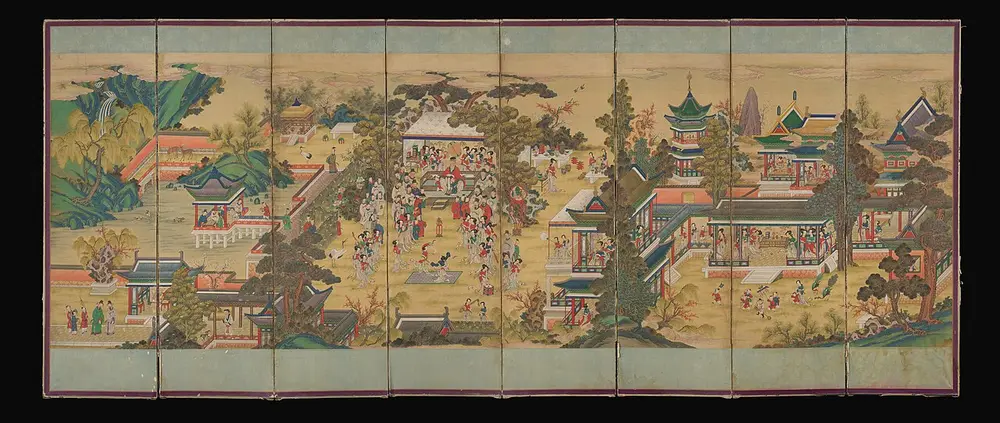
- Guo Ziyi (郭子仪, 697 to 781), Tang general who helped end the An Lushan Rebellion. Paintings of his banquet, like the screen above, became a symbol of a long life and many descendants.
- Guo Xi (郭熙, about 1020 to 1090), Song landscape painter.
- Guo Shoujing (郭守敬, 1231 to 1316), Yuan astronomer and engineer who built observatories across China.
- Guo Moruo (郭沫若, 1892 to 1978), poet, historian and archaeologist.
- Terry Gou (郭台銘, born 1950), founder of Foxconn, whose name uses an unusual spelling of the surname.
- Aaron Kwok (郭富城, born 1965), Hong Kong singer and actor, an example of the Cantonese spelling.
- Guo Jingjing (郭晶晶, born 1981), Olympic diving champion.
Related surnames and pages
- Guo is sometimes confused in English with Gao 高, because Koh and Ko can spell both.
- The surname finder lists every character behind a spelling such as Kwok or Koh.
- Guo also appears in the list of the most common surnames in Taiwan, where it is spelled Kuo.
- See the full ranking in the 100 most common surnames in China.
Frequently asked questions
What does the surname Guo mean?
郭 means the outer wall of a city, the second ring of walls built outside the inner city. As a surname it usually comes from the ancient states of Guo, whose name was written 虢 and later replaced by the simpler 郭.
How do you pronounce Guo?
Say gwaw, close to the start of the English word guava without the va, with a high flat first tone: guō.
Is Kwok the same surname as Guo?
Yes. Kwok is the Hong Kong Cantonese spelling of 郭, read gwok3 in Cantonese. Kuo is the Wade-Giles spelling used in Taiwan, and Quek or Kueh are Hokkien forms common in Singapore and Malaysia.
Are there Muslim families named Guo?
Yes. A Guo lineage around Quanzhou in Fujian descends from a Persian who settled there in the 14th century. Many of its members are registered as Hui today, though most no longer practice Islam.
Sources and open data
- Unihan database entry for U+90ED 郭, Unicode Consortium
- Frequently Occurring Surnames from the 2010 Census, US Census Bureau
- Guo (surname), English Wikipedia
- 郭姓 (Guo surname), Chinese Wikipedia
- Western Guo, English Wikipedia
- Guo Ziyi, English Wikipedia
- Guo, family name (Q4140836), Wikidata