Key facts
- Shen is written 沈 (7 strokes, water radical) in both simplified and traditional Chinese.
- As a surname it is read shěn; the reading chén belongs to the old word "to sink", now written 沉.
- It is 14th in the Hundred Family Surnames and ranked 52nd in mainland China in 2019; about 36% of bearers live in Jiangsu and Zhejiang.
- Spellings: Shum, Sum, Sham (Cantonese), Sim (Hokkien, Teochew), Shim / Sim (Korean 심), Thẩm (Vietnamese).
- The 2010 US Census counted 12,839 people named Shen, 93.8% of them Asian or Pacific Islander.
沈
Pinyin: Shěn (Unihan reading: shěn chén)
Same character in simplified and traditional: 沈
Rank in mainland China: 52 of the top 100 (Ministry of Public Security, 2019 report)
Characters and spellings of 沈
| Unicode code point | U+6C88 |
|---|---|
| Stroke count | 7 |
| Radical (simplified form) | No. 85 ⽔, plus 4 strokes |
| Dictionary meaning (Unihan) | sink, submerge; addicted to; surname |
Romanizations by Chinese language
| Language | System | Spelling |
|---|---|---|
| Mandarin | Hanyu Pinyin (PRC standard) | Shěn |
| Mandarin | Wade-Giles (Taiwan, older English texts) | Shen |
| Cantonese | Jyutping (Unihan) | sam2 |
| Cantonese | Hong Kong / common spellings | Shum, Sum, Sham, Sam |
| Hokkien (Min Nan) | Pe̍h-ōe-jī and common spellings | Sím, Sim |
| Hakka | Pha̍k-fa-sṳ and common spellings | Shím, Sím, Sim |
| Gan | Romanization and common spellings | Sím |
| Wu (Shanghainese) | Romanization and common spellings | Sen, Sung |
Equivalent surnames in other languages
| Language | Form |
|---|---|
| Vietnamese | Thẩm / Trầm |
| Korean | Sim/Shim (심) |
| Japanese | Shin |
These spellings in the 2010 US Census
| Spelling | People | US rank | Asian / Pacific Islander |
|---|---|---|---|
| SHEN | 12,839 | 2,806 | 93.77% |
| SAM | 12,053 | 2,974 | 33.73% |
| SUNG | 7,360 | 4,801 | 94.14% |
| SIM | 6,047 | 5,732 | 71.08% |
| SHIM | 4,958 | 6,801 | 86.65% |
| SEN | 3,059 | 10,491 | 75.48% |
| SHUM | 2,222 | 13,627 | 81.1% |
| SUM | 1,482 | 18,596 | 73.14% |
| THAM | 1,355 | 19,834 | 87.75% |
| TRAM | 1,190 | 21,842 | 93.61% |
Counts are people recorded with each spelling among the 265,667,228 people with a surname shared by at least 100 people (US Census Bureau, 2010, public domain). A spelling is not proof of Chinese origin: the last column shows the share of bearers who identified as Asian or Pacific Islander. Together these spellings total 53,238 people, but some of them belong to unrelated surnames (for example English Lee, Hmong Vang or Vietnamese Ly). Search any spelling with the US census surname lookup.
Stroke order
Animation by the open-source Hanzi Writer library (MIT) with stroke data from Make Me a Hanzi (Arphic Public License). Stroke order tool for any character.

Shen (沈) is a Chinese surname pronounced shěn, roughly like the English word “shun” with a low, dipping tone. The character means “to sink, to submerge”, but the surname is traditionally traced to the ancient state of Shen in today’s Henan. It is spelled Shum, Sum or Sham in Hong Kong Cantonese, Sim in Hokkien and Teochew, Shim or Sim (심) in Korean and Thẩm in Vietnamese. It is 14th in the classic Hundred Family Surnames and ranked 52nd in mainland China in 2019.
Meaning of the character 沈, and shěn versus chén
沈 has 7 strokes: the water radical 氵 (radical 85) beside 冘. Unihan glosses it “sink, submerge; addicted to; surname” and lists two Mandarin readings, shěn and chén.
The two readings are two words. Chén is the old reading of the verb “to sink”, which modern standard Chinese writes 沉; CC-CEDICT records 沈 chén only as a variant of 沉. The surname is shěn, the reading CC-CEDICT gives for the surname entry. So a Shen is never “Chen”, and the surname has nothing to do with Chen 陈.
Chinese Wikipedia adds that some genealogies distinguish a rare second reading for one lineage, but this is not standard usage.
A third detail: in simplified Chinese 沈 is also the short form of 瀋, used in the city name Shenyang (沈阳, traditional 瀋陽). The surname itself was always 沈 and has no complex traditional form.
Origin of the Shen surname
Chinese and English Wikipedia report several traditional origins, which do not fully agree:
- The Zhou state of Shen. Ji Zai (季载, also called Ran Ji), the tenth son of King Wen of Zhou, was enfeoffed at Shen, near today’s Pingyu in Henan. The state was destroyed by Cai in the Spring and Autumn period, and its ruling family took the state’s name as a surname. Most Shen genealogies follow this line.
- A Chu fief. A branch of the royal Mi 芈 family of Chu held a fief called Shen, and their descendants adopted its name.
- An older state of Shen in the Fen valley of Shanxi, said to descend from the legendary Shaohao, absorbed early by Jin.
- Non-Han lines. Mongol, Manchu and Xibe families adopted Shen as a Chinese surname under the Qing.
Tradition also holds that the You 尤 clan of Fujian split off from the Shen in the 10th century by dropping the water radical, and that the two names long avoided intermarrying. See the same-surname marriage taboo.
Where Shen families live
Shen is above all an eastern name. According to English Wikipedia, citing a 2013 survey, about 5.5 million people bear it, and Jiangsu and Zhejiang together hold about 36% of them. It ranked 6th among surnames in Hangzhou (2011) and 8th in Shanghai (2018). The historic commanderies (郡望) are Runan in Henan and Wuxing in Zhejiang. One hall name, Mengxi Tang (梦溪堂), honors the polymath Shen Kuo and his Dream Pool Essays; see clan associations and hall names.
In Korea, 沈 (심) ranked 32nd among surnames in 2015, with 272,049 people, the largest clan being the Cheongsong Sim. In Taiwan it ranked 40th in 2018.
How Shen is spelled
| Spelling | Where it comes from | Example |
|---|---|---|
| Shen | Pinyin and Wade-Giles | Shen Congwen, writer |
| Shum / Sum / Sham | Hong Kong Cantonese | |
| Sim | Hokkien, Teochew, Hakka; Singapore, Malaysia | |
| Shim / Sim (심) | Korean | |
| Sen / Sung | Shanghainese (Wu) | |
| Thẩm / Trầm | Vietnamese |
The Hokkien and Teochew spellings guide explains Sim; the Korean surnames guide explains Shim.
Shen in the United States
2010 US Census counts for the spellings of 沈:
- Shen: 12,839 people, 93.8% Asian or Pacific Islander.
- Sim: 6,047 people, 71.1%.
- Shim: 4,958 people, 86.7%, largely Korean.
- Shum: 2,222 people, 81.1%.
- Sum: 1,482 people, 73.1%.
- Tram: 1,190 people, 93.6% (Vietnamese Trầm).
- Sham: 673 people.
Several spellings are too ambiguous to attribute: Sam (12,053) is only 33.7% Asian or Pacific Islander, Sung (7,360) is shared with 宋 Song and Korean names, and Tham (1,355) also serves for 譚 Tan. The census surname lookup shows any spelling’s figures.
Famous people named Shen
- Shen Yue (沈約, 441 to 513), historian, poet and music theorist of the Southern Dynasties.
- Shen Kuo (沈括, 1031 to 1095), Song polymath, author of the Dream Pool Essays.
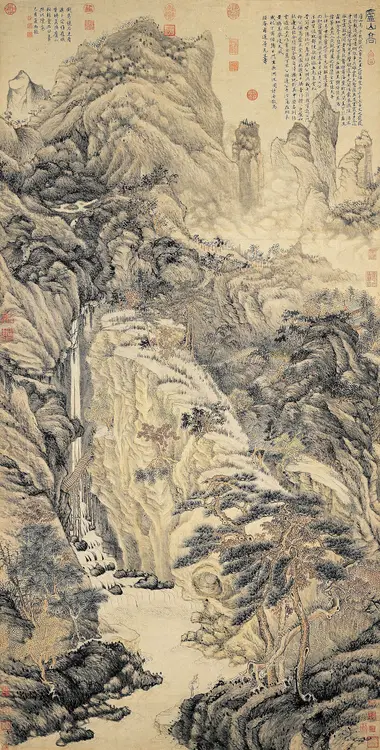
- Shen Zhou (沈周, 1427 to 1509), Ming painter; his Lofty Mount Lu illustrates this page.
- Shen Baozhen (沈葆楨, 1820 to 1879), Qing official and reformer.
- Shen Congwen (沈從文, 1902 to 1988), novelist of western Hunan.
Related pages
- 沈 sits in the opening verse of the Hundred Family Surnames: 蒋沈韩杨, Jiang Shen Han Yang.
- Jiang 蒋, its neighbor in that verse.
- The full list of surname pages.
Frequently asked questions
Is 沈 pronounced shen or chen?
As a surname it is shěn, with a dipping third tone. Unihan also lists chén, but that reading belongs to the old meaning to sink, which modern Chinese writes 沉.
How do you pronounce Shen?
Roughly like the English word shun, with a low dipping tone. It does not rhyme with hen.
Is Sim the same surname as Shen?
Often. Sim is the Hokkien and Teochew spelling of 沈 used in Singapore and Malaysia, and also the Korean reading 심. But Sim can stand for other characters, so check the Chinese characters.
What does the surname Shen mean?
The character 沈 means to sink or submerge. As a surname it is traditionally traced to the ancient state of Shen in today's Henan, not to the meaning of the word.
Sources and open data
- Unihan database entry for U+6C88 沈, Unicode Consortium
- Frequently Occurring Surnames from the 2010 Census, US Census Bureau
- Shěn (surname), English Wikipedia
- 沈姓 (Shen surname), Chinese Wikipedia
- Shen, family name (Q911493), Wikidata