Key facts
- Shi is written 施, the same in simplified and traditional script (9 strokes), and pronounced shī, roughly "shr" with a high level tone.
- The character means to give, to bestow, to carry out, as in 布施 (alms) and 实施 (to implement).
- Tradition traces most Shi families to Shi Fu (施父), a son of Duke Hui of the state of Lu, in today's Shandong.
- It is 23rd in the Hundred Family Surnames and 108th in the extended 2019 ranking for mainland China. It is common in Jiangsu, Fujian and Taiwan.
- Spellings include Shih (Wade-Giles), Sze and Si (Cantonese), Sy, See and Siy (Hokkien, Philippines), Thi (Vietnamese) and Si (Korean 시).
施
Pinyin: Shī
Same character in simplified and traditional: 施
Rank: outside the official top 100
Characters and spellings of 施
| Unicode code point | U+65BD |
|---|---|
| Stroke count | 9 |
| Radical (simplified form) | No. 70 ⽅, plus 5 strokes |
| Dictionary meaning (Unihan) | grant, bestow; give; act; name |
Romanizations by Chinese language
| Language | System | Spelling |
|---|---|---|
| Mandarin | Hanyu Pinyin (PRC standard) | Shī |
| Mandarin | Wade-Giles (Taiwan, older English texts) | Shih |
| Cantonese | Jyutping (Unihan) | si1 |
| Cantonese | Hong Kong / common spellings | Si, Xi |
| Hokkien (Min Nan) | Pe̍h-ōe-jī and common spellings | Si, Soa, Sy, Sua |
| Hakka | Pha̍k-fa-sṳ and common spellings | Sṳ̂, Sii´ |
| Wu (Shanghainese) | Romanization and common spellings | Sy, Si |
Equivalent surnames in other languages
| Language | Form |
|---|---|
| Vietnamese | Thí |
| Korean | Si (시) |
| Japanese | Shi, I |
| Filipino | Sy, Siy, See, Sze, Shi |
These spellings in the 2010 US Census
| Spelling | People | US rank | Asian / Pacific Islander |
|---|---|---|---|
| SU | 12,973 | 2,779 | 93.36% |
| SHI | 10,055 | 3,551 | 96.86% |
| SEE | 9,081 | 3,911 | 19.51% |
| SHIH | 4,935 | 6,833 | 94.1% |
| SY | 4,457 | 7,473 | 71.89% |
| SZE | 1,353 | 19,865 | 91.06% |
| SI | 1,166 | 22,158 | 84.91% |
| THI | 1,024 | 24,446 | 91.31% |
| XI | 963 | 25,620 | 96.57% |
| SUA | 660 | 34,353 | 58.94% |
Counts are people recorded with each spelling among the 265,667,228 people with a surname shared by at least 100 people (US Census Bureau, 2010, public domain). A spelling is not proof of Chinese origin: the last column shows the share of bearers who identified as Asian or Pacific Islander. Together these spellings total 46,846 people, but some of them belong to unrelated surnames (for example English Lee, Hmong Vang or Vietnamese Ly). Search any spelling with the US census surname lookup.
Stroke order
Animation by the open-source Hanzi Writer library (MIT) with stroke data from Make Me a Hanzi (Arphic Public License). Stroke order tool for any character.

Shi (施) is a Chinese surname pronounced shī, roughly “shr” with a high level tone. It is written the same way in simplified and traditional script. It is the 23rd name in the Hundred Family Surnames, in the line 何呂施張 (He, Lü, Shi, Zhang), and ranks 108th in the extended 2019 ranking for mainland China. It is common in Jiangsu, Fujian and Taiwan. Outside the mainland it is spelled Shih (Wade-Giles), Sze or Si (Cantonese), Sy, See or Siy (Hokkien, especially in the Philippines), Sua (another Hokkien reading), Thi (Vietnamese Thí) and Si (Korean 시).
Meaning of the character 施
施 is listed under the radical 方 (radical 70) and has 9 strokes. Its left part is the flag component also found in 旗, “flag”, and 也 on the right gives the sound. The Unihan database glosses it as “grant, bestow; give; act; name”.
In modern Chinese 施 has two main senses. The first is to give: 布施 means alms or charitable giving, and 施舍 to give to the poor. The second is to carry out or apply: 实施 (to implement), 措施 (a measure), 施工 (construction work). Neither sense explains the surname, which comes from the name of an ancestor. Pinyin also spells other surnames Shi, such as 石 and 史, so the character matters.
Origin: Shi Fu of Lu
Chinese Wikipedia gives three origins:
| Origin | Period | Story |
|---|---|---|
| Shi Fu (施父) of Lu | Spring and Autumn | a son of Duke Hui of Lu, of the royal Ji (姬) clan; his descendants took his name |
| a Shang clan of flag makers | early Zhou | one of the Shang clans placed under Kang Shu, lord of Wey, after the Zhou conquest |
| state of Shi (施国) | Xia dynasty | a state at today’s Enshi, in Hubei |
The main line is the first: the descendants of Shi Fu, a son of Duke Hui of Lu, made his name their surname. Lu was ruled by the descendants of the Duke of Zhou, so this branch of the Shi belongs to the great Ji clan. The traditional ancestral seat is Wuxing, today’s Huzhou in Zhejiang. See where Chinese surnames come from for how personal names became surnames, and the Hundred Family Surnames for the classic list.
Shi Lang and the Shi of Taiwan
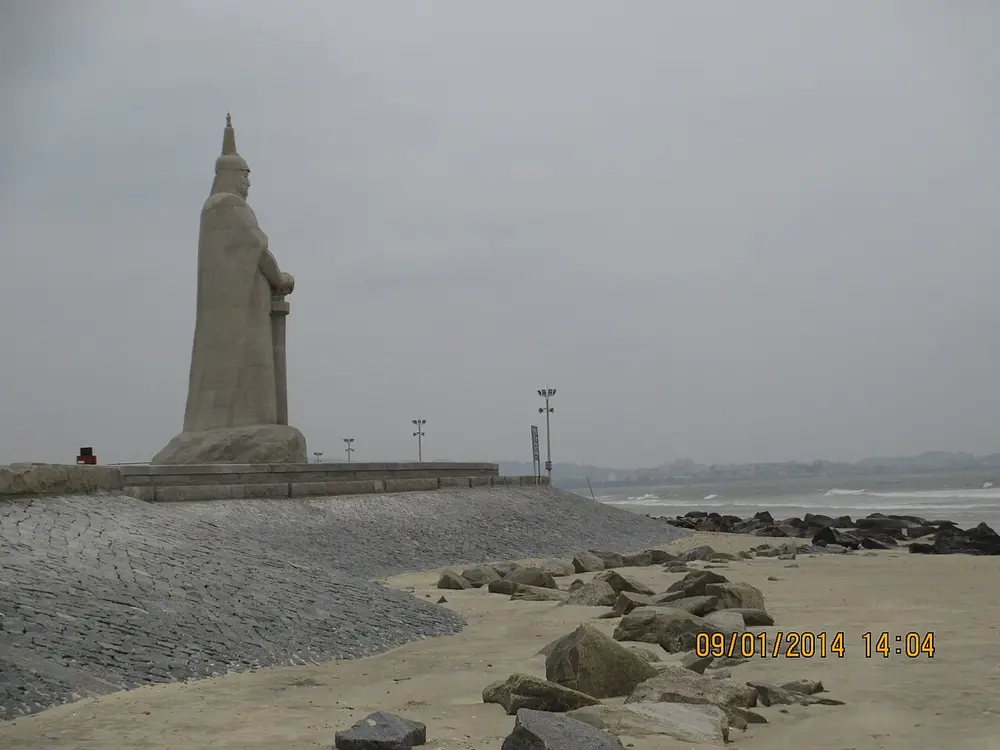
The best-known man of the name is Shi Lang (施琅, 1621 to 1696), shown above in a statue at Jinjiang. Born to a Fujian lineage, he served the Zheng family’s fleet before quarrelling with Koxinga, who killed his father, brother and son. He went over to the Qing, and in 1683 he led 300 warships and 20,000 men against the Zheng kingdom in Taiwan. After defeating its fleet near the Pescadores, he accepted the surrender of Zheng Keshuang. English Wikipedia credits him with persuading the Kangxi Emperor to keep Taiwan rather than abandon it. Taiwan became a prefecture of Fujian in 1684, and Shi Lang was made a marquis.
According to Chinese Wikipedia, most Shi families in Taiwan trace their roots to Jinjiang, in Quanzhou prefecture, and Shi Lang himself came from Yakou in Jinjiang. Another Shi, Shi Shibang (施世榜), began the Babao canal in Changhua in 1719, the largest irrigation work in Qing Taiwan. In 1784 a direct crossing was opened between Lukang and Hanjiang in Jinjiang, tying the two places even closer. Today Lukang and Tainan have the largest Shi communities on the island, a pattern shared by other Quanzhou surnames on the list of the most common surnames in Taiwan.
How Shi is spelled around the world
| Spelling | Language or system | Where you meet it |
|---|---|---|
| Shi | Hanyu Pinyin | mainland China |
| Shih | Wade-Giles | Taiwan, older books |
| Sze / Si | Cantonese (si1) | Hong Kong, Macau |
| Sy / See / Siy | Hokkien (Si), Filipino Chinese | Philippines |
| Sua | Hokkien (Soa) | Philippines, Taiwan |
| Thí | Vietnamese | Vietnam |
| Si (시) | Korean | Korea |
| Shi | Japanese | Japan |
The Philippine forms come from the Hokkien of Jinjiang and Quanzhou, the home of most Chinese Filipinos. The guide to Filipino Chinese surnames explains why many families there carry spellings such as Sy, Tan or Co, and the Hokkien and Teochew guide covers the readings behind them.
Shi in the United States
The 2010 US Census counted:
- Shi: 10,055 people (96.9% Asian or Pacific Islander). Pinyin Shi also covers 石 and 史, so not all are 施.
- Shih: 4,935 people (94.1%), the Taiwan spelling, shared with the same other surnames.
- Sy: 4,457 people (71.9%), the Filipino Chinese spelling.
- Sze: 1,353 people (91.1%) and Si: 1,166 (84.9%), Cantonese spellings.
- Sua: 660 (58.9%) and Siy: 179 (69.3%).
Su (12,973), See (9,081, only 19.5% Asian), Thi (1,024) and Xi (963) also appear in the data panel, but Su is mostly Su 苏, See is mostly an English name, Thị is a common Vietnamese middle name for women, and Xi is the pinyin of other surnames. The US census surname lookup shows these overlaps.
Famous people named Shi
- Xi Shi (西施), one of the Four Beauties of ancient China. Tradition gives her personal name as Shi Yiguang (施夷光).
- Shi Lang (施琅, 1621 to 1696), admiral who took Taiwan for the Qing.
- Shi Zhecun (施蛰存), writer and translator.
- Shih Ming-teh (施明德), Taiwanese activist, a political prisoner for more than 25 years.
- Simon Sze (施敏), electrical engineer, co-inventor of the floating-gate transistor.
- Henry Sy (施至成, 1924 to 2019), founder of the SM group and for years the richest person in the Philippines.
- Shih Wing-ching (施永青), Hong Kong businessman.
Related surnames and pages
- For the surname most often spelled Su, see Su 苏.
- The surname finder lists every character behind a spelling such as Shi, Shih or Sy.
- Wade-Giles spellings such as Shih are explained in the Wade-Giles guide.
- See the full ranking in the 100 most common surnames in China.
Frequently asked questions
Is Sy a Chinese surname?
Yes. Sy is the usual Filipino Chinese spelling of 施, from its Hokkien reading. The best-known example is Henry Sy (施至成), founder of the SM group, who was born in Fujian.
Is Shi 施 the same surname as Shi 石 or Shi 史?
No. Pinyin spells several unrelated surnames Shi, among them 施, 石 and 史. They differ in character and in tone: 施 has the high level tone, 石 the rising tone and 史 the dipping tone.
What does the character 施 mean?
It means to give or bestow, and to carry out or apply. The Unihan database glosses it as grant, bestow, give, act and name. As a surname it comes from the name of an ancestor, not from these meanings.
Why is Shi common in Taiwan?
Many Shi families came from Jinjiang, near Quanzhou in Fujian, across the strait from Taiwan. The admiral Shi Lang, who took Taiwan for the Qing in 1683, came from Jinjiang. Lukang and Tainan have the largest Shi communities.
Sources and open data
- Unihan database entry for U+65BD 施, Unicode Consortium
- Frequently Occurring Surnames from the 2010 Census, US Census Bureau
- Shī (surname), English Wikipedia
- 施姓 (Shi surname), Chinese Wikipedia
- Shi Lang, English Wikipedia
- Henry Sy, English Wikipedia
- Shi, family name (Q4523552), Wikidata