Key facts
- Ding is written 丁, the same in simplified and traditional script, and pronounced dīng, roughly "ding" with a high level tone.
- With only 2 strokes, it is one of the simplest characters in Chinese. Only 一 and 乙 have fewer.
- The character first drew a nail. It later came to mean an adult man and the fourth of the ten Heavenly Stems.
- Tradition traces most Ding families to Duke Ding of Qi, son of Jiang Ziya. A famous Hui lineage near Quanzhou claims descent from the Muslim governor Sayyid Ajjal Shams al-Din.
- It ranks 48th in mainland China in the Ministry of Public Security's 2019 report. Spellings include Ting (Taiwan, Hong Kong, Philippines), Teng (Hokkien), Đinh (Vietnamese) and Jeong (Korean 정).
丁
Pinyin: Dīng
Same character in simplified and traditional: 丁
Rank in mainland China: 48 of the top 100 (Ministry of Public Security, 2019 report)
Characters and spellings of 丁
| Unicode code point | U+4E01 |
|---|---|
| Stroke count | 2 |
| Radical (simplified form) | No. 1 ⼀, plus 1 stroke |
| Dictionary meaning (Unihan) | male adult; robust, vigorous; 4th heavenly stem |
Romanizations by Chinese language
| Language | System | Spelling |
|---|---|---|
| Mandarin | Hanyu Pinyin (PRC standard) | Dīng |
| Mandarin | Wade-Giles (Taiwan, older English texts) | Ting |
| Cantonese | Jyutping (Unihan) | ding1 |
| Cantonese | Hong Kong / common spellings | Ting, Ding |
| Hokkien (Min Nan) | Pe̍h-ōe-jī and common spellings | Teng |
| Hakka | Pha̍k-fa-sṳ and common spellings | Tén, Ten |
| Gan | Romanization and common spellings | Tiang |
| Wu (Shanghainese) | Romanization and common spellings | Tin |
Equivalent surnames in other languages
| Language | Form |
|---|---|
| Vietnamese | Đinh |
| Korean | Jeong (정) |
| Japanese | Tei |
| Filipino | Ting, Tin |
These spellings in the 2010 US Census
| Spelling | People | US rank | Asian / Pacific Islander |
|---|---|---|---|
| DING | 4,973 | 6,784 | 93.16% |
| TENG | 3,433 | 9,473 | 92.98% |
| TING | 3,103 | 10,382 | 87.59% |
| TIN | 1,158 | 22,260 | 86.96% |
| TEN | 452 | 47,006 | 44.69% |
Counts are people recorded with each spelling among the 265,667,228 people with a surname shared by at least 100 people (US Census Bureau, 2010, public domain). A spelling is not proof of Chinese origin: the last column shows the share of bearers who identified as Asian or Pacific Islander. Together these spellings total 13,119 people, but some of them belong to unrelated surnames (for example English Lee, Hmong Vang or Vietnamese Ly). Search any spelling with the US census surname lookup.
Stroke order
Animation by the open-source Hanzi Writer library (MIT) with stroke data from Make Me a Hanzi (Arphic Public License). Stroke order tool for any character.

Ding (丁) is a Chinese surname pronounced dīng, roughly “ding” with a high level tone. It is written the same way in simplified and traditional script and ranks 48th in mainland China in the 2019 official list. With only two strokes, it is one of the shortest surnames to write. Outside the mainland it is spelled Ting (Taiwan, Hong Kong and the Philippines), Teng (Hokkien), Tin (Wu and some Filipino families), Đinh (Vietnamese) and Jeong (Korean 정).
Meaning of the character 丁
丁 is usually explained as an early drawing of a nail seen from the side: a flat head and a pointed shank. That sense is now written 钉 (dīng), with the metal radical added. The radical of 丁 itself is 一, and the whole character has just two strokes. English Wikipedia notes that only 一 and 乙 have fewer.
From an early date 丁 also meant a grown man, especially as a unit for tax and labor: imperial registers counted households by their 丁, and 人丁 still means family members or population. The same sense survives in 园丁 (gardener) and 家丁 (household servant). 丁 is also the fourth of the ten Heavenly Stems used to count years and days, which is why the Unihan database gives “male adult; robust, vigorous; 4th heavenly stem”.
Origin: Duke Ding of Qi
Chinese genealogies, as summarized in English Wikipedia, give several sources:
| Source | Period | Story |
|---|---|---|
| Duke Ding of Qi | Western Zhou | descendants used his posthumous name |
| a lord of Ding | Shang dynasty | the earliest recorded use of the name |
| Duke Ding of Song | Spring and Autumn | a second line of descendants |
| Sun Kuang | Three Kingdoms | ordered by Sun Quan to change his name to Ding |
The main line is the first. Duke Ding of Qi, also called Lü Ji, was the son of Jiang Ziya, the general who helped found the Zhou dynasty and received the state of Qi. Ding was his posthumous title, and his descendants made it their surname. Most Ding families therefore count themselves as part of the great Jiang clan, together with Jiang 姜 and Lü 吕. The second line goes back to the state of Song 宋, through Duke Ding of Song.
The Three Kingdoms story is the oddest. According to the tradition, the Wu general Sun Kuang accidentally burned an army’s supplies. Sun Quan, his elder brother, was angry and did not want to share a surname with him, so he ordered him to call himself Ding. The traditional homeland of the Ding is placed near Dingtao in Shandong. See where Chinese surnames come from for how posthumous titles became family names.
The Hui Ding of Quanzhou
Ding is also one of the best-known surnames among the Hui, China’s Chinese-speaking Muslims. The usual explanation is that it comes from the last syllable of the Arabic honorific al-Din or ud-Din.
The best-documented case is the Ding lineage of Chendai, near Quanzhou in Fujian. It traces its descent to Sayyid Ajjal Shams al-Din, a Muslim from Bukhara who served the Mongol Yuan dynasty as governor of Yunnan in the 13th century. English Wikipedia reports that many members of the lineage no longer practice Islam, yet still identify as Hui and avoid offering pork to their ancestors. One branch moved to Taisi in Yunlin County, Taiwan, in the 19th century and built a mosque that later became a Taoist temple. Other branches settled in the Philippines, Indonesia, Malaysia and Singapore.
A Hui legend from Ningxia adds that the surnames Na, Su, La and Ding were formed by dividing the Chinese transcription of the name of Shams al-Din’s son, Nasruddin. It is a story, not proof, but it shows how Hui families explain their names.
How Ding is spelled around the world
| Spelling | Language or system | Where you meet it |
|---|---|---|
| Ding | Hanyu Pinyin | mainland China |
| Ting | Wade-Giles, Cantonese (ding1) | Taiwan, Hong Kong, Philippines |
| Teng | Hokkien | Singapore, Malaysia |
| Ten / Tén | Hakka | Malaysia |
| Tin | Wu, Filipino Chinese | Philippines |
| Đinh | Vietnamese | Vietnam |
| Jeong (정) | Korean | Korea |
| Tei | Japanese | Japan |
Cantonese keeps the initial d but Hong Kong spelling writes it t, which is why 丁 becomes Ting there too. The Wade-Giles guide and the Hokkien and Teochew guide explain these shifts.
Ding in the United States
The 2010 US Census counted:
- Ding: 4,973 people (93.2% Asian or Pacific Islander).
- Teng: 3,433 people (93.0%). Many are Hokkien Ding, but Teng is also the Wade-Giles spelling of Deng 邓.
- Ting: 3,103 people (87.6%), the Taiwan and Hong Kong spelling.
- Tin: 1,158 people (87.0%), shared with the Cantonese spelling of 田 Tian.
- Ten: 452 people (44.7%).
Vietnamese Đinh appears as Dinh in US records and is counted separately. The US census surname lookup shows these overlaps.
Famous people named Ding
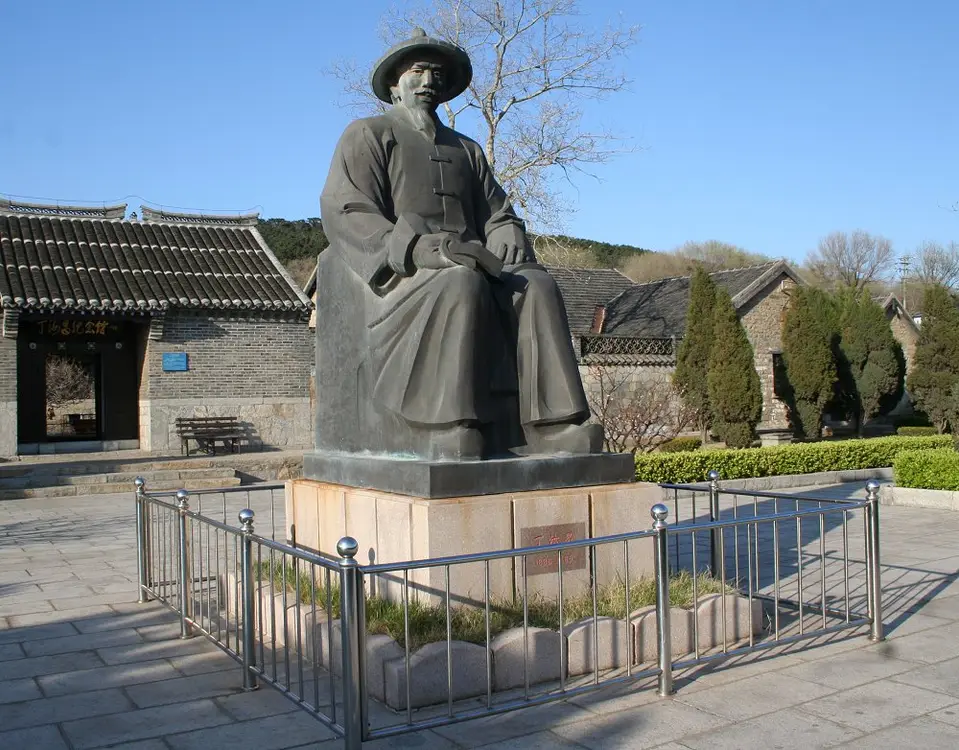
- Ding Ruchang (丁汝昌, 1836 to 1895), commander of the Qing Beiyang Fleet in the First Sino-Japanese War. His statue on Liugong Island is shown above.
- Samuel C. C. Ting (丁肇中, born 1936), physicist, Nobel Prize in Physics 1976, an example of the spelling Ting.
- Ding Lei (丁磊, born 1971), founder of the internet company NetEase.
- Ding Junhui (丁俊晖, born 1987), snooker player.
- Ding Liren (丁立人, born 1992), chess grandmaster and former world champion.
Related surnames and pages
- Ding shares its Jiang clan ancestry with Jiang 姜 and Lü 吕.
- The surname finder lists every character behind a spelling such as Ting or Teng.
- Filipino forms are covered in the guide to Filipino Chinese surnames.
- See the full ranking in the 100 most common surnames in China.
Frequently asked questions
What does the surname Ding mean?
The character 丁 began as a picture of a nail, a sense now written 钉. It came to mean an adult man, as in 人丁 (family members) and 园丁 (gardener), and it is the fourth of the ten Heavenly Stems. As a surname it is traditionally traced to the posthumous name of Duke Ding of Qi.
Is Ting the same surname as Ding?
Usually. Ting is the Wade-Giles and Cantonese spelling of 丁, used in Taiwan, Hong Kong and the Philippines. The physicist Samuel C. C. Ting (丁肇中) is an example.
Are Ding families Muslim?
Most are not. But one well-known Ding lineage in Chendai, near Quanzhou in Fujian, is Hui and traces its descent to the Yuan dynasty governor Sayyid Ajjal Shams al-Din. Many of its members no longer practice Islam but keep a Hui identity.
Is Teng the same surname as Ding?
Sometimes. Teng is the Hokkien spelling of 丁, common in Singapore and Malaysia. But Teng is also the Wade-Giles spelling of 邓 Deng, so in Taiwan it usually means Deng.
Sources and open data
- Unihan database entry for U+4E01 丁, Unicode Consortium
- Frequently Occurring Surnames from the 2010 Census, US Census Bureau
- Ding (surname), English Wikipedia
- 丁姓 (Ding surname), Chinese Wikipedia
- Sayyid Ajjal Shams al-Din Omar, English Wikipedia
- Ding, family name (Q1410170), Wikidata