Key facts
- Hong is written 洪, the same in simplified and traditional script (9 strokes), and pronounced hóng, with a rising tone.
- The character means flood, vast. Legend says the clan descends from Gonggong (共工), the water spirit, and added the water radical to 共.
- It is 184th in the Hundred Family Surnames and 109th in the extended 2019 ranking for mainland China, but far more common in Taiwan, where it is among the 20 most common surnames.
- In Korea the same character is the surname Hong (홍), whose largest clan is the Namyang Hong.
- Spellings include Hung (Wade-Giles, Cantonese), Ang (Hokkien), Fung (Hakka), Ung (Wu), Hồng (Vietnamese) and Kō (Japanese).
洪
Pinyin: Hóng
Same character in simplified and traditional: 洪
Rank: outside the official top 100
Characters and spellings of 洪
| Unicode code point | U+6D2A |
|---|---|
| Stroke count | 9 |
| Radical (simplified form) | No. 85 ⽔, plus 6 strokes |
| Dictionary meaning (Unihan) | vast, immense; flood, deluge |
Romanizations by Chinese language
| Language | System | Spelling |
|---|---|---|
| Mandarin | Hanyu Pinyin (PRC standard) | Hóng |
| Mandarin | Wade-Giles (Taiwan, older English texts) | Hung |
| Cantonese | Jyutping (Unihan) | hung4 |
| Cantonese | Hong Kong / common spellings | Hung, Huhng |
| Hokkien (Min Nan) | Pe̍h-ōe-jī and common spellings | Âng, Hông, Ang, Hong |
| Hakka | Pha̍k-fa-sṳ and common spellings | Fùng, Fung |
| Wu (Shanghainese) | Romanization and common spellings | Ghon, Won, Ung One |
Equivalent surnames in other languages
| Language | Form |
|---|---|
| Vietnamese | Hồng |
| Korean | Hong (홍) |
| Japanese | Kō |
| Filipino | Ang, Hong |
These spellings in the 2010 US Census
| Spelling | People | US rank | Asian / Pacific Islander |
|---|---|---|---|
| HONG | 31,670 | 1,106 | 88.12% |
| FUNG | 8,837 | 4,024 | 87.56% |
| HUNG | 7,137 | 4,932 | 87.73% |
| UNG | 4,519 | 7,369 | 91.79% |
| WON | 4,309 | 7,702 | 92.09% |
| ANG | 3,413 | 9,525 | 84.18% |
Counts are people recorded with each spelling among the 265,667,228 people with a surname shared by at least 100 people (US Census Bureau, 2010, public domain). A spelling is not proof of Chinese origin: the last column shows the share of bearers who identified as Asian or Pacific Islander. Together these spellings total 59,885 people, but some of them belong to unrelated surnames (for example English Lee, Hmong Vang or Vietnamese Ly). Search any spelling with the US census surname lookup.
Stroke order
Animation by the open-source Hanzi Writer library (MIT) with stroke data from Make Me a Hanzi (Arphic Public License). Stroke order tool for any character.

Hong (洪) is a Chinese surname pronounced hóng, with a rising tone. It is written the same way in simplified and traditional script. It is 184th in the Hundred Family Surnames and 109th in the extended 2019 ranking for mainland China, where it is strongest in the south: Guangdong, Guangxi, southern Jiangxi and southern Fujian. It is far more common in Taiwan, where English Wikipedia ranks it 15th in 2005, and in Korea, where it is the surname Hong (홍). Outside the mainland it is spelled Hung (Wade-Giles and Cantonese), Ang (Hokkien and Teochew), Fung (Hakka), Ung or Won (Wu), Hồng (Vietnamese) and Kō (Japanese).
Meaning of the character 洪
洪 combines the water radical 氵 (radical 85) with 共 (gòng), which gives the sound. The Unihan database glosses it as “vast, immense; flood, deluge”. The everyday word for a flood is 洪水, and 洪亮 describes a loud, resonant voice. The meaning fits the family’s own legend, which ties the surname to the water spirit Gonggong (共工). Pinyin also spells a few rarer surnames Hong, such as 弘 and 宏, so the character matters.
Origin: from Gong 共 to Hong 洪
Chinese and English Wikipedia list several origins:
| Origin | Period | Story |
|---|---|---|
| Gonggong (共工) | legendary | descendants of the water spirit added the water radical to 共 |
| state of Gong (共国) | Zhou dynasty | after Wey destroyed the state of Gong, its descendants changed 共 to 洪 to escape revenge |
| name taboo | Tang and Five Dynasties | families named 宏 or 弘 switched to 洪 to avoid an emperor’s personal name |
| Weng (翁) family | Song | one of six sons of Weng Qiandu, in the Six Laurels story |
The main legend is the first. According to English Wikipedia, the Gonggong clan descended from the Yan Emperor, whose surname was Jiang 姜, and was in charge of managing the waters. When the legendary ruler Yao banished them, they added the water radical to 共 and became 洪. Chinese Wikipedia places the old Gong lands at today’s Huixian, in Henan. The traditional ancestral seats are Dunhuang in Gansu and Yuzhang (Nanchang) in Jiangxi, and 敦煌堂 (Dunhuang hall) is one of the family’s hall names. See where Chinese surnames come from for how place names and the taboo on emperors’ names shaped many surnames.
The Six Laurels: one family, six surnames
A popular story in southern Fujian, Taiwan and Southeast Asia tells of Weng Qiandu (翁乾度), of the Song period, whose six sons all passed the imperial examinations. The brothers are said to have taken six different surnames: Hong 洪, Jiang 江, Weng 翁, Fang 方, Gong 龚 and Wang 汪. Their descendants call themselves the Six Laurels (六桂), and the hall name 六桂堂 is shared by all six families. Chinese Wikipedia notes that the reliability of the story is doubtful. It is best read as a family tradition, not as proof that all six surnames share one ancestor. See also Wang 汪.
Hong Xiuquan and the Taiping Rebellion
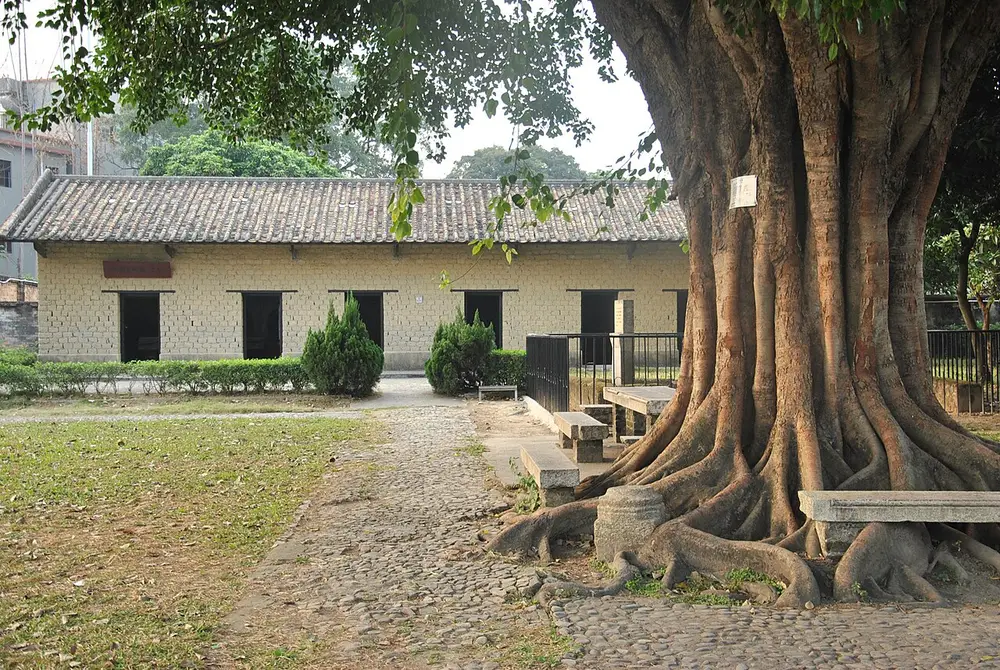
The best-known man of the name is Hong Xiuquan (洪秀全, 1814 to 1864), whose former home in Huadu, Guangzhou, is shown above. Born into a Hakka family in the village of Fuyuanshui, he failed the imperial examinations several times and then reported visions in which he was told that he was the younger brother of Jesus Christ. His God Worshipping Society grew into an army, and after the Jintian uprising of January 1851 he proclaimed the Taiping Heavenly Kingdom, with himself as Heavenly King. His forces took Nanjing in March 1853 and renamed it Tianjing, the Heavenly Capital. He died in June 1864, a month before Nanjing fell to the Qing. His cousin Hong Rengan (洪仁玕) became one of the kingdom’s leaders in its last years.
How Hong is spelled around the world
| Spelling | Language or system | Where you meet it |
|---|---|---|
| Hong | Hanyu Pinyin | mainland China |
| Hung | Wade-Giles | Taiwan, older books |
| Hung | Hong Kong Cantonese (hung4) | Hong Kong, Macau |
| Ang / Hong | Hokkien, Teochew | Singapore, Malaysia, Philippines, Taiwan |
| Fung | Hakka | Hakka communities |
| Ung / Won | Wu (Shanghainese) | rare in English |
| Hồng | Vietnamese | Vietnam |
| Hong (홍) | Korean | Korea |
| Kō | Japanese | Japan |
Chinese Wikipedia puts the Korean Hong at about 1.13% of the population of South Korea. The largest Korean clan is the Namyang Hong, which English Wikipedia describes as unusual for joining two unrelated family lines under one name. See Korean surnames and Chinese characters and the Hokkien and Teochew guide, which explains why 洪 becomes Ang.
Hong in the United States
The 2010 US Census counted:
- Hong: 31,670 people (88.1% Asian or Pacific Islander). Hong is also the Korean surname 홍 and a Cantonese spelling of 熊 Xiong.
- Hung: 7,137 people (87.7%), from Taiwan and Hong Kong, shared with other surnames read hung.
- Ang: 3,413 people (84.2%), shared with Hokkien 汪 and other surnames.
Fung (8,837), Ung (4,519) and Won (4,309) also appear in the data panel, but in the United States Fung is mostly the Cantonese spelling of Feng 冯, and Won is mostly a Korean surname written with other characters. The US census surname lookup shows these overlaps.
Famous people named Hong
- Hong Hao (洪皓), Song envoy held by the Jin for 15 years without yielding, and his son Hong Mai (洪迈), scholar.
- Hong Chengchou (洪承畴, 1593 to 1665), Ming general who went over to the Qing.
- Hong Liangji (洪亮吉, 1746 to 1809), Qing scholar.
- Hong Xiuquan (洪秀全, 1814 to 1864), leader of the Taiping Rebellion.
- Sammo Hung (洪金宝, born 1952), Hong Kong actor and director, an example of the spelling Hung.
- James Hong (born 1929), American actor and voice actor.
- Ang Kiukok (1931 to 2005), Filipino painter, an example of the spelling Ang.
Related surnames and pages
- For the surname most often spelled Fung, see Feng 冯.
- Hong is common in Taiwan; see the most common surnames in Taiwan.
- The surname finder lists every character behind a spelling such as Hong, Hung or Ang.
- See the full ranking in the 100 most common surnames in China.
Frequently asked questions
What does the surname Hong mean?
The character 洪 means a flood or something vast, as in 洪水 (flood). The surname is linked by legend to Gonggong, a water spirit of Chinese myth, whose descendants are said to have added the water radical to the character 共.
Is Ang the same surname as Hong?
Often. Ang is the Hokkien and Teochew spelling of 洪 in Singapore, Malaysia and the Philippines. But Ang is also a Hokkien spelling of 汪 Wang and of other surnames, so only the Chinese character settles the question.
Is Hung always Hong 洪?
No. Hung is the Wade-Giles and Cantonese spelling of 洪, but Wade-Giles also writes 弘 and 宏 as Hung, and Cantonese uses Hung for 熊 Xiong and 孔 Kong. In the United States, many people named Hung come from Taiwan or Hong Kong, with any of these characters.
Is the Korean surname Hong the same as the Chinese Hong?
It is written with the same character, 洪. Korean Hong families belong to their own clans, such as the Namyang Hong and the Pungsan Hong, each with its own founder. Of about 241 clans once claimed, only four survive.
Sources and open data
- Unihan database entry for U+6D2A 洪, Unicode Consortium
- Frequently Occurring Surnames from the 2010 Census, US Census Bureau
- Hong (Chinese surname), English Wikipedia
- 洪姓 (Hong surname), Chinese Wikipedia
- Hong (Korean surname), English Wikipedia
- Hong Xiuquan, English Wikipedia
- Hong, family name (Q4502336), Wikidata