Key facts
- Fan is written 范, the same in simplified and traditional script (9 strokes), and pronounced fàn, roughly "fahn" with a falling tone.
- The character means a model, pattern or mold, as in 模范 (model) and 规范 (norm). In simplified script it also replaced 範.
- Tradition traces the surname to Shi Hui, a commander of the state of Jin who received the fief of Fan, in today's Fan County, Henan.
- It ranks 58th in mainland China in the Ministry of Public Security's 2019 report and 46th in the Hundred Family Surnames.
- Its Vietnamese form Phạm is one of the five most common surnames in Vietnam. Other spellings include Faan (Cantonese), Huan or Hoan (Hokkien), Fam (Hakka) and Beom (Korean 범).
范
Pinyin: Fàn
Same character in simplified and traditional: 范
Rank in mainland China: 58 of the top 100 (Ministry of Public Security, 2019 report)
Characters and spellings of 范
| Unicode code point | U+8303 |
|---|---|
| Stroke count | 9 |
| Radical (simplified form) | No. 140 ⾋, plus 5 strokes |
| Dictionary meaning (Unihan) | surname; bee-like insect |
Romanizations by Chinese language
| Language | System | Spelling |
|---|---|---|
| Mandarin | Hanyu Pinyin (PRC standard) | Fàn |
| Mandarin | Wade-Giles (Taiwan, older English texts) | Fan |
| Cantonese | Jyutping (Unihan) | faan6 |
| Cantonese | Hong Kong / common spellings | Fan |
| Hokkien (Min Nan) | Pe̍h-ōe-jī and common spellings | Hoān (X, Z, K, T), Hoǎn (Q)Hwan, Huang, Hoan, Hwan |
| Hakka | Pha̍k-fa-sṳ and common spellings | Fam, Hoan, Hwan |
| Gan | Romanization and common spellings | Fàn |
| Wu (Shanghainese) | Romanization and common spellings | Ve, Vae |
Equivalent surnames in other languages
| Language | Form |
|---|---|
| Vietnamese | Phạm |
| Korean | Beom (범) |
| Japanese | Han |
| Filipino | Juan, Hwan |
These spellings in the 2010 US Census
| Spelling | People | US rank | Asian / Pacific Islander |
|---|---|---|---|
| PHAM | 84,320 | 370 | 96.33% |
| HUANG | 72,328 | 456 | 97.14% |
| FAN | 8,441 | 4,197 | 94.78% |
| JUAN | 7,350 | 4,808 | 20.83% |
| FAM | 392 | 52,851 | 21.68% |
| VE | 149 | 116,829 | 48.99% |
Counts are people recorded with each spelling among the 265,667,228 people with a surname shared by at least 100 people (US Census Bureau, 2010, public domain). A spelling is not proof of Chinese origin: the last column shows the share of bearers who identified as Asian or Pacific Islander. Together these spellings total 172,980 people, but some of them belong to unrelated surnames (for example English Lee, Hmong Vang or Vietnamese Ly). Search any spelling with the US census surname lookup.
Stroke order
Animation by the open-source Hanzi Writer library (MIT) with stroke data from Make Me a Hanzi (Arphic Public License). Stroke order tool for any character.

Fan (范) is a Chinese surname pronounced fàn, roughly “fahn” with a falling tone. It is written the same way in simplified and traditional script and ranks 58th in mainland China in the 2019 official list. Its history runs from the noble Fan clan of the state of Jin to the Song statesman Fan Zhongyan. In Vietnam the same character is read Phạm, one of the country’s five most common surnames, which is why Pham far outnumbers Fan in the United States. Other spellings include Faan (Cantonese), Huan or Hoan (Hokkien), Fam (Hakka) and Beom (Korean 범).
Meaning of the character 范
范 is built from the grass radical 艹 (radical 140) and 氾 (fàn), which gives the sound. The Unihan database glosses it as “surname; bee-like insect”, an old sense that has disappeared from use.
In modern Chinese 范 means a model, pattern or mold: 模范 (a model worker or example), 规范 (norm, standard), 示范 (to demonstrate), 范围 (scope). That meaning originally belonged to a different character, 範, which drew a mold for casting. When characters were simplified in the 1950s, 範 was merged into the simpler 范, which had always been the surname. In traditional script the two are still kept apart, and the surname is never written 範. The guide to simplified and traditional surname characters covers similar cases.
Origin: Shi Hui and the fief of Fan
The main line is unusually well documented. English and Chinese Wikipedia, following the Tang genealogy Xingzuan, trace it to the descendants of the legendary Emperor Yao:
| Generation | Person | Event |
|---|---|---|
| ancestor | Du Bo (杜伯), lord of Du | killed by King Xuan of Zhou |
| son | Xi Shu (隰叔) | fled to the state of Jin and became its judge (士师) |
| grandson | Shi Wei (士蒍) | first to use the surname Shi, from the office |
| great-grandson | Shi Hui (士会), also Fan Wuzi | given the fief of Fan; his descendants became the Fan |
Shi Hui commanded the armies of Jin in the 7th century BC and received Fan, in today’s Fan County in Henan, as his fief. His sons and grandsons were chief ministers of Jin, and the Fan became one of the six great families that dominated the state, alongside the Zhao, Han, Wei, Zhonghang and Zhi. In 490 BC the Fan and Zhonghang were defeated by the other four, and the clan scattered. The families that defeated them later divided Jin among themselves, as told on the pages for Zhao 赵 and Wei 魏.
The same story explains why some families named Du 杜 and Shi (士) count the Fan as kin. English Wikipedia also lists smaller lines from the Mi (芈) clan of Chu, from Jurchen and Manchu families, and from rulers of Champa in what is now Vietnam. See where Chinese surnames come from for how fiefs became family names.
Fan Li and Fan Zhongyan
Two men made the name famous. Fan Li (5th century BC) was the adviser who helped King Goujian of Yue destroy the rival state of Wu. Legend says he then left politics, sailed away with Xi Shi, one of the Four Beauties of ancient China, and became a rich merchant under the name Tao Zhugong. Chinese businesses still honor him as a patron of trade.
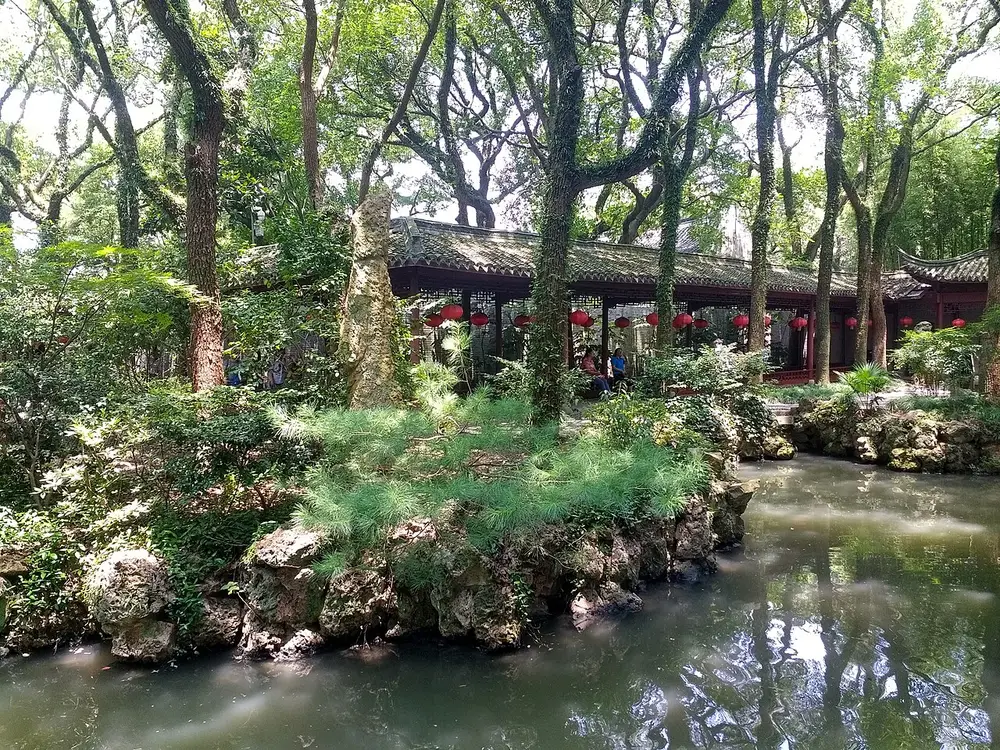
Fan Zhongyan (范仲淹, 989 to 1052) was a Song statesman who led the short-lived Qingli reforms. His essay on the Yueyang Tower contains a line every Chinese student learns: an official should “be the first to worry about the world’s troubles and the last to enjoy its pleasures”. He also founded a charitable estate to support poor members of his clan, a model copied by Chinese lineages for centuries. Much later, the Ming official Fan Qin built the Tianyi Pavilion in Ningbo in 1561, shown above, now one of the oldest private libraries in China.
How Fan is spelled around the world
| Spelling | Language or system | Where you meet it |
|---|---|---|
| Fan | Pinyin, Wade-Giles, Cantonese (faan6) | mainland China, Taiwan, Hong Kong |
| Huan / Hoan / Hwan | Hokkien, Teochew | Singapore, Malaysia, Philippines |
| Fam | Hakka | Malaysia |
| Ve / Vae | Wu (Shanghainese) | rare in English |
| Phạm | Vietnamese | Vietnam |
| Beom (범) | Korean | Korea |
| Han | Japanese | Japan |
Do not confuse Phạm (范) with Phan, which is the Vietnamese reading of Pan 潘. The guide to Vietnamese surnames and Chinese characters explains how Vietnamese readings work, and Korean surnames and Chinese characters covers Beom.
Fan in the United States
The 2010 US Census shows how much larger the Vietnamese branch is:
- Pham: 84,320 people (96.3% Asian or Pacific Islander), almost all Vietnamese.
- Fan: 8,441 people (94.8%), the Chinese spelling.
- Fam: 392 people (21.7%).
- Ve: 149 people (49.0%).
Juan (7,350) and Huang (72,328) appear in the data panel as Filipino and Hokkien forms, but in the census Juan is mostly a Spanish name and Huang is almost always Huang 黄. The US census surname lookup shows these overlaps.
Famous people named Fan
- Fan Li (5th century BC), adviser to the king of Yue and legendary merchant.
- Fan Ye (范晔, 398 to 445), historian who compiled the Book of the Later Han.
- Fan Kuan (范宽), Northern Song landscape painter.
- Fan Zhongyan (范仲淹, 989 to 1052), statesman and reformer.
- Fan Bingbing (范冰冰, born 1981), actress.
- Fan Zhendong (樊振东) is often listed by mistake: his surname is 樊, a different character also spelled Fan.
Related surnames and pages
- For the Vietnamese surname that looks like Phạm, see Pan 潘.
- Fan is the 46th name in the Hundred Family Surnames.
- The surname finder lists every character behind a spelling such as Fan or Huan.
- See the full ranking in the 100 most common surnames in China.
Frequently asked questions
What does the surname Fan mean?
The character 范 now means a model or pattern, a sense it took over from 範 when characters were simplified. As a surname it comes from a place name, the fief of Fan in the state of Jin, so it means, in effect, a person from Fan.
Is Pham the same surname as Fan?
Yes. Phạm is the Sino-Vietnamese reading of 范. It is one of the five most common surnames in Vietnam, so most people named Pham in the United States are Vietnamese, not Chinese.
Is Phạm the same as Phan?
No. Phan is the Vietnamese reading of 潘, the Chinese surname Pan. Phạm and Phan look alike in English but come from two different characters.
Is Fan related to the word for rice, fàn?
No. Rice or a meal is 饭 fàn, a different character with the same sound and tone. The surname 范 has nothing to do with food.
Sources and open data
- Unihan database entry for U+8303 范, Unicode Consortium
- Frequently Occurring Surnames from the 2010 Census, US Census Bureau
- Fan (surname), English Wikipedia
- 范姓 (Fan surname), Chinese Wikipedia
- Phạm, English Wikipedia
- Tianyi Ge, English Wikipedia
- Fan, family name (Q11134579), Wikidata