Key facts
- In the United States, heatwaves kill more people than hurricanes, floods and tornadoes combined, and the Chicago heatwave of 1995 caused about 739 deaths in five days.
- US urban areas run 1 to 7 °F (0.55 to 3.9 °C) warmer by day and 2 to 5 °F (1.1 to 2.8 °C) warmer at night than their surroundings.
- A 2025 review of 115 studies found that urban trees generally cool more than other kinds of vegetation.
- Whitening roofs on a planetary scale is a different matter: a 2009 Royal Society report priced white roofs over 1% of land at about $300 billion per year and called the method one of the least effective.

Heat is the quietest of the major weather hazards. It destroys little property, so it makes fewer headlines than a flood, yet it kills many people each year. The engineering response, from planting trees to painting roofs white, is attractive because it promises to cool a place without waiting for emissions to fall. This note sets out what the sources say about the scale of the danger, the extra heat that cities add, and how much each remedy can realistically do. It belongs to the science notes on climate and cities.
How deadly a heatwave is
English Wikipedia’s article on heat waves cites a source stating that heat waves kill more people in the United States than hurricanes, floods and tornadoes combined. It gives an average of about 400 direct heat deaths per year in the country. The worst single case it describes is Chicago in 1995, with about 739 deaths in five days.
Europe supplies a larger example. The article on the 2003 European heat wave reports the hottest summer in Europe since at least 1540 and more than 70,000 deaths, including 14,802 in France according to the French National Institute of Health.
Exposure is growing. The heat wave article cites a 2021 study of 13,115 cities, which found that the number of people exposed to a wet-bulb globe temperature above 30 degrees Celsius tripled between 1983 and 2016. How scientists judge whether climate change made a given heatwave more likely is covered in how climate change influences extreme weather.
Why cities run hotter
Wikipedia’s article on the urban heat island effect describes a city that is warmer than its surroundings. Urban areas cover about 0.5 percent of the Earth’s land, yet hold more than half of the world’s population, so the effect reaches a large share of people. In the United States, urban areas are 1 to 7 °F (0.55 to 3.9 °C) warmer than the surrounding countryside by day and 2 to 5 °F (1.1 to 2.8 °C) warmer at night.
The night-time figure shows that the difference does not disappear after sunset. The article lists the main tools for reducing the effect: green roofs, light-colored surfaces and ventilation corridors. It also cites a 2025 review of 115 studies concluding that urban trees generally provide greater cooling than other kinds of vegetation.
What each remedy does
| Measure | What the sources say |
|---|---|
| Urban trees | Generally greater cooling than other vegetation, in a review of 115 studies (2025) |
| Green roofs | Cut runoff in rainstorms by more than 75 percent in a study cited by the EPA (2004); cooling is not quantified in that study |
| Light surfaces and cool roofs | Mitigation option for urban heat; cost and scale are discussed below |
| Ventilation corridors | Named as an urban design option; no published figures cited here |
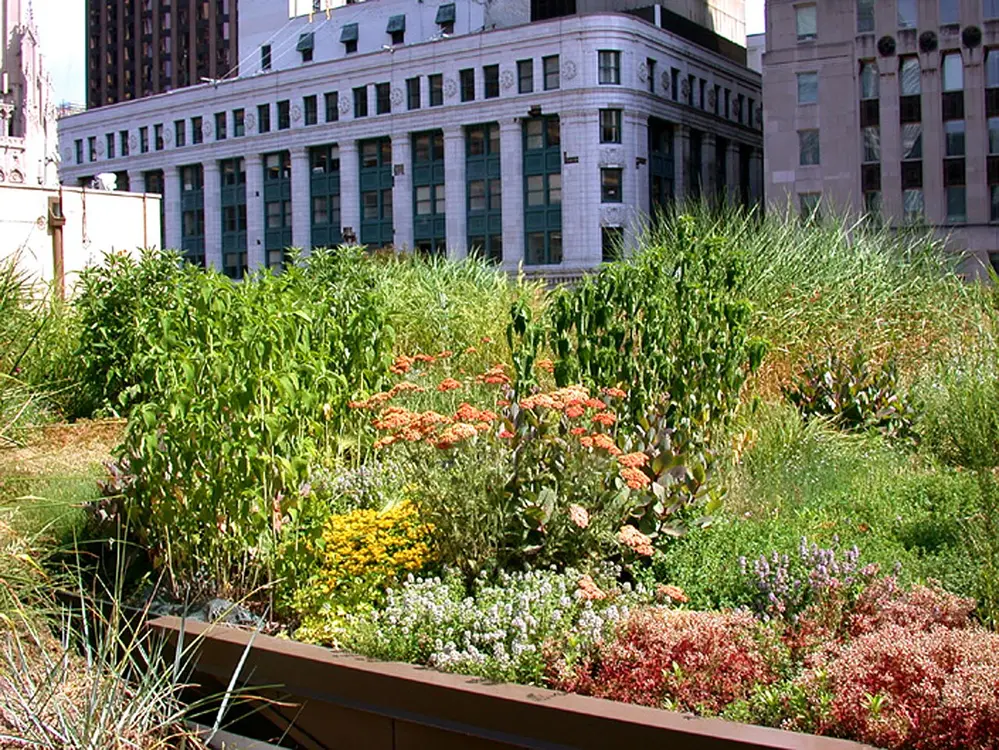
The honest summary is that trees are the best-supported option for cooling streets, while green roofs have a clearly documented benefit for stormwater. The Chicago City Hall green roof pictured here is described on Commons as a pilot green roof project. Its value for cooling in a heatwave is not documented in the sources cited here.
The white roof idea at planetary scale
A different proposal treats roofs as a climate-engineering tool, using bright surfaces to reflect sunlight and cool the whole planet. Wikipedia’s article on cool roofs reports the verdict of the IPCC in 2018: the effect on global temperature is small, though regional changes of 1 to 3 °C are recognized. It adds that a 2009 Royal Society report estimated that painting roofs white over 1 percent of the land surface would cost about $300 billion per year, and described this as one of the least effective and most expensive methods considered. The forcing involved is small when set against the 3.7 watts per square meter produced by a doubling of CO2, a figure explained in climate sensitivity.
The distinction matters. A white roof on a particular building can reduce the heat that building absorbs, a local benefit that does not depend on planetary arithmetic. The planetary version fails on cost and scale.
Design and policy
Adaptation also happens indoors and in institutions, but the sources cited do not cover warning systems, cooling centers or building codes, so no claims are made about them. The city policies that change how people move, for instance the road charging schemes described in what Americans can learn from London’s war on cars, are a separate line of urban policy, and the sources cited here do not link them to temperature.
What this note leaves out
This note does not give cooling figures in degrees for trees or green roofs, because the sources cited do not state them. It does not cover air conditioning, which cools indoors but adds waste heat and electricity demand, nor the medical side of heat illness, nor the many proposals for solar radiation management at high altitude. It also leaves out regional differences in what works in a humid climate compared with a dry one. The Wikipedia articles used here summarize the literature; the 2025 review of 115 studies and the 2009 Royal Society report are cited as they summarize them.
What remains open
Engineering helps at the margin of a street, a roof or a district, and the evidence for trees is the strongest of the options discussed. Whether a city can cool itself enough to offset a hotter climate is a question the sources cited do not answer. The planetary options are expensive and small in effect, which leaves emissions as the lever that matters for the long run.
About the image
The image shows the pilot green roof on Chicago City Hall, a roof planted with vegetation. It is used here as an example of the green roofs discussed above, whose benefit for stormwater runoff is documented, while the evidence for cooling is more limited than for trees.
Frequently asked questions
What is the urban heat island effect?
It is the extra warmth of built-up areas compared with their surroundings. In the United States urban areas are 1 to 7 °F (0.55 to 3.9 °C) warmer by day and 2 to 5 °F (1.1 to 2.8 °C) warmer at night.
Do white roofs cool the planet?
Their effect on global temperature is small. The IPCC said in 2018 that the global effect is small, while recognizing regional changes of 1 to 3 °C. Their value is mainly local, for the buildings and districts where they are installed.
Do green roofs help in a heatwave?
The documented benefit is a different one: a study cited by the US Environmental Protection Agency in 2004 found that green roofs cut runoff in rainstorms by more than 75 percent. Cooling benefits of vegetation are better documented for trees.
Are heatwaves getting worse?
A 2021 study of 13,115 cities found that human exposure above a wet-bulb globe temperature of 30 degrees Celsius tripled between 1983 and 2016.
Sources and open data
- Heat wave, English Wikipedia
- Urban heat island, English Wikipedia
- Cool roof, English Wikipedia
- Green roof, English Wikipedia
- 2003 European heat wave, English Wikipedia