Key facts
- Climate sensitivity is the long-run warming for a doubling of atmospheric CO2. Without any feedbacks it would be a bit more than 1 °C.
- The IPCC's sixth assessment gives an equilibrium sensitivity of 2.5 to 4 °C, with a best estimate of 3 °C, and a transient response of 1.4 to 2.2 °C (best estimate 1.8 °C).
- Most of the uncertainty comes from feedbacks, clouds above all, rather than from the basic physics of CO2.
- The 3 °C figure has barely moved since the 1979 Charney report, which gave 3 °C plus or minus 1.5 °C.

Climate sensitivity is a single number that summarizes how strongly the climate responds to carbon dioxide: the warming, in degrees Celsius, expected when the concentration of CO2 in the atmosphere doubles. It is the quantity that connects emissions scenarios to temperature outcomes, so it appears in almost every discussion of targets and budgets. This note explains the definitions, why the basic number is small and the final one larger, and where the remaining uncertainty lies. It belongs to the science notes on climate. The figures below come from the IPCC’s sixth assessment report (Working Group I, Chapter 7 and the Summary for Policymakers), checked against English Wikipedia’s summary and Carbon Brief’s explainer.
What the number measures
Radiative forcing is the change in the planet’s energy balance caused by an outside factor. IPCC Chapter 7 gives the effective radiative forcing from a doubling of CO2 as 3.93 watts per square meter, with an uncertainty of plus or minus 0.47. If nothing else responded, the planet would have to warm by a bit more than 1 °C to radiate that extra energy back to space. That is the no-feedback response.
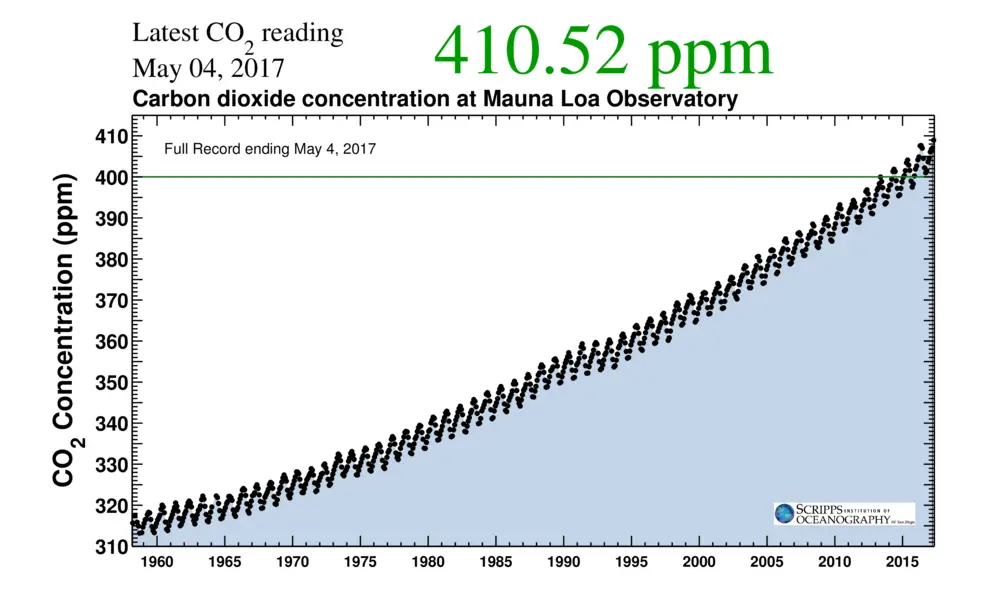
The real response is larger because warming triggers further changes. The same article explains that carbon dioxide has risen from about 280 ppm in 1750 to over 415 ppm by 2020, that the planet has warmed by about 1 °C over that period, and that the forcing from the 50 percent increase in CO2 amounts to roughly 2.1 watts per square meter.
Two definitions, two timescales
Two measures are in common use, and they answer different questions.
| Measure | What it means | IPCC AR6 range |
|---|---|---|
| Transient climate response (TCR) | Warming averaged over a 20-year period centered on the time CO2 doubles, with CO2 rising 1 percent per year | Best estimate 1.8 °C, likely 1.4 to 2.2 °C, very likely 1.2 to 2.4 °C |
| Equilibrium climate sensitivity (ECS) | Warming once the climate has fully adjusted to a doubled CO2 level | Best estimate 3 °C, likely 2.5 to 4 °C, very likely 2 to 5 °C |
The TCR is smaller because it is read off at the moment of doubling, before the climate has finished adjusting. Wikipedia notes that reaching equilibrium can take centuries or millennia. A third concept, Earth system sensitivity, also counts the slow feedbacks, and it is a separate quantity from ECS.
Feedbacks do the work
Feedbacks are the processes that amplify or damp the initial warming. Wikipedia lists four main ones:
- Water vapor.
- Ice-albedo, the change in how much sunlight snow and ice reflect.
- Lapse rate, the change in temperature with altitude.
- Clouds, the largest source of uncertainty.
The article states that most of the uncertainty in sensitivity comes from feedbacks, and from clouds in particular. This is why the range has stayed wide even as models have improved: the basic radiative physics of CO2 is well understood, while the behavior of clouds across the whole globe is not.
A number that has barely moved
The estimate is old. A 1979 committee led by Jule Charney concluded that a doubling of CO2 would produce warming of 3 °C, plus or minus 1.5 °C. The article notes that the committee reconciled two models, one by Manabe and Wetherald giving 2 °C and one by Hansen giving 4 °C. The IPCC’s fifth assessment (2013) gave a likely range of 1.5 to 4.5 °C and declined to give a best estimate. The sixth assessment (2021) narrowed the likely range to 2.5 to 4 °C with a best estimate of 3 °C, so the central value is the same as it was more than four decades earlier, with the range tightened.
Cloud feedback in numbers
Chapter 7 puts the net cloud feedback at 0.42 watts per square meter per degree of warming, with a range of minus 0.10 to plus 0.94. It judges the feedback positive, meaning clouds amplify warming, with high confidence, and reports that the uncertainty has shrunk by about 50 percent compared with the fifth assessment.
Evidence beyond models
Estimates draw on several lines of evidence, not only climate models. The IPCC assessment combines four: basic physical understanding of the feedbacks (process evidence), the observed warming since the industrial era, the paleoclimate record, and emergent constraints that link observable model behavior to sensitivity. The IPCC calls an ECS below 1.5 °C virtually certain not to occur.
Carbon Brief’s explainer shows how the combination works. It reports a combined likely range of 2.6 to 4.1 °C, which widens to 2.3 to 4.5 °C if one line of evidence is dropped. The conclusion is therefore robust to the loss of any one method, though the width of the tails is not.
Observed warming gives context. The Summary for Policymakers reports that global surface temperature in 2011 to 2020 was 1.09 °C (range 0.95 to 1.20) above 1850 to 1900, and that human-caused forcing in 2019 was 2.72 watts per square meter relative to 1750.
Some recent climate models, called “hot models” in the article, have a higher sensitivity than the range above. The article reports that in the worst case such models give more than 5 °C of warming by 2100. Chapter 7 notes that the CMIP6 generation of models has a higher mean ECS and TCR than the previous generation, which is one reason the assessed range rests on several lines of evidence rather than on model output alone.
Why a few tenths of a degree matter
The target arithmetic depends on this number. The article cites a study concluding that the 2 °C goal cannot be met if sensitivity exceeds 3.4 °C. Sensitivity also underlies the questions discussed in how climate change influences extreme weather.
What this note leaves out
This note does not report the numerical result of each line of evidence behind the IPCC range, and it does not give the full probability distribution of sensitivity, only the ranges stated in the sources. It does not cover the connection between sensitivity and specific emission pathways, regional warming patterns, sea level, or the debate over the reliability of paleoclimate estimates.
What remains open
The range of 2.5 to 4 °C is still wide enough to matter for policy. Because the source attributes most of the uncertainty to feedbacks and clouds in particular, narrowing it depends on understanding those. Until then the reading that the sources support is a best estimate of about 3 °C per doubling within a likely range of 2.5 to 4 °C.
About the image
The image is the Keeling Curve, the record of atmospheric carbon dioxide concentration, shown here for 1958 to 2017. It illustrates the rise in CO2 behind the warming discussed above.
Frequently asked questions
What is the difference between ECS and TCR?
Equilibrium climate sensitivity (ECS) is the warming after the climate has fully adjusted to a doubling of CO2, which can take centuries or millennia. Transient climate response (TCR) is the warming around the time of doubling when CO2 rises by 1 percent a year, so it is smaller. The IPCC's sixth assessment gives a best estimate of 1.8 °C and a likely range of 1.4 to 2.2 °C for TCR, against 3 °C and 2.5 to 4 °C for ECS.
Why is the no-feedback figure only about 1 °C?
A doubling of CO2 adds a forcing of about 3.9 watts per square meter in the IPCC's sixth assessment (3.93, with an uncertainty of plus or minus 0.47). Raising the planet's temperature to radiate that heat away takes a bit more than 1 °C, before water vapor, ice and clouds respond.
Is the observed warming consistent with a sensitivity of 3 °C?
Carbon dioxide rose from 280 ppm before industrialization to over 415 ppm by 2020, and the planet warmed by about 1 °C between 1750 and 2020. That is the transient response to a rise of roughly half a doubling, not the equilibrium figure.
Can sensitivity be below 2 °C or above 5 °C?
The IPCC's sixth assessment calls an ECS below 1.5 °C virtually certain not to occur, and gives a very likely range of 2 to 5 °C. The upper end of that range carries only medium confidence because the lines of evidence disagree more at high values.
Does a higher sensitivity change the 2 °C target?
Yes. One study cited on Wikipedia concludes that the 2 °C goal could not be met if sensitivity were above 3.4 °C.