Key facts
- Peng 彭 has one form in simplified and traditional Chinese: 12 strokes, radical 59 (彡). It combines a drum with strokes for its sound.
- It was the 31st most common surname in mainland China in 2019 and is the 47th name of the Hundred Family Surnames.
- Tradition traces it to Peng Zu, the legendary long-lived lord of Dapeng, near modern Xuzhou in Jiangsu.
- It is most common in Hunan, Sichuan and Hubei; in Taiwan most Pengs are Hakka, and in Hong Kong the Pang clan of Fanling is one of the Five Great Clans.
- Spellings include Pang (Cantonese), Phang (Hakka), Bành (Vietnamese) and Pangestu (Indonesian). The US had 10,575 Peng and 2,415 Banh in 2010.
彭
Pinyin: Péng
Same character in simplified and traditional: 彭
Rank in mainland China: 31 of the top 100 (Ministry of Public Security, 2019 report)
Characters and spellings of 彭
| Unicode code point | U+5F6D |
|---|---|
| Stroke count | 12 |
| Radical (simplified form) | No. 59 ⼺, plus 9 strokes |
| Dictionary meaning (Unihan) | name of ancient country; surname |
Romanizations by Chinese language
| Language | System | Spelling |
|---|---|---|
| Mandarin | Hanyu Pinyin (PRC standard) | Péng |
| Mandarin | Wade-Giles (Taiwan, older English texts) | P'eng |
| Cantonese | Jyutping (Unihan) | paang4 |
| Cantonese | Hong Kong / common spellings | Pang, Banh |
| Hokkien (Min Nan) | Pe̍h-ōe-jī and common spellings | Phêⁿ (K), Phîⁿ (X, Q, T), Phêeⁿ (Z), Peh, Phe |
| Hakka | Pha̍k-fa-sṳ and common spellings | Phàng, Phang |
| Gan | Romanization and common spellings | Pháng |
| Wu (Shanghainese) | Romanization and common spellings | Ban |
Equivalent surnames in other languages
| Language | Form |
|---|---|
| Vietnamese | Bành |
| Korean | Paeng (팽) |
| Japanese | Hō |
| Khmer | Pay |
These spellings in the 2010 US Census
| Spelling | People | US rank | Asian / Pacific Islander |
|---|---|---|---|
| PENG | 10,575 | 3,374 | 76.04% |
| PANG | 7,642 | 4,645 | 86.97% |
| BANH | 2,415 | 12,775 | 95.57% |
| BAN | 2,011 | 14,768 | 42.02% |
| PHANG | 742 | 31,251 | 75.74% |
| PHIN | 312 | 63,873 | 78.85% |
| PHEN | 298 | 66,371 | 79.19% |
| PHE | 184 | 98,553 | 92.39% |
Counts are people recorded with each spelling among the 265,667,228 people with a surname shared by at least 100 people (US Census Bureau, 2010, public domain). A spelling is not proof of Chinese origin: the last column shows the share of bearers who identified as Asian or Pacific Islander. Together these spellings total 24,179 people, but some of them belong to unrelated surnames (for example English Lee, Hmong Vang or Vietnamese Ly). Search any spelling with the US census surname lookup.
Stroke order
Animation by the open-source Hanzi Writer library (MIT) with stroke data from Make Me a Hanzi (Arphic Public License). Stroke order tool for any character.

Peng (彭) is a Chinese surname traced by tradition to Peng Zu, the legendary long-lived lord of the ancient state of Dapeng. It is pronounced péng, close to “pung” with a rising tone, and is spelled Pang in Hong Kong Cantonese, Phang in Hakka, Bành in Vietnamese and sometimes Pangestu in Indonesia. It was the 31st most common surname in mainland China in 2019, concentrated in Hunan, Sichuan and Hubei.
Meaning of the character 彭
The character 彭 is made of 壴, a drum on a stand, and 彡, three slanting strokes that represent the sound of the beating. Its original meaning was the booming of drums. The Unihan database glosses it “name of ancient country; surname”, which is how it is used today. It has 12 strokes, is filed under radical 59 (彡) and has the same form in simplified and traditional Chinese.
Origin: Peng Zu and the state of Dapeng
Chinese tradition traces the surname to Peng Zu (彭祖), a descendant of the legendary emperor Zhuanxu. According to the Tang-era genealogy Yuanhe Xingzuan, quoted in the Chinese Wikipedia article, Dapeng (大彭) was a vassal state of the Shang and its people took the state’s name as their surname. Dapeng is placed near modern Xuzhou, in northern Jiangsu, a city long known as Pengcheng (彭城). Peng Zu himself is a figure of legend, said to have lived about 800 years, and is still a symbol of longevity in Chinese culture.
Other lines recorded by the Chinese article:
- The Tujia rulers of western Hunan. Peng Shichou (彭士愁), prefect of Xizhou in the 10th century, founded a dynasty of hereditary Tujia chieftains (tusi) that ruled until 1728. Their genealogies claimed descent from a Han Chinese official from Jiangxi, but the Chinese article cites Y-chromosome studies that found their lineages unrelated to the Jiangxi Pengs.
- Manchu and other peoples. Branches of the Manchu Donggo clan, and Hui, Miao, Yi, Bai and Yao families, also use the surname.
These are traditional accounts, except the genetic finding, which is a modern test of one of them. On how such claims are built, see where Chinese surnames come from.
Spellings of Peng
| Spelling | Where it comes from | Example |
|---|---|---|
| Peng | Pinyin, and Wade-Giles P’eng without the apostrophe | Peng Liyuan |
| Pang | Hong Kong Cantonese (Jyutping paang4) | the Pang brothers, filmmakers |
| Phang | Hakka (and Indonesian Hakka) | |
| Phee, Phe, Peh | Hokkien and Teochew | |
| Bành | Vietnamese reading | |
| Pangestu | Indonesian adapted name | Prajogo Pangestu |
| Paeng (팽) | Korean reading |
The Indonesian form shows a common pattern: under the Suharto-era pressure to adopt Indonesian names, many Chinese Indonesians built a new name around the sound of their surname. Prajogo Pangestu was born Phang Djoen Phen. See Chinese Indonesian names and the Hakka spelling guide.
Peng in Hong Kong, Taiwan and Korea
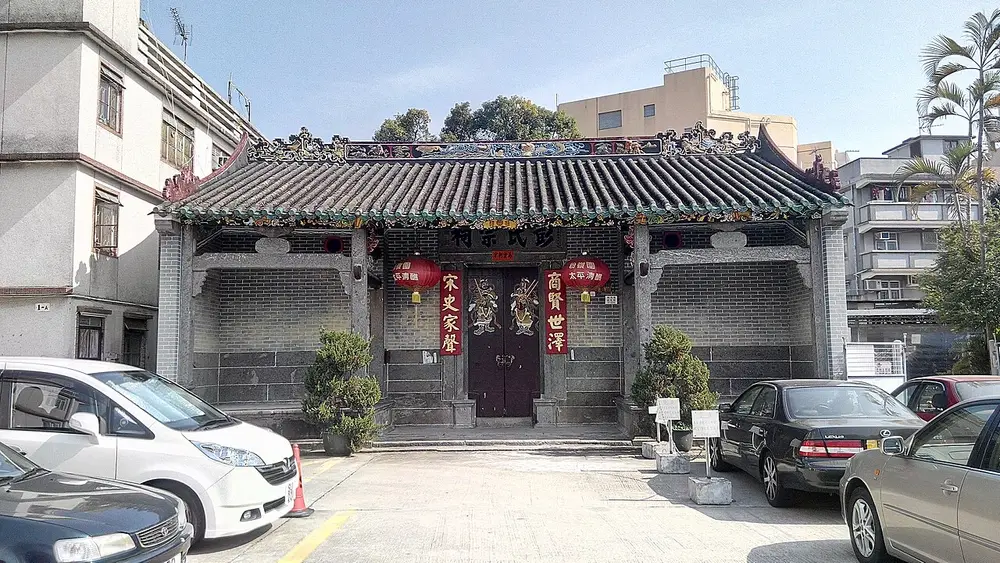
In Hong Kong, the Pang (彭) clan of Fanling Wai is one of the Five Great Clans of the New Territories, alongside the Tang (鄧) clan, the Man, the Hau and the Liu. Its ancestral hall in Fanling, pictured above, is still in use. In Taiwan, the Chinese Wikipedia article notes that almost all Pengs are Hakka, concentrated in Hsinchu, Miaoli and Taoyuan. In Korea the surname is read Paeng (팽) and is rare: South Korea’s 2000 census counted 2,825 people, in two clans descended from Chinese immigrants.
Peng in the United States
From the 2010 US Census file:
- Peng: 10,575 people (76.0% Asian or Pacific Islander).
- Pang: 7,642 (87.0%), shared with 庞 Pang and 冯 Feng.
- Banh: 2,415 (95.6%), Vietnamese Bành.
- Ban: 2,011, of which only 42.0% Asian, mostly unrelated.
- Phang: 742; Phen: 298; Phe: 184.
See the US census analysis and the census lookup tool for other spellings.
Famous people named Peng
- Peng Dehuai (彭德怀, 1898 to 1974), marshal of the People’s Republic of China and Minister of National Defense from 1954 to 1959.
- Peng Ming-min (彭明敏, 1923 to 2022), Taiwanese legal scholar, independence activist and the first opposition candidate in a Taiwanese presidential election.
- Peng Liyuan (彭丽媛, born 1962), folk singer and wife of Xi Jinping.
- Prajogo Pangestu (彭云鹏, born 1944), Indonesian businessman, founder of the Barito Pacific group.
- Danny and Oxide Pang (彭发, 彭顺, born 1965), Hong Kong twin filmmakers, directors of The Eye.
- Eddie Peng (彭于晏, born 1982), Taiwanese actor.
- Peng Shuai (彭帅, born 1986), tennis player, former world number one in doubles.
Related pages
- Browse the 100 most common surnames in China or look up any spelling with the surname finder.
- Peng is the 47th name of the Hundred Family Surnames.
Frequently asked questions
What does the surname Peng mean?
The character 彭 shows a drum (壴) with three strokes (彡) for its beating, and originally meant the sound of drums. As a surname it comes from the ancient state of Dapeng, associated with Peng Zu.
How do you pronounce Peng?
In Mandarin it is péng, with a rising tone. Pinyin eng is said with a short unstressed vowel, so it sounds closer to pung than to the English word peng.
Is Pang the same surname as Peng?
Often. Pang is the Hong Kong Cantonese spelling of 彭. But Pang is also the pinyin of 庞 Páng and a Hokkien spelling of 冯 Feng, so the character is needed to be sure.
Who was Peng Zu?
Peng Zu is a legendary figure said to have lived about 800 years, from the Xia into the Zhou dynasty. He became a symbol of longevity and is honored as the ancestor of the Peng surname.
Sources and open data
- Unihan database entry for U+5F6D 彭, Unicode Consortium
- Frequently Occurring Surnames from the 2010 Census, US Census Bureau
- 彭姓 (Peng surname), Chinese Wikipedia
- Peng (surname), English Wikipedia
- Peng Zu, English Wikipedia
- Five Great Clans of the New Territories, English Wikipedia
- Peng, family name (Q842166), Wikidata