Key facts
- Phytoplankton account for about half of global photosynthesis and at least half of oxygen production, while making up only about 1% of plant biomass.
- The ocean's biological pump moves about 10.2 gigatonnes of carbon a year into the deep, and without it atmospheric CO2 would be roughly 400 ppm higher.
- The 2024 Plankton Manifesto by over 30 experts urges a plankton atlas, wider monitoring and applications from water purification to bioplastics.
- Fertilizing the ocean with iron to grow more plankton may not work at scale and risks oxygen depletion and methane.

Plankton are the organisms that drift with the water rather than swimming against it. The group includes the photosynthesizing algae and the small animals that graze on them. Their activity shapes the chemistry of the atmosphere, yet they are rarely part of public discussion of climate. This note summarizes what English Wikipedia’s articles on plankton, phytoplankton, zooplankton and the biological pump report, checked against two NOAA National Ocean Service pages, along with a recent call by experts for a stronger plankton agenda. It belongs to the science notes on the ocean and climate.
Drifters of two kinds
The name comes from the Greek planktos, “drifter,” and was coined by Victor Hensen in 1887. Plankton are defined by their inability to swim against the current, not by size or kinship. Two broad groups matter most:
- Phytoplankton photosynthesize like plants. Cyanobacteria and diatoms are among them.
- Zooplankton are the animal grazers that feed on phytoplankton and on each other.
The two groups are linked as predator and prey, and Wikipedia notes that in many ocean regions the supply of nutrients from below, a bottom-up control, predicts phytoplankton populations better than grazing does. Growth is limited by nutrients in the subtropical gyres and by light in the subarctic. In regions known as high-nutrient, low-chlorophyll zones, iron is the limiting factor.
Small mass, large output
Wikipedia reports that phytoplankton account for about half of global photosynthesis and at least half of oxygen production, even though they make up only about 1 percent of plant biomass. The reason is turnover: phytoplankton replace themselves in days, where land plants take years or decades.
The sources do not agree on a single oxygen figure. The plankton article gives about 50 percent in one place and around 70 percent elsewhere. The Plankton Manifesto, a 2024 document by more than 30 experts working with the UN Global Compact Ocean Stewardship Coalition, uses about 50 percent. This note therefore says “about half” and treats the higher number as an upper estimate.
What NOAA says
NOAA’s National Ocean Service states that about half of Earth’s oxygen comes from the ocean and that the majority of this production is from oceanic plankton. It also states that the ocean produces at least 50 percent of the oxygen on Earth, and that the single bacterium Prochlorococcus produces up to 20 percent of the oxygen in the whole biosphere. NOAA adds that marine life consumes about the same amount, so the ocean’s oxygen is largely used up in the sea. It cautions that exact percentages are hard to calculate because plankton populations shift with the seasons, nutrient levels and water temperature, which fits the spread of figures noted above.
On the animal side, NOAA describes zooplankton as including krill, sea snails, pelagic worms, the young of larger invertebrates and fish, and weak swimmers such as jellyfish. Krill are a major food for humpback, right and blue whales. Many zooplankton rise toward the surface each night and sink by day, a movement NOAA calls the largest migration on Earth, visible from space. Changes in the timing or abundance of phytoplankton can quickly reach zooplankton and travel up the food chain. Plankton are sensitive to temperature, salinity, pH and nutrients, and excess nutrients can set off harmful algal blooms such as red tides.
The biological pump
When phytoplankton fix carbon at the surface, part of it is carried down into deep water. This transfer is the biological pump. Wikipedia’s article gives about 10.2 gigatonnes of carbon a year moving into the ocean interior, with about 1,300 gigatonnes held there over an average residence of 127 years. It adds that without the pump, atmospheric CO2 would be about 400 ppm higher than it is.
| Quantity | Value (Wikipedia, Biological pump) |
|---|---|
| Carbon exported into the interior | about 10.2 Gt C per year |
| Carbon held in the interior by the pump | about 1,300 Gt C |
| Average residence time | 127 years |
| Atmospheric CO2 without the pump | about 400 ppm higher |
The Plankton Manifesto gives a wider range for the carbon the ocean’s plankton move, 30 to 50 billion tonnes of carbon a year, a larger figure than the one above. The sources do not reconcile the two, and this note does not try to.
The Plankton Manifesto
The manifesto, published in 2024, sets out a research and policy agenda. Its recommendations include building a plankton atlas to map what lives where, developing plankton-based applications such as water purification, bioplastics, fertilizer and animal feed, and “plankton literacy”. The manifesto is an advocacy document, and it should be read as a research agenda rather than a set of proven technologies.
Climate and risk
Plankton are both a victim and a potential tool in climate change. A 2019 study cited on Wikipedia suggests that Antarctic phytoplankton could become smaller. The article also mentions the Great Calcite Belt, a region of coccolithophores.
Iron fertilization, spreading iron to stimulate blooms in iron-limited regions, is the most discussed idea for increasing the pump. According to Wikipedia it may not be practical at scale, and has drawbacks including ocean oxygen depletion and methane production. How the climate responds to higher CO2 is the subject of climate sensitivity, and plankton are part of that story as well as part of the answer to it.
Plankton also matter to health. Wikipedia notes that the cholera bacterium, Vibrio cholerae, lives on copepods, which links plankton ecology to disease risk.
What this note leaves out
This note does not give regional plankton biomass, trends in plankton abundance, or any measurement of how plankton populations have changed. It does not assess the technical readiness of the manifesto’s proposed applications. It does not cover harmful algal blooms beyond the NOAA mention, microplastics, or the role of plankton in fisheries. The Plankton Manifesto figures are given as reported in the Wikipedia article, and the carbon numbers from different sources do not match and are not reconciled here.
What remains open
The size of plankton’s contribution to oxygen, the rate of carbon export and the response of both to warming are all uncertain, and the sources cited give ranges and not firm values. What is better established is the scale of the system relative to its visibility: a group that makes up about 1 percent of plant biomass supports about half of photosynthesis.
About the image
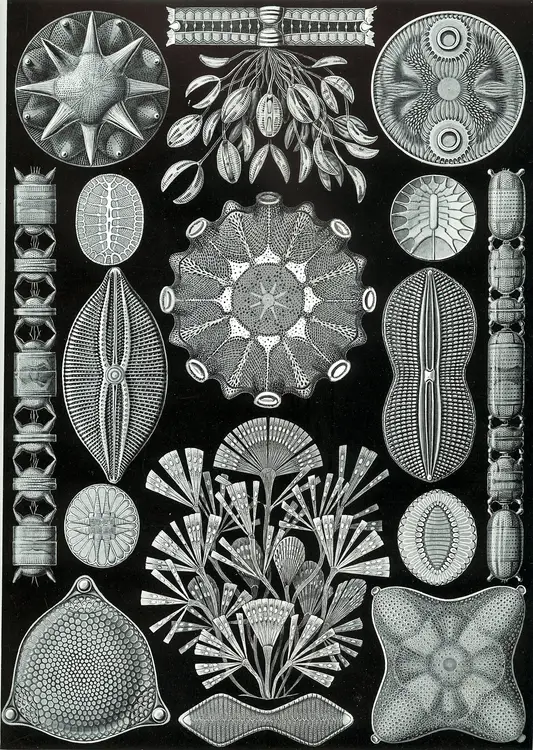
The image is a plate of diatoms by Ernst Haeckel, whose Commons description lists species such as Pyrgodiscus armatus. The file is in the public domain. Diatoms are among the phytoplankton named in the Wikipedia article, and the plate shows a few of their forms.
Frequently asked questions
What does the word plankton mean?
It comes from the Greek planktos, meaning drifter or wanderer. Victor Hensen coined the term in 1887. Plankton are organisms that cannot swim against currents, whatever their size.
How much of Earth's oxygen comes from plankton?
About half, according to Wikipedia and the Plankton Manifesto, although estimates vary between sources, and the Wikipedia plankton article itself gives different figures in different places.
Does the ocean's oxygen reach us?
Not all of it. NOAA states that about half of Earth's oxygen comes from the ocean, mostly from plankton, but that marine life uses up about the same amount, so the oxygen is largely consumed in the sea.
What is the biological pump?
It is the set of processes that move carbon fixed by plankton at the surface down to the deep ocean, where it can stay for long periods. Wikipedia gives about 10.2 gigatonnes of carbon a year and about 1,300 gigatonnes stored over an average of 127 years.
Can plankton be used to fight climate change?
Iron fertilization is the best-known proposal, but Wikipedia says it may not be practical at scale and could deplete oxygen and produce methane.
Sources and open data
- Plankton, English Wikipedia
- Phytoplankton, English Wikipedia
- Zooplankton, English Wikipedia
- Biological pump, English Wikipedia
- How much oxygen comes from the ocean?, NOAA National Ocean Service
- What is plankton?, NOAA National Ocean Service