Key facts
- Hu is written 胡, the same in simplified and traditional script (9 strokes), and pronounced hú with a rising tone.
- It ranks 15th in mainland China in the Ministry of Public Security's 2019 report, and is most common along the Yangtze, with Hubei as its largest province.
- Tradition traces it to Duke Hu of Chen (陈胡公), whose posthumous title became a family name, and to two small Zhou-era states called Hu.
- In ancient texts 胡 also named the non-Han peoples of the northern and western frontiers, and some of those peoples took Hu as a surname.
- Spellings include Woo and Wu (Cantonese), Foo (Hakka), Oh (Hokkien) and Hồ (Vietnamese). The 2010 US Census counted 19,999 people spelled Hu.
胡
Pinyin: Hú
Same character in simplified and traditional: 胡
Rank in mainland China: 15 of the top 100 (Ministry of Public Security, 2019 report)
Characters and spellings of 胡
| Unicode code point | U+80E1 |
|---|---|
| Stroke count | 9 |
| Radical (simplified form) | No. 130 ⾁, plus 5 strokes |
| Dictionary meaning (Unihan) | recklessly, foolishly; wildly |
Romanizations by Chinese language
| Language | System | Spelling |
|---|---|---|
| Mandarin | Hanyu Pinyin (PRC standard) | Hú |
| Mandarin | Wade-Giles (Taiwan, older English texts) | Hu |
| Cantonese | Jyutping (Unihan) | wu4 |
| Cantonese | Hong Kong / common spellings | Wu, Woo<!-- do not disambiguate -->, Vu |
| Hokkien (Min Nan) | Pe̍h-ōe-jī and common spellings | Ô͘, Oh, Ow, Aw |
| Hakka | Pha̍k-fa-sṳ and common spellings | Fù, Foo |
| Gan | Romanization and common spellings | Ū, Wu, Foo |
| Wu (Shanghainese) | Romanization and common spellings | Wu, Woo |
Equivalent surnames in other languages
| Language | Form |
|---|---|
| Vietnamese | Hồ |
| Korean | Ho (호) |
| Japanese | Ko |
| Filipino | Hu, Ho |
These spellings in the 2010 US Census
| Spelling | People | US rank | Asian / Pacific Islander |
|---|---|---|---|
| WU | 71,721 | 461 | 96.37% |
| HO | 49,817 | 691 | 93.06% |
| VU | 36,179 | 962 | 96.61% |
| DO | 30,301 | 1,159 | 94.78% |
| HU | 19,999 | 1,797 | 94.93% |
| OH | 18,285 | 1,978 | 95.48% |
| WOO | 13,003 | 2,775 | 86.86% |
| FU | 8,370 | 4,235 | 94.06% |
| FOO | 1,405 | 19,282 | 79.29% |
| OW | 405 | 51,396 | 68.89% |
Counts are people recorded with each spelling among the 265,667,228 people with a surname shared by at least 100 people (US Census Bureau, 2010, public domain). A spelling is not proof of Chinese origin: the last column shows the share of bearers who identified as Asian or Pacific Islander. Together these spellings total 249,800 people, but some of them belong to unrelated surnames (for example English Lee, Hmong Vang or Vietnamese Ly). Search any spelling with the US census surname lookup.
Stroke order
Animation by the open-source Hanzi Writer library (MIT) with stroke data from Make Me a Hanzi (Arphic Public License). Stroke order tool for any character.

Hu (胡) is a Chinese surname pronounced hú, a bit like “who” with a rising tone. It is written the same way in simplified and traditional characters and ranks 15th in mainland China in the 2019 official list. Tradition traces it to Duke Hu of Chen, a Zhou-era ruler. Common spellings outside the mainland are Woo or Wu (Cantonese), Foo (Hakka), Oh or Aw (Hokkien) and Hồ (Vietnamese).
Meaning of the character 胡
胡 is built from 古 (gǔ, old), which gives the sound, and 月, here a form of 肉 (flesh), which gives the meaning. Its earliest sense was the dewlap, the loose skin under the throat of an ox. In Classical Chinese it was also a question word (“why, how”) and part of words such as 蝴蝶 (húdié, butterfly), which later took the insect radical.
The Unihan database gives the modern sense: “recklessly, foolishly; wildly”, as in 胡说 (húshuō, nonsense). None of these meanings explains the surname. The character has no simplified form, which is why 胡 looks the same on mainland, Taiwanese and Hong Kong documents.
The frontier sense of 胡
The sense that needs the most care is the ethnic one. From the Warring States period onward, Chinese texts used 胡 as a broad label for peoples on the northern and western frontiers: steppe nomads, and later Sogdians, Persians and other Central Asians. English sources often translate it as “barbarian”, a term that reflects how Chinese courts saw outsiders rather than a name those peoples gave themselves.
The label survives in everyday words for things that came from the west or north: 胡琴 (húqín, the two-string fiddle), 胡椒 (hújiāo, pepper), 胡萝卜 (húluóbo, carrot). It also shaped the surname in one documented way: some frontier peoples took Hu as their Chinese surname. The best-known case is the Xianbei clan name Hegu (纥骨), which became Hu during the Northern Wei renaming of 496. That reform is a good example of how Chinese surnames came to be.
Origin: Duke Hu of Chen
Chinese genealogies give three main Han Chinese origins, summarized in the Song-era Tongzhi and in the Chinese Wikipedia article:
- A posthumous title. King Wu of Zhou gave the state of Chen, in today’s Huaiyang, Henan, to Gui Man (妫满), said to descend from the sage king Shun. Gui Man was remembered by his posthumous title Duke Hu (胡公). Some of his descendants took Hu as their surname, others took Chen. This is why Hu and Chen 陈 are often described as cousin surnames.
- The states named Hu. Two small Zhou-era states called Hu existed, near today’s Luohe in Henan and Fuyang in Anhui. Their people could take the state’s name.
- Changed surnames. The old compound surname Huwu (胡毋) was shortened to Hu after the Jin dynasty. Huyan (呼延), a Xiongnu clan name, often became Hu in the Ming and Qing periods.
These are traditional accounts recorded long after the events. They tell you which groups claimed the name, not where a given family actually came from.
How Hu is spelled around the world
| Spelling | Language or system | Notes |
|---|---|---|
| Hu | Pinyin and Wade-Giles | the two systems agree on this name |
| Woo / Wu | Cantonese (wu4) | Hong Kong and older US families |
| Foo | Hakka | Malaysia, Singapore |
| Oh / Ow / Aw | Hokkien | Malaysia, Singapore, Philippines |
| Hồ | Vietnamese | Hồ dynasty, Hồ Xuân Hương |
| Ho (호) | Korean | rare in Korea |
The Cantonese forms are the source of most confusion: Woo and Wu also spell Wu 吴, a far more common surname. The Hong Kong Cantonese guide and the Hakka spellings guide explain why one character takes so many forms.
Hu in the United States
The 2010 US Census counted 19,999 people named Hu, 94.9% of them Asian or Pacific Islander. That is the cleanest figure, because Hu as a spelling belongs almost only to 胡 (and a few rarer characters read hù or hǔ).
The other spellings in the data panel are shared and should not be added up:
- Wu (71,721) and Woo (13,003) are mostly Wu 吴.
- Ho (49,817) covers Vietnamese Hồ but also Cantonese spellings of He 何.
- Vu (36,179) and Do (30,301) are mainly the Vietnamese surnames Vũ (武) and Đỗ (杜), not Hồ.
- Oh (18,285) is overwhelmingly the Korean surname 오 (吳).
- Foo (1,405) is a clearer Hakka and Malaysian form of 胡.
The US census surname lookup shows which characters stand behind each spelling.
Where Hu is common in China
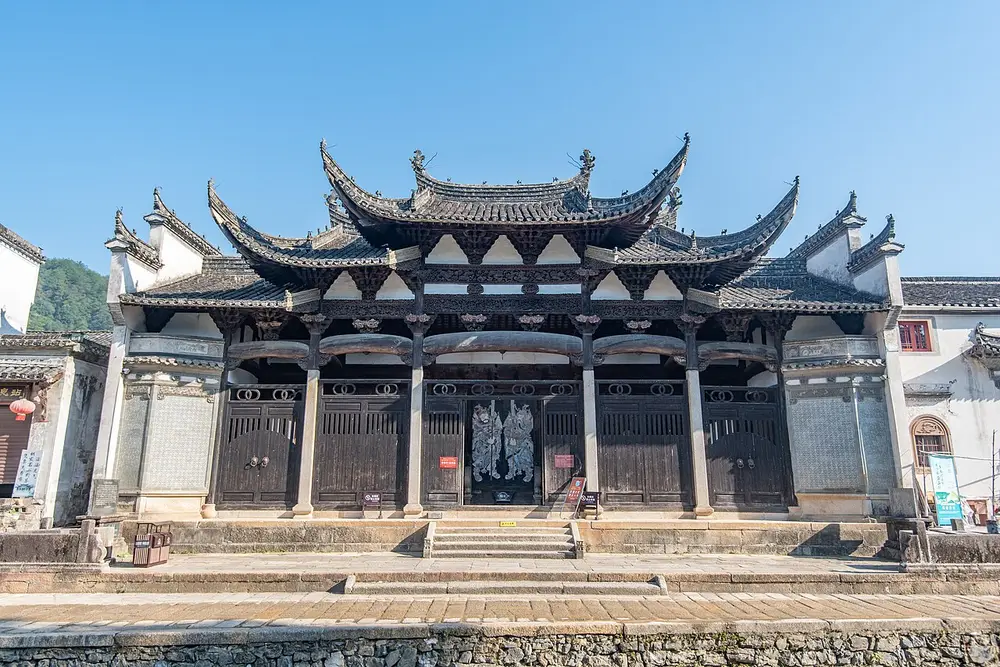
Chinese Wikipedia, citing national surname studies, puts Hu at about 1.31% of the Han population and places it mainly in the Yangtze basin. Sichuan, Henan, Hubei, Jiangxi, Anhui, Zhejiang, Shandong and Hunan together hold around 65% of all Hus, with Hubei in first place. In Taiwan the surname ranks 38th. Jixi County in southern Anhui, home of the Longchuan Hu ancestral hall shown above, is one of the best-known Hu clan centers.
Famous people named Hu
- Hu Xueyan (胡雪岩, 1823 to 1885), Hangzhou merchant and banker of the late Qing.
- Hu Shih (胡適, 1891 to 1962), philosopher and leader of the vernacular literature movement, from Jixi, Anhui. His name is still usually spelled the Wade-Giles way.
- Hu Die (胡蝶, 1908 to 1989), film star of 1930s Shanghai, known in English as Butterfly Wu, a Cantonese-style spelling.
- Hu Yaobang (胡耀邦, 1915 to 1989), general secretary of the Chinese Communist Party.
- Hu Jintao (胡锦涛, born 1942), president of China from 2003 to 2013.
- Hồ Quý Ly (胡季犛), founder of Vietnam’s short-lived Hồ dynasty in 1400.
- Hồ Xuân Hương, Vietnamese poet of the late 18th and early 19th centuries.
Related surnames and pages
- Hu and Chen 陈 share the Duke Hu of Chen tradition.
- Hu, Wu and Woo are easy to mix up in English: the surname finder lists every character behind a spelling.
- For Vietnamese readings of Chinese surnames, see Vietnamese surnames and Chinese characters.
- See how Hu ranks in the 100 most common surnames in China.
Frequently asked questions
What does the surname Hu mean?
As a word, 胡 had several old senses: the dewlap of an animal, a question word meaning why, and a name for non-Han frontier peoples. Today it means reckless or foolish in compounds. As a surname it usually comes from Duke Hu of Chen or from the ancient states named Hu.
How do you pronounce Hu?
Say it like who, but with a slightly rougher h made at the back of the throat and a rising second tone: hú.
Is Woo the same surname as Hu?
Often. In Cantonese 胡 is read wu, and Hong Kong and older American families usually spell it Woo or Wu. Wu and Woo are also spellings of 吴 Wu, so check the character.
Is the Vietnamese surname Ho the same as Hu?
Hồ is the Vietnamese reading of 胡. It is the surname of the Hồ dynasty (1400 to 1407). Ho Chi Minh used it as part of an adopted name: he was born Nguyễn Sinh Cung.
Does Hu mean barbarian?
In ancient texts 胡 was a general name for peoples on China's northern and western frontiers, often translated as barbarians. That sense explains words like 胡琴 (huqin, a fiddle) but not the origin of most Hu families.
Sources and open data
- Unihan database entry for U+80E1 胡, Unicode Consortium
- Frequently Occurring Surnames from the 2010 Census, US Census Bureau
- Hu (surname), English Wikipedia
- 胡姓 (Hu surname), Chinese Wikipedia
- Hu (people), English Wikipedia
- Hồ dynasty, English Wikipedia
- Hu, family name (Q1132594), Wikidata