Key facts
- Yuan is written 袁 in both simplified and traditional Chinese (10 strokes). Unihan glosses it as robe, the meaning given in the ancient Shuowen dictionary.
- It ranked 37th in mainland China in 2019. Chinese and English Wikipedia put it at about 0.54% of the population, some 6.5 million people.
- Tradition traces the name to Yuan Taotu, a 7th-century BC noble of the state of Chen, in today's eastern Henan.
- Spellings include Yüan (Wade-Giles), Yuen and Wan (Cantonese), Viên (Vietnamese) and Won (Korean).
- The 2010 US Census counted 8,588 people spelled Yuan and 7,688 spelled Yuen.
袁
Pinyin: Yuán
Same character in simplified and traditional: 袁
Rank in mainland China: 37 of the top 100 (Ministry of Public Security, 2019 report)
Characters and spellings of 袁
| Unicode code point | U+8881 |
|---|---|
| Stroke count | 10 |
| Radical (simplified form) | No. 145 ⾐, plus 4 strokes |
| Dictionary meaning (Unihan) | robe; surname |
Romanizations by Chinese language
| Language | System | Spelling |
|---|---|---|
| Mandarin | Hanyu Pinyin (PRC standard) | Yuán |
| Mandarin | Wade-Giles (Taiwan, older English texts) | Yüan |
| Cantonese | Jyutping (Unihan) | jyun4 |
| Cantonese | Hong Kong / common spellings | Yuen, Wan |
| Hokkien (Min Nan) | Pe̍h-ōe-jī and common spellings | Oân, Wang |
| Hakka | Pha̍k-fa-sṳ and common spellings | Yèn, Yen |
| Gan | Romanization and common spellings | Iōn |
| Wu (Shanghainese) | Romanization and common spellings | Yoe, Yoo, Yeu |
Equivalent surnames in other languages
| Language | Form |
|---|---|
| Vietnamese | Viên |
| Korean | Won (원) |
| Japanese | En |
| Filipino | Yan |
These spellings in the 2010 US Census
| Spelling | People | US rank | Asian / Pacific Islander |
|---|---|---|---|
| WANG | 109,883 | 282 | 95.24% |
| YOO | 13,225 | 2,724 | 95.49% |
| YAN | 11,354 | 3,182 | 94.06% |
| YUAN | 8,588 | 4,129 | 96.43% |
| YUEN | 7,688 | 4,614 | 87.12% |
| WAN | 5,831 | 5,911 | 89.97% |
| YEN | 5,066 | 6,671 | 89.12% |
| VIEN | 1,031 | 24,325 | 63.92% |
| ION | 603 | 37,029 | n/a |
| YOE | 509 | 42,579 | 15.32% |
Counts are people recorded with each spelling among the 265,667,228 people with a surname shared by at least 100 people (US Census Bureau, 2010, public domain). A spelling is not proof of Chinese origin: the last column shows the share of bearers who identified as Asian or Pacific Islander. Together these spellings total 163,884 people, but some of them belong to unrelated surnames (for example English Lee, Hmong Vang or Vietnamese Ly). Search any spelling with the US census surname lookup.
Stroke order
Animation by the open-source Hanzi Writer library (MIT) with stroke data from Make Me a Hanzi (Arphic Public License). Stroke order tool for any character.

Yuan (袁) is a Chinese surname pronounced yuán, roughly “ywen” with a rising tone. The character once meant “a long robe”, but the surname is traced to a noble family of the ancient state of Chen. It was the 37th most common surname in mainland China in the 2019 official ranking, about 0.54% of the population or some 6.5 million people according to Chinese and English Wikipedia. It is spelled Yüan in Wade-Giles, Yuen or Wan in Cantonese, Viên in Vietnamese and Won (원) in Korean. Simplified and traditional forms are identical.
Meaning of the character 袁
Unihan glosses 袁 as “robe; surname”. English Wikipedia notes that the Han dictionary Shuowen Jiezi defines it as “a long garment”, a meaning already obsolete in antiquity. Today 袁 is used almost only as a surname, which makes it easy to spot in a Chinese name.
Origin: the Yuan of Chen
The story repeated by most traditional sources runs as follows. Yuan Taotu (轅濤塗), a 7th-century BC noble of the state of Chen and a descendant of its ruling house, took as his surname the second character of his grandfather’s style name, Boyuan (伯爰). He was granted an estate at Yangjia (陽夏), in today’s Taikang county, Henan. Through the Chen rulers, the clan claimed descent from the legendary Emperor Shun.
Early texts wrote the name in several interchangeable ways: 爰, 轅, 榬, 溒, 援 and 袁. Chinese Wikipedia quotes a Song genealogy: “one surname, six characters, five lineages”. By the 1st century the form 袁 had become standard.
Two famous medieval clans grew from this root:
- The Yuan of Ru’nan (汝南袁氏), in Henan, held the top offices of the Eastern Han for four generations. The warlords Yuan Shao and Yuan Shu came from this clan.
- The Yuan of Chen commandery (陳郡袁氏), a leading aristocratic family of the Jin and Southern dynasties.
A less accepted theory links the name to Xuanyuan (軒轅), the clan name of the Yellow Emperor. These are traditional accounts; see clan associations and hall names for how such histories are used today.
Where Yuans live
Chinese Wikipedia, citing population studies, says that about 23% of all Yuans live in Sichuan and Hebei, and another 38% in Jiangxi, Jiangsu, Henan, Zhejiang and Hubei. The name is widespread but unevenly spread. English Wikipedia reports a Hong Kong Association of Yuen Clansmen active in root-seeking trips to Ru’nan.
Spellings and where they come from
| Spelling | Language or system | Example |
|---|---|---|
| Yuan | Hanyu Pinyin | Yuan Longping, agronomist |
| Yüan | Wade-Giles | Yüan Shih-k’ai, in older texts |
| Yuen | Hong Kong Cantonese | Yuen Woo-ping, choreographer |
| Wan | Other Cantonese spelling | |
| Yen | Hakka | |
| Viên | Vietnamese | |
| Won (원) | Korean |
The Hong Kong Cantonese guide explains why jyun4 becomes Yuen, and the Wade-Giles guide covers the umlaut in Yüan, usually dropped on passports.
Yuan in the United States
The 2010 Census counts spellings only:
- Yuan: 8,588 people, 96.4% Asian or Pacific Islander.
- Yuen: 7,688 (87.1%).
- Wan: 5,831 (90.0%).
- Yen: 5,066 (89.1%), also the spelling of 严 and 颜.
- Vien: 1,031 (63.9%).
Two spellings in the data panel need care. Wang (109,883) is a Teochew reading of 袁, but nearly all Wangs are Wang 王. Yoo (13,225) is almost always a Korean name. The census data page explains how these overlaps are handled.
Famous people named Yuan
- Yuan Shao (袁绍, died 202), Eastern Han warlord from the Ru’nan Yuan clan, defeated by Cao Cao at Guandu.
- Yuan Chonghuan (袁崇焕, 1584 to 1630), Ming general who defended the northeast against the Later Jin.
- Yuan Mei (袁枚, 1716 to 1797), Qing poet and author of a famous cookbook, the Suiyuan Shidan.
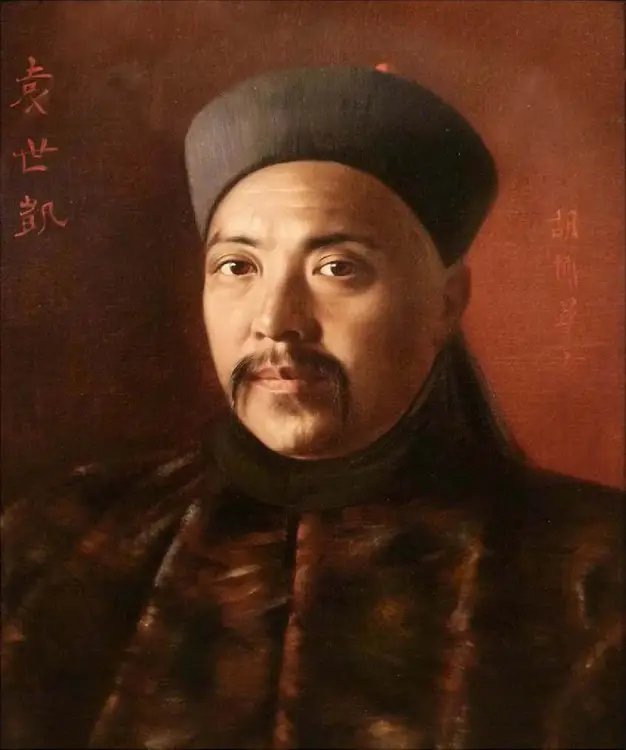
- Yuan Shikai (袁世凯, 1859 to 1916), first formal President of the Republic of China, who briefly tried to make himself emperor. His portrait is shown above.
- Yuan Longping (袁隆平, 1930 to 2021), agronomist known as the “father of hybrid rice”.
- Yuen Woo-ping (袁和平, born 1945), Hong Kong action choreographer and director.
Related surnames and confusions
- 元 Yuan, 苑 Yuan and 原 Yuan are different surnames with the same pinyin.
- 阮 Ruan is spelled Yuen in Cantonese but is Nguyễn in Vietnamese: a different name.
- Check any spelling in the surname finder.
Frequently asked questions
What does the surname Yuan mean?
The ancient Shuowen dictionary defines 袁 as a long robe, a meaning no longer used. As a surname it is traced to the style name Boyuan (伯爰) of a noble of Chen, whose grandson took the second character as a family name.
How do you pronounce Yuan?
Say ywen, starting with the rounded ü of French tu, on a rising second tone: yuán. It is one syllable, not you-an.
Is Yuen the same surname as Yuan?
Usually yes. Yuen is the Hong Kong Cantonese spelling of 袁, as in Yuen Woo-ping. But Yuen can also spell 阮 or 原 and Yuan can spell 元 or 苑, so check the character.
Is the Yuan surname related to the Yuan dynasty?
No. The Yuan dynasty (元, 1271 to 1368) uses a different character meaning origin. The surname 袁 is more than two thousand years older and unrelated to the Mongol dynasty.
Sources and open data
- Unihan database entry for U+8881 袁, Unicode Consortium
- Frequently Occurring Surnames from the 2010 Census, US Census Bureau
- Yuan (surname), English Wikipedia
- 袁姓 (the surname Yuan), Chinese Wikipedia
- Yuan Shikai, English Wikipedia
- Yuan, family name (Q716212), Wikidata