Key facts
- Xie is written 谢 in simplified and 謝 in traditional characters (12 against 17 strokes). As a word it means to thank.
- It ranked 23rd in mainland China in 2019 (about 0.79% of the population in a 2013 study) and 13th in Taiwan in 2016.
- Spellings: Hsieh (Wade-Giles, Taiwan), Tse (Hong Kong), Chia, Cheah, Seah, Sia (Hokkien, Teochew), Sese (Philippines), Tạ (Vietnam).
- The 2010 US Census counted 9,716 Xie, 6,382 Hsieh, 6,227 Tse and 8,017 Ta.
- The Xie clan of Chen commandery was, with the Wang of Langya, one of the two leading families of the Eastern Jin: the Wang-Xie (王謝) of Chinese poetry.
谢
謝
Pinyin: Xiè
Simplified / traditional: 谢 / 謝
Rank in mainland China: 23 of the top 100 (Ministry of Public Security, 2019 report)
Characters and spellings of 谢
| Unicode code point | U+8C22 (traditional 謝: U+8B1D) |
|---|---|
| Stroke count | 12 (traditional: 17) |
| Radical (simplified form) | No. 149 ⾔, plus 10 strokes |
| Dictionary meaning (Unihan) | thank; decline |
Romanizations by Chinese language
| Language | System | Spelling |
|---|---|---|
| Mandarin | Hanyu Pinyin (PRC standard) | Xiè |
| Mandarin | Wade-Giles (Taiwan, older English texts) | Hsieh |
| Cantonese | Jyutping (Unihan) | ze6 |
| Cantonese | Hong Kong / common spellings | Tse, Che |
| Hokkien (Min Nan) | Pe̍h-ōe-jī and common spellings | Chiā (Z, K), Siā (X, T), Sià (Q), Chia, Cheah, Seah |
| Hakka | Pha̍k-fa-sṳ and common spellings | Tshia, Cheah |
| Gan | Romanization and common spellings | Chhià |
| Wu (Shanghainese) | Romanization and common spellings | Zia |
Equivalent surnames in other languages
| Language | Form |
|---|---|
| Vietnamese | Tạ |
| Korean | Sa (사) |
| Japanese | Sha |
| Can | Tsia |
| Filipino | Sia, Saa, Sese, Chia, Tse |
| Misc | Shie |
These spellings in the 2010 US Census
| Spelling | People | US rank | Asian / Pacific Islander |
|---|---|---|---|
| XIE | 9,716 | 3,662 | 98.19% |
| TA | 8,017 | 4,434 | 94.29% |
| HSIEH | 6,382 | 5,453 | 93.73% |
| TSE | 6,227 | 5,582 | 93.51% |
| CHE | 2,393 | 12,865 | 78.56% |
| CHIA | 1,748 | 16,450 | 68.54% |
| ZIA | 1,495 | 18,486 | 67.56% |
| SIA | 943 | 26,008 | 76.56% |
| SESE | 483 | 44,500 | 81.37% |
| CHEAH | 457 | 46,568 | 85.12% |
Counts are people recorded with each spelling among the 265,667,228 people with a surname shared by at least 100 people (US Census Bureau, 2010, public domain). A spelling is not proof of Chinese origin: the last column shows the share of bearers who identified as Asian or Pacific Islander. Together these spellings total 38,484 people, but some of them belong to unrelated surnames (for example English Lee, Hmong Vang or Vietnamese Ly). Search any spelling with the US census surname lookup.
Stroke order
Animation by the open-source Hanzi Writer library (MIT) with stroke data from Make Me a Hanzi (Arphic Public License). Stroke order tool for any character.

Xie (谢, traditional 謝) is a Chinese surname whose character means “to thank”. It is pronounced xiè, roughly “shyeh” with a falling tone, and is spelled Hsieh in Wade-Giles and Taiwan, Tse in Hong Kong Cantonese, Chia, Cheah, Seah or Sia in Hokkien and Teochew, Sese in the Philippines and Tạ in Vietnamese. It ranked 23rd in mainland China in 2019 and 13th in Taiwan in 2016, and is common across the southern Chinese diaspora.
Meaning of the character 谢
The Unihan database glosses 謝 as “thank; decline”. In modern Chinese 谢谢 (xièxie) is “thank you”, so the surname is one of the most familiar words a learner meets. The character is built from the speech radical 言 (number 149) and 射, “to shoot”, which gives the sound. The traditional form has 17 strokes; the simplified form uses the short speech radical 讠 and has 12.
Origin: two traditions
The sources disagree, and the Chinese Wikipedia article on the surname discusses the disagreement in detail.
- The state of Xie of the Ren surname. The Shiben (世本), the oldest genealogical text, lists Xie among the states of the Ren (任) clan, which it traces to a son of the Yellow Emperor. Every surviving reconstruction of the Shiben gives this account.
- Shen Bo’s fief. The Tang-era Yuanhe Xingzuan (元和姓纂) says instead that King Xuan of Zhou (reigned 827 to 782 BC) granted the land of Xie, near today’s Nanyang in Henan, to his maternal uncle Shen Bo (申伯), of the Jiang (姜) clan. His descendants took Xie as their surname. Most modern Xie clans honor Shen Bo as their founding ancestor.
Chinese Wikipedia points out that the Yuanhe Xingzuan was written about a thousand years after the Shiben and is therefore the weaker source, even though its version is the one most genealogies follow. It also notes that no bronze or archaeological find yet mentions a state of Xie directly. These are traditions, not documented descent.
The Xie clan of Chen and the Wang-Xie
The Xie clan of Chen commandery (陳郡謝氏), from today’s Zhoukou in Henan, rose to the top of society after the court fled south in the early 4th century. With the Wang clan of Langya, it formed the pair called Wang-Xie (王謝), shorthand for aristocracy itself. The Tang poet Liu Yuxi wrote of their decline: “The swallows that nested before the halls of the Wang and the Xie now fly into the homes of ordinary people” (舊時王謝堂前燕,飛入尋常百姓家).
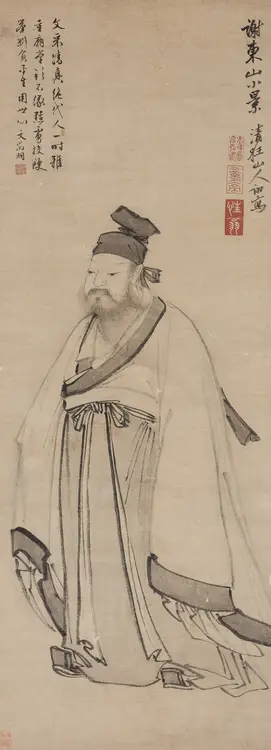
The clan produced Xie An, the statesman who directed the Jin victory at the Battle of the Fei River in 383, shown in the portrait above, attributed to the painter Guo Xu, and the poet Xie Lingyun. See also the Wang surname page.
How Xie is spelled around the world
| Spelling | Where it comes from | Example |
|---|---|---|
| Xie | Hanyu Pinyin | Xie Fuzhi, PRC general |
| Hsieh (Shieh, Shay) | Wade-Giles, used in Taiwan | Frank Hsieh, Taiwan |
| Tse / Tze | Hong Kong Cantonese (ze6) | Nicholas Tse, Hong Kong |
| Der / Dea | Taishanese | |
| Chia / Cheah / Seah / Sia | Hokkien and Teochew | common in Malaysia and Singapore |
| Tjia / Tjhia | Indonesian Dutch-era spelling | |
| Sese | Philippines (Kapampangan region) | |
| Tạ | Vietnamese reading |
Hsieh is the textbook case of a Wade-Giles spelling that English speakers cannot read: the hs stands for pinyin x. The Wade-Giles guide explains the system, and the Hokkien and Teochew spellings guide explains how one character became Chia, Cheah or Seah in Malaysia and Singapore. English Wikipedia notes that in the Philippines the spelling Sese also means “thank you” in Kapampangan; see Filipino-Chinese surnames.
Xie in the United States
The 2010 US Census gives:
- Xie: 9,716 people (98.2% Asian or Pacific Islander).
- Ta: 8,017 (94.3%), mostly Vietnamese Tạ.
- Hsieh: 6,382 (93.7%).
- Tse: 6,227 (93.5%).
- Che: 2,393, Chia: 1,748, Zia: 1,495, Sia: 943, Sese: 483, Cheah: 457, Seah: 170.
The pinyin Xie, Taiwanese Hsieh and Cantonese Tse are almost the same size, which mirrors three waves of Chinese migration. Smaller spellings such as Chia (68.5% Asian) and Zia (67.6%) are shared with other names. The US census lookup tool gives any spelling’s figures.
Famous people named Xie, Hsieh or Tse
- Xie An (謝安, 320 to 385), Eastern Jin statesman.
- Xie Daoyun (謝道韞), Eastern Jin poet and calligrapher, daughter-in-law of Wang Xizhi.
- Xie Lingyun (謝靈運, 385 to 433), poet and pioneer of landscape (mountain-and-water) poetry.
- Hsieh Tung-min (謝東閔, 1908 to 2001), first native Taiwanese to become Vice President of the Republic of China.
- Frank Hsieh (謝長廷, born 1946), former mayor of Kaohsiung and Premier of Taiwan.
- Tony Hsieh (1973 to 2020), American entrepreneur and CEO of Zappos, who pronounced his name “Shay”.
- Nicholas Tse (謝霆鋒, born 1980), Hong Kong actor and singer.
Related surnames and confusions
- Chia: also the Hokkien spelling of other surnames; check the character with the surname finder.
- Hsieh vs Shieh: the same name; Shieh and Shay are respellings of Hsieh.
- Xieqiu (謝丘): a rare compound surname; see compound surnames.
- Xie is 34th in the Hundred Family Surnames.
Frequently asked questions
How do you pronounce Xie?
In Mandarin it is xiè, roughly shyeh, said with a sharp falling tone. The pinyin x is a soft sh made with the tongue behind the lower teeth. It is not pronounced zee or ksee.
What does the surname Xie mean?
The character 謝 means to thank, and also to decline or wither. As a surname it comes from the name of an ancient state or fief called Xie, according to tradition.
How do you pronounce Hsieh?
Hsieh is the Wade-Giles spelling of the same Mandarin sound, xiè, roughly shyeh. In the United States many families have adapted it to Shay, as the Zappos founder Tony Hsieh did.
Are Tse and Xie the same surname?
Yes. Tse is the Hong Kong Cantonese spelling of 謝, from the Cantonese reading ze6. Chia, Cheah, Seah and Sia are the Hokkien and Teochew spellings of the same character.
Sources and open data
- Unihan database entry for U+8C22 谢, Unicode Consortium
- Frequently Occurring Surnames from the 2010 Census, US Census Bureau
- 谢姓 (Xie surname), Chinese Wikipedia
- Xie (surname), English Wikipedia
- Xie clan of Chen Commandery, English Wikipedia
- Xie An, English Wikipedia
- Xie, Chinese family name (Q3570980), Wikidata