Key facts
- Xiao is written 萧 in simplified and 蕭 in traditional characters (12 against 16 strokes). It ranked 33rd in mainland China in the 2019 official list.
- Many mainland families write it 肖: the second-round simplification published on 20 December 1977 merged 萧 into 肖, and when that scheme was withdrawn in 1986 many identity documents were never changed back.
- Tradition traces the name to the fief of Xiao (in today's Xiao County, Anhui), held by a noble of the state of Song.
- Main spellings: Hsiao (Wade-Giles, Taiwan), Siu (Hong Kong), Seow or Siow (Singapore, Malaysia), Tiêu (Vietnamese).
- The 2010 US Census counted 6,123 people spelled Xiao, 4,877 Siu and 2,666 Hsiao.
萧
蕭
Pinyin: Xiāo
Simplified / traditional: 萧 / 蕭
Rank in mainland China: 33 of the top 100 (Ministry of Public Security, 2019 report)
Characters and spellings of 萧
| Unicode code point | U+8427 (traditional 蕭: U+856D) |
|---|---|
| Stroke count | 12 (traditional: 16) |
| Radical (simplified form) | No. 140 ⾋, plus 8 strokes |
| Dictionary meaning (Unihan) | common artemisia; sighing of wind; mournful; dejected |
Romanizations by Chinese language
| Language | System | Spelling |
|---|---|---|
| Mandarin | Hanyu Pinyin (PRC standard) | Xiāo |
| Mandarin | Wade-Giles (Taiwan, older English texts) | Hsiao |
| Cantonese | Jyutping (Unihan) | siu1 |
| Cantonese | Hong Kong / common spellings | Siu, Shiu, Sio |
| Hokkien (Min Nan) | Pe̍h-ōe-jī and common spellings | Siau (X, Z, K, T), Sio (X, Q, Seow, Siau, Siow |
| Hakka | Pha̍k-fa-sṳ and common spellings | Siâu, Siew, Siaw |
| Gan | Romanization and common spellings | Sieu |
| Wu (Shanghainese) | Romanization and common spellings | Siau, Shio |
Equivalent surnames in other languages
| Language | Form |
|---|---|
| Vietnamese | Tiêu |
| Korean | So (소) |
| Filipino | Siao, Syaw, Shau, Shao, Shaw |
| Japanese | Shō |
These spellings in the 2010 US Census
| Spelling | People | US rank | Asian / Pacific Islander |
|---|---|---|---|
| SHAW | 160,400 | 164 | 1.48% |
| XIAO | 6,123 | 5,669 | 97.91% |
| SIU | 4,877 | 6,892 | 86.06% |
| SHAO | 3,741 | 8,765 | 95.35% |
| HSIAO | 2,666 | 11,751 | 94.97% |
| TIEU | 2,275 | 13,391 | 95.69% |
| SHIU | 917 | 26,576 | 90.62% |
| SIO | 416 | 50,275 | 73.08% |
| SIEW | 325 | 61,745 | 75.08% |
| SIAO | 311 | 64,054 | 89.07% |
Counts are people recorded with each spelling among the 265,667,228 people with a surname shared by at least 100 people (US Census Bureau, 2010, public domain). A spelling is not proof of Chinese origin: the last column shows the share of bearers who identified as Asian or Pacific Islander. Together these spellings total 183,035 people, but some of them belong to unrelated surnames (for example English Lee, Hmong Vang or Vietnamese Ly). Search any spelling with the US census surname lookup.
Stroke order
Animation by the open-source Hanzi Writer library (MIT) with stroke data from Make Me a Hanzi (Arphic Public License). Stroke order tool for any character.

Xiao (萧, traditional 蕭) is a Chinese surname pronounced xiāo, roughly “shyow”. The character originally names a kind of artemisia (mugwort) and, by extension, a mournful, desolate sound. It was the 33rd most common surname in mainland China in the 2019 official ranking. It is spelled Hsiao in Taiwan, Siu in Hong Kong, Seow or Siow in Singapore and Malaysia, and Tiêu in Vietnamese. In mainland China a large share of Xiao families now write the name 肖, a legacy of an abandoned 1977 script reform.
Meaning of the character 萧
The Unihan database glosses 萧 as “common artemisia; sighing of wind; mournful; dejected”. The grass radical 艹 at the top (radical 140) points to the plant meaning. The traditional form 蕭 has 16 strokes and the simplified 萧 has 12. As with most surnames, the dictionary meaning is not why families bear the name: it comes from a place.
萧 or 肖? The second-round simplification
This is the question most people ask about the name, and the answer runs through two reforms.
The first round of simplification (1956 to 1964) turned 蕭 into 萧, which is still the standard form today. The Chinese Wikipedia article on 肖 reports that 肖, a much simpler character meaning “to resemble”, had already been used informally for the surname in northern China since the Qing period.
The second-round simplification, published in the People’s Daily and the Guangming Daily on 20 December 1977, went further and merged every use of 萧 into 肖. This happened while household registration was being systematized, so many Xiao families were entered into the records as 肖. The State Council withdrew the whole second round on 24 June 1986, but identity papers did not change back by themselves. Correcting a surname requires paperwork, and many families kept 肖.
The result is a split family name:
| Form | Where it is used | Status |
|---|---|---|
| 蕭 | Taiwan, Hong Kong, Macau, Malaysia, older texts | Traditional form |
| 萧 | Mainland China, Singapore | Standard simplified form |
| 肖 | Many mainland identity documents since 1977 | Separate standard character, not an official simplification of 蕭 |
The 2013 Table of General Standard Chinese Characters pairs 蕭 with 萧 only. Major mainland dictionaries now list 肖 as a surname of its own. In 2005 the Ministry of Education’s language office replied that both 萧 and 肖 are standard characters with no simplified-to-traditional link, and that any change should follow the bearer’s wishes and household registration rules. Clan associations have since campaigned to “correct 肖 back to 萧”, with mixed success. The same thing happened to 閻 Yan (now often 闫) and 傅 Fu (often 付). The guide to simplified and traditional surname characters covers these cases.
A genuine, very rare surname 肖 did exist before 1977, read xiào, and in bronze inscriptions 肖 is a form of 趙 (see the Zhao surname). Today, a mainlander named 肖 Xiāo is almost always a Xiao of the 萧 line. The actor Xiao Zhan (肖战, born 1991) is a well-known example of the 肖 spelling.
Origin of the Xiao surname
Traditional sources, from the Fengsu Tongyi to the Tang-era Yuanhe Xingzuan, tell the same story. Daxin (蕭叔大心), a noble of the state of Song, was enfeoffed at Xiao, a small dependency of Song near today’s Xiao County in Anhui. When Chu destroyed the fief, his descendants took its name as their surname.
Genealogies then follow the line to Lanling (兰陵, in Shandong) and, after the Jin court fled south, to “South Lanling” near Changzhou. That branch produced two dynasties: Xiao Daocheng founded the Southern Qi, and Xiao Yan founded the Liang. Under the Liao dynasty the Khitan emperors gave the surname Xiao to their consort clans, so most Liao empresses were named Xiao. These are inherited accounts, not proven descent.
Spellings and where they come from
| Spelling | Language or system | Example |
|---|---|---|
| Xiao | Hanyu Pinyin | Xiao Hong, writer |
| Hsiao | Wade-Giles, Taiwan | Hsiao Bi-khim, Taiwanese politician |
| Siu / Siao | Hong Kong Cantonese | Josephine Siao, actress |
| Seow / Siow / Siauw | Hokkien, Teochew, Hakka | Francis Seow, Singaporean lawyer |
| Tiêu | Vietnamese | |
| So (소) | Korean |
Hsiao follows the Wade-Giles rule that writes pinyin x as hs. Seow and Siow come from Hokkien and Teochew spellings, and Siu from Hong Kong Cantonese.
Xiao in the United States
In the 2010 Census file, spellings for this name include:
- Xiao: 6,123 people, 97.9% Asian or Pacific Islander.
- Siu: 4,877 (86.1%).
- Shao: 3,741, a count that mixes Filipino-Chinese Xiaos with the pinyin of 邵 Shao, a different surname.
- Hsiao: 2,666 (95.0%).
- Tieu: 2,275 (95.7%), the Vietnamese form.
- Shaw: 160,400 people, but only 1.5% Asian or Pacific Islander, so almost all are of British or Irish origin.
The census does not record characters, so a Xiao in the file may be 萧, 肖 or even 晓. The US census lookup shows every spelling side by side.
Famous people named Xiao
- Xiao He (萧何, died 193 BC), first chancellor of the Han dynasty.
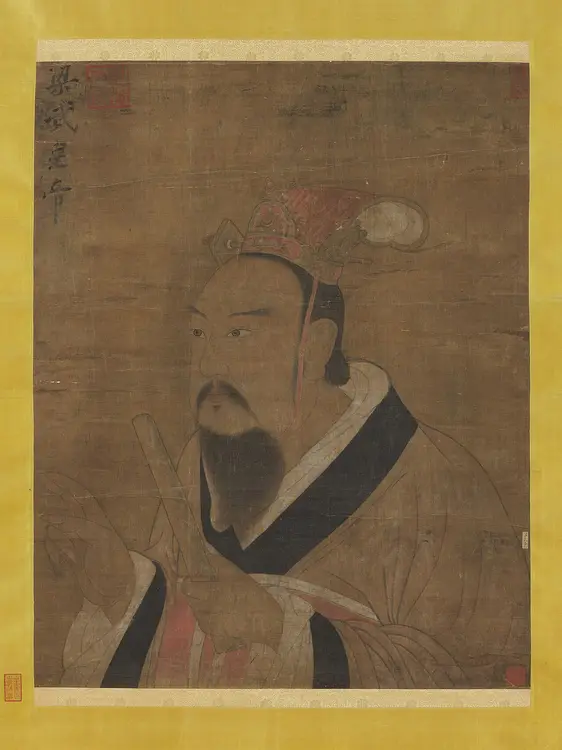
- Xiao Yan (萧衍, 464 to 549), Emperor Wu of Liang, shown in the portrait above.
- Xiao Hong (萧红, 1911 to 1942), novelist. Xiao Hong was a pen name; her birth name was Zhang Naiying.
- Xiao Qian (萧乾, 1910 to 1999), writer and translator. Chinese Wikipedia reports that a newspaper once printed his name 肖干 under the 1950s draft simplification, to his annoyance.
- Xiao Ke (萧克, 1907 to 2008), PLA general, also written 肖克.
- Hsiao Bi-khim (蕭美琴, born 1971), Vice President of Taiwan since 2024.
- Josephine Siao (蕭芳芳, born 1947), Hong Kong actress.
Related surnames and confusions
- Shao 邵 sounds close in English but is a different character and surname.
- Jiang 江 of Wuyuan: genealogies say a Xiao branch took the name Jiang after 907, and call themselves the Xiao-Jiang.
- Spell-check any name in the surname finder, which lists every character a romanization can stand for.
Frequently asked questions
Are 肖 and 萧 the same surname?
For most families, yes. Nearly all mainland people surnamed 肖 and pronounced Xiāo descend from 萧 families whose name was rewritten 肖 under the 1977 second-round simplification. Officially, though, the two are now separate characters, and a rare older surname 肖 (read Xiào) also existed.
How do you pronounce Xiao?
Say shyow, rhyming with now, on a high level tone: xiāo. The pinyin x is a soft sh sound made with the tongue behind the lower teeth.
Is Hsiao the same as Xiao?
Yes. Hsiao is the Wade-Giles spelling of the same Mandarin sound, the usual form in Taiwan and in older English texts. Siu, Seow, Siow and Siauw are the same name in Cantonese, Hokkien, Teochew and Hakka.
Why is Shaw sometimes a Chinese surname?
Some Chinese Americans and Taiwanese scholars write 蕭 as Shaw because of its sound, and the convention also works the other way: George Bernard Shaw is 萧伯纳 in Chinese. Most people named Shaw in the US are not of Chinese origin.
Can I change 肖 back to 萧 on Chinese documents?
It is possible but not automatic. In 2005 China's Ministry of Education said that both characters are standard and that changes should follow the bearer's wishes and household registration rules, which ask for documentary proof.
Sources and open data
- Unihan database entry for U+8427 萧, Unicode Consortium
- Unihan database entry for U+856D 蕭, Unicode Consortium
- Second round of simplified Chinese characters, English Wikipedia
- 肖姓 (the surname 肖), Chinese Wikipedia
- 蕭姓 (the surname 蕭), Chinese Wikipedia
- 国务院关于公布《通用规范汉字表》的通知 (Table of General Standard Chinese Characters, 2013), State Council of the PRC
- Frequently Occurring Surnames from the 2010 Census, US Census Bureau
- Xiao (surname), English Wikipedia