Key facts
- Lu 陆 (traditional 陸) is pronounced with a falling fourth tone, lù, and means land: 7 strokes simplified, 10 traditional.
- It ranked 57th among mainland surnames in the Ministry of Public Security's 2019 top 100.
- Cantonese speakers write it Luk or Lok, Malaysian families often Loke, Vietnamese Lục.
- In Taiwan it is much rarer: 96th, with 17,082 bearers in the Ministry of the Interior's June 2023 count.
- The 2010 US Census counted 35,628 people named Lu, but that spelling also covers 卢, 吕, 鲁 and 路.
陆
陸
Pinyin: Lù
Simplified / traditional: 陆 / 陸
Rank in mainland China: 57 of the top 100 (Ministry of Public Security, 2019 report)
Characters and spellings of 陆
| Unicode code point | U+9646 (traditional 陸: U+9678) |
|---|---|
| Stroke count | 7 (traditional: 10) |
| Radical (simplified form) | No. 170 ⾩, plus 5 strokes |
| Dictionary meaning (Unihan) | land, continental; army |
Romanizations by Chinese language
| Language | System | Spelling |
|---|---|---|
| Mandarin | Hanyu Pinyin (PRC standard) | Lù |
| Mandarin | Wade-Giles (Taiwan, older English texts) | Lu |
| Cantonese | Jyutping (Unihan) | luk6 |
| Cantonese | Hong Kong / common spellings | Luk, Lok |
| Hokkien (Min Nan) | Pe̍h-ōe-jī and common spellings | Lio̍k, Loke, Lek |
| Hakka | Pha̍k-fa-sṳ and common spellings | Liu̍k, Luk |
| Gan | Romanization and common spellings | Liuk |
| Wu (Shanghainese) | Romanization and common spellings | Loh, Loq |
Equivalent surnames in other languages
| Language | Form |
|---|---|
| Vietnamese | Lục |
| Korean | Yuk/Ryuk / (육/륙) |
| Japanese | Riku |
| Filipino | Diokno |
These spellings in the 2010 US Census
| Spelling | People | US rank | Asian / Pacific Islander |
|---|---|---|---|
| LU | 35,628 | 978 | 95.74% |
| LUC | 2,636 | 11,877 | 62.82% |
| LOH | 2,379 | 12,921 | 74.02% |
| LUK | 1,920 | 15,289 | 92.03% |
| LOK | 1,552 | 17,992 | 85.05% |
| LOKE | 457 | 46,568 | 50.77% |
| LEK | 253 | 76,029 | 86.96% |
| DIOKNO | 199 | 92,358 | 88.94% |
Counts are people recorded with each spelling among the 265,667,228 people with a surname shared by at least 100 people (US Census Bureau, 2010, public domain). A spelling is not proof of Chinese origin: the last column shows the share of bearers who identified as Asian or Pacific Islander. Together these spellings total 45,024 people, but some of them belong to unrelated surnames (for example English Lee, Hmong Vang or Vietnamese Ly). Search any spelling with the US census surname lookup.
Stroke order
Animation by the open-source Hanzi Writer library (MIT) with stroke data from Make Me a Hanzi (Arphic Public License). Stroke order tool for any character.

Lu (陆, traditional 陸) is a Chinese surname meaning “land”. It is pronounced lù, like the English word “loo” with a falling tone, and is spelled Luk or Lok in Cantonese, Loke in Malaysia, Loh in Shanghainese-based spellings and Lục in Vietnamese. It was the 57th most common surname in mainland China in the 2019 official ranking.
In English, “Lu” hides at least four different families: 陆 Lù, 卢 Lú, 鲁 Lǔ and 路 Lù, plus 吕 Lǚ when the umlaut is dropped. This page is about 陆. For the others, see Lu 卢 and Lü 吕.
Meaning of the character 陆
The Unihan database glosses 陆 as “land, continental; army”. The left part 阝 (a form of radical 170, 阜 “mound”) marks words about terrain. The traditional form 陸 has 10 strokes; the simplified form keeps the radical and reduces the right-hand part, for 7 strokes.
The same character is used as the “anti-fraud” form of the number six (陆 for 六) on cheques and contracts, which is why a bank form can show the surname character with no family meaning at all.
Origins of the Lu 陆 surname
Chinese genealogical tradition, as summarized in the Chinese Wikipedia article on 陆姓, gives several origins. These are traditional accounts, not traceable descent:
- Luzhong (陆终), a descendant of the mythical Zhuanxu, named in the Records of the Grand Historian among the ancestors of the Chu royal house.
- Prince Tong of Qi, a younger son of King Xuan of Qi, said to have been enfeoffed at Lu village (陆乡) in Pingyuan commandery, whose descendants took the place name.
- The Luhun (陆浑) state, founded by the Luhun Rong people and destroyed by Jin in 525 BC; its survivors kept the name.
- The Bulugu (步六孤) clan of the Xianbei, ordered to adopt Lu during the sinicization reforms of Emperor Xiaowen of Northern Wei.
The same article notes that Lu is common among the Zhuang people of Guangxi. The surname’s great medieval lineage was the Lu of Wu commandery (around Suzhou), the family of the Three Kingdoms chancellor Lu Xun and the poet Lu Ji.
Spellings of 陆 and where they come from
| Spelling | Language or system | Typical place |
|---|---|---|
| Lu | Pinyin and Wade-Giles (Mandarin lù) | Mainland China, Taiwan |
| Luk | Hong Kong Cantonese (Jyutping luk6) | Hong Kong, Canada |
| Lok | Alternative Cantonese spelling | Hong Kong, Macau |
| Loke | Cantonese-based Malaysian spelling | Malaysia, Singapore |
| Loh | Shanghainese (Wu) reading | Shanghai, Jiangsu families abroad |
| Liok, Lek | Hokkien (Pe̍h-ōe-jī lio̍k) | Taiwan, Fujian, Southeast Asia |
| Lục | Vietnamese | Vietnam |
| Yuk / Ryuk (육) | Korean | Korea |
The Cantonese final -k is the useful clue. A name spelled Luk or Loke almost always points to 陆, never to 卢, whose Cantonese spelling is Lo or Law. The Hong Kong Cantonese spelling guide explains why Cantonese keeps those stop consonants that Mandarin lost, and the one surname, many spellings page shows the same pattern for other names.
Lu 陆 in Taiwan, Malaysia and the United States
In Taiwan, 陸 is a minor name. The Ministry of the Interior’s 2023 name statistics (population at 30 June 2023) rank it 96th, with 17,082 people, against 111,185 for 盧, which comes 42nd. The gap most likely reflects migration history: most Taiwanese families descend from Hokkien and Hakka settlers from Fujian and Guangdong, and 陆 has never been a leading name among them.
In Malaysia and Singapore the Cantonese spellings dominate. Loke Yew (陸佑, 1845 to 1917), a tin magnate of Cantonese descent, helped build early Kuala Lumpur, and his son Loke Wan Tho (陸運濤, 1915 to 1964) founded the Cathay Organisation cinema chain.
The 2010 US Census file shows how ambiguous the English spelling is:
- Lu: 35,628 people (95.7% Asian or Pacific Islander). This total mixes 陆, 卢, 吕, 鲁 and 路, and cannot be split by character.
- Luc: 2,636 (62.8%), largely Vietnamese Lục, though Luc is also a French given name and surname.
- Loh: 2,379 (74.0%), shared with Cantonese 卢 and 罗 families.
- Luk: 1,920 (92.0%), the most specific spelling for 陆.
- Lok: 1,552 (85.1%) and Loke: 457 (50.8%).
The US census surname lookup gives the figures for any spelling, and the census analysis explains why Chinese surname counts always need this caveat.
Famous people named Lu 陆
- Lu Xun (陸遜, 183 to 245), general and chancellor of Eastern Wu in the Three Kingdoms period, not to be confused with the modern writer Lu Xun (鲁迅), whose pen name uses 鲁.
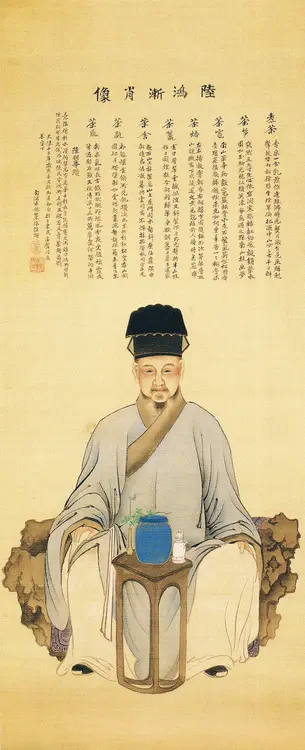
- Lu Yu (陸羽, 733 to 804), author of The Classic of Tea (茶经), honored as the Sage of Tea. He is the subject of the scroll shown at the top of this page.
- Lu You (陸游, 1125 to 1210), historian and one of the most prolific poets of the Southern Song.
- Lu Jiuyuan (陸九淵, 1139 to 1192), Neo-Confucian philosopher and rival of Zhu Xi.
- Lu Haodong (陸皓東, 1868 to 1895), revolutionary who designed the Blue Sky with a White Sun flag.
- Lu Xiaoman (陆小曼, 1903 to 1965), painter and writer, wife of the poet Xu Zhimo.
- Loke Wan Tho (陸運濤, 1915 to 1964), Malaysian film magnate, an example of the Loke spelling.
- Lu Chuan (陆川, born 1971), film director of Kekexili: Mountain Patrol and City of Life and Death.
How to tell 陆 from other Lu surnames
| Character | Pinyin | Cantonese | Meaning |
|---|---|---|---|
| 陆 / 陸 | Lù (4th tone) | Luk | land |
| 卢 / 盧 | Lú (2nd tone) | Lo | a fief of Qi; also “black” |
| 吕 / 呂 | Lǚ (3rd tone, ü) | Lui | spine; the ancient state of Lü |
| 鲁 / 魯 | Lǔ (3rd tone) | Lo | the state of Lu |
| 路 | Lù (4th tone) | Lo | road |
If a document only says “Lu”, the tone mark or the character is the only reliable guide. Our surname finder lists every character behind a spelling, and the simplified and traditional characters guide explains why 陸 and 陆 are the same name.
Frequently asked questions
What does the surname Lu 陆 mean?
The character 陆 (traditional 陸) means land or dry land, as opposed to water. As a surname it is traced to old place names, such as the fief of Lu village in Pingyuan, rather than to the meaning of the word.
Is Lu 陆 the same surname as Lu 卢?
No. 陆 is Lù with a falling tone and means land, 卢 is Lú with a rising tone and is the name of an ancient fief in Qi. They are separate surnames that only look the same in English. In Cantonese they even sound different: Luk for 陆 and Lo for 卢.
How do you pronounce Lu 陆?
In Mandarin it sounds like the English word loo, said with a sharp falling tone: lù. In Cantonese it is luk, with a short final k.
Is Loke a Chinese surname?
Yes. Loke is a Malaysian and Singaporean spelling, most often of 陆, based on its Cantonese reading. The tycoons Loke Yew (陸佑) and Loke Wan Tho (陸運濤) are well-known examples.
Sources and open data
- Unihan database entry for U+9646 陆, Unicode Consortium
- Frequently Occurring Surnames from the 2010 Census, US Census Bureau
- 全國姓名統計分析 (National name statistics, 2023), Ministry of the Interior, Taiwan (Department of Household Registration)
- Lu (surname), English Wikipedia
- 陆姓 (Lu surname), Chinese Wikipedia
- Loke Wan Tho, English Wikipedia