Key facts
- Liao is written 廖, the same in simplified and traditional script (14 strokes), and pronounced liào, roughly "lyow" with a falling tone.
- The Unihan database glosses it as "surname; name of an ancient state". Tradition traces it to the state of Liao, in today's southern Henan.
- It ranks 60th in mainland China in the Ministry of Public Security's 2019 report, but 18th in Taiwan, and is strongest in Guangdong, Sichuan, Guangxi and Hunan.
- In Hong Kong the same character is spelled Liu: the Liu of Sheung Shui are one of the Five Great Clans of the New Territories.
- Other spellings include Lew, Liew and Leow (Cantonese, Hakka, Hokkien), Liau (Hokkien, Hakka), Liêu (Vietnamese) and Ryo (Korean 료).
廖
Pinyin: Liào
Same character in simplified and traditional: 廖
Rank in mainland China: 60 of the top 100 (Ministry of Public Security, 2019 report)
Characters and spellings of 廖
| Unicode code point | U+5ED6 |
|---|---|
| Stroke count | 14 |
| Radical (simplified form) | No. 53 ⼴, plus 11 strokes |
| Dictionary meaning (Unihan) | surname; name of an ancient state |
Romanizations by Chinese language
| Language | System | Spelling |
|---|---|---|
| Mandarin | Hanyu Pinyin (PRC standard) | Liào |
| Mandarin | Wade-Giles (Taiwan, older English texts) | Liao |
| Cantonese | Jyutping (Unihan) | liu6 |
| Cantonese | Hong Kong / common spellings | Liu, Lew, Leow, Liew, Lio |
| Hokkien (Min Nan) | Pe̍h-ōe-jī and common spellings | Liāu (X, Z, K, T), Liàu (Q), Leow, Liau, Liow |
| Hakka | Pha̍k-fa-sṳ and common spellings | Liau, Liew |
| Gan | Romanization and common spellings | Lièu |
| Wu (Shanghainese) | Romanization and common spellings | Liau |
Equivalent surnames in other languages
| Language | Form |
|---|---|
| Vietnamese | Liêu / Liệu |
| Korean | Ryo (료) |
| Japanese | Ryō |
These spellings in the 2010 US Census
| Spelling | People | US rank | Asian / Pacific Islander |
|---|---|---|---|
| LIU | 78,370 | 411 | 95.62% |
| LIAO | 8,482 | 4,177 | 95.91% |
| LEW | 7,410 | 4,775 | 71.5% |
| LIEU | 3,612 | 9,045 | 95.1% |
| LIEW | 1,017 | 24,572 | 93.41% |
| LIO | 516 | 42,094 | 38.95% |
| LEOW | 286 | 68,770 | 44.41% |
| LIAU | 238 | 79,846 | 89.08% |
Counts are people recorded with each spelling among the 265,667,228 people with a surname shared by at least 100 people (US Census Bureau, 2010, public domain). A spelling is not proof of Chinese origin: the last column shows the share of bearers who identified as Asian or Pacific Islander. Together these spellings total 99,931 people, but some of them belong to unrelated surnames (for example English Lee, Hmong Vang or Vietnamese Ly). Search any spelling with the US census surname lookup.
Stroke order
Animation by the open-source Hanzi Writer library (MIT) with stroke data from Make Me a Hanzi (Arphic Public License). Stroke order tool for any character.

Liao (廖) is a Chinese surname pronounced liào, roughly “lyow” with a falling tone. It is written the same way in simplified and traditional script and ranks 60th in mainland China in the 2019 official list, but 18th in Taiwan. Its heartland is the south: Guangdong, Sichuan, Guangxi and Hunan. Outside the mainland it is spelled Liu (Hong Kong), Lew, Liew, Leow or Lio (other Cantonese forms), Liau or Liow (Hokkien and Hakka), Liêu (Vietnamese) and Ryo (Korean 료). The Hong Kong spelling Liu is easily confused with Liu 刘, a different surname.
Meaning of the character 廖
廖 is built from the shelter radical 广 (radical 53) and 翏 (liù), which gives the sound. The Unihan database glosses it simply as “surname; name of an ancient state”. Unlike most common surnames, it has no everyday meaning in modern Chinese: it is used almost only as a family name. With 14 strokes in both scripts, it is one of the few surnames left untouched by simplification, a point covered in the guide to simplified and traditional surname characters.
Origin: the state of Liao
Chinese Wikipedia lists several origins, most tied to small states of the Xia and Zhou periods in what is now southern Henan:
| Origin | Period | Story |
|---|---|---|
| state of Liao (飂, later 廖) | Xia dynasty | Shu’an, a descendant of the legendary Zhuanxu, was given a state near today’s Tanghe, Henan; Chu later absorbed it |
| state of Liao (蓼) | Zhou dynasty | a state near today’s Gushi, Henan, ruled by descendants of Gao Yao, conquered by Chu |
| Shao Bo Liao (召伯廖) | Eastern Zhou | descendants of a minister of King Hui of Zhou used his personal name |
| Zhang-Liao (张廖) | early Ming | a Zhang who married into a Liao family in Zhao’an, Fujian |
| granted surnames | Qing dynasty | indigenous peoples of Taiwan in 1758, and some Yao, Miao and Sui families |
The Tanghe line is the one most genealogies place first. When the state fell, its former subjects kept its name, one of the commonest ways Chinese surnames formed, as explained in where Chinese surnames come from. The traditional hall name of the Liao is Wuwei (武威堂). In the Hundred Family Surnames the name stands far down the list, at 342nd, which says more about its northern rarity in the Song period than about its size today.
The Zhang-Liao: one family, two surnames
The most unusual branch is the Zhang-Liao (张廖) of Zhao’an, in southern Fujian. Chinese Wikipedia, quoting the Liao clan genealogy, says that in the early Ming a man named Zhang Yuanzi (张元子) married into a Liao family at Guanbei, and that his descendants carried the Liao name. To repay both families, they named their hall Qingwu (清武), taking the first character of the Zhang ancestral seat, Qinghe, and of the Liao seat, Wuwei. Liao families of this line are called the “double Liao” (双廖), and those of other lines the “single Liao” (单廖).
Chinese Wikipedia also lists a hall founded by Zhang-Liao descendants in Taiwan, where the surname is far more common than on the mainland. A husband who joins his wife’s family is an exception to the usual rule, as the guide to whether a child takes the father’s or mother’s surname explains; see also Zhang 张.
The Liu of Sheung Shui
In Hong Kong, 廖 is spelled Liu, and the Liu of Sheung Shui are one of the Five Great Clans of the New Territories, the families that settled there before the 17th century. English Wikipedia traces them to Yongding in Fujian. Their founding ancestor, Liu Chung-kit (廖仲傑), moved south at the end of the Song or under the Yuan and settled by the river at Sheung Shui. His descendants built the walled village of Sheung Shui Wai, still home to most of the clan.
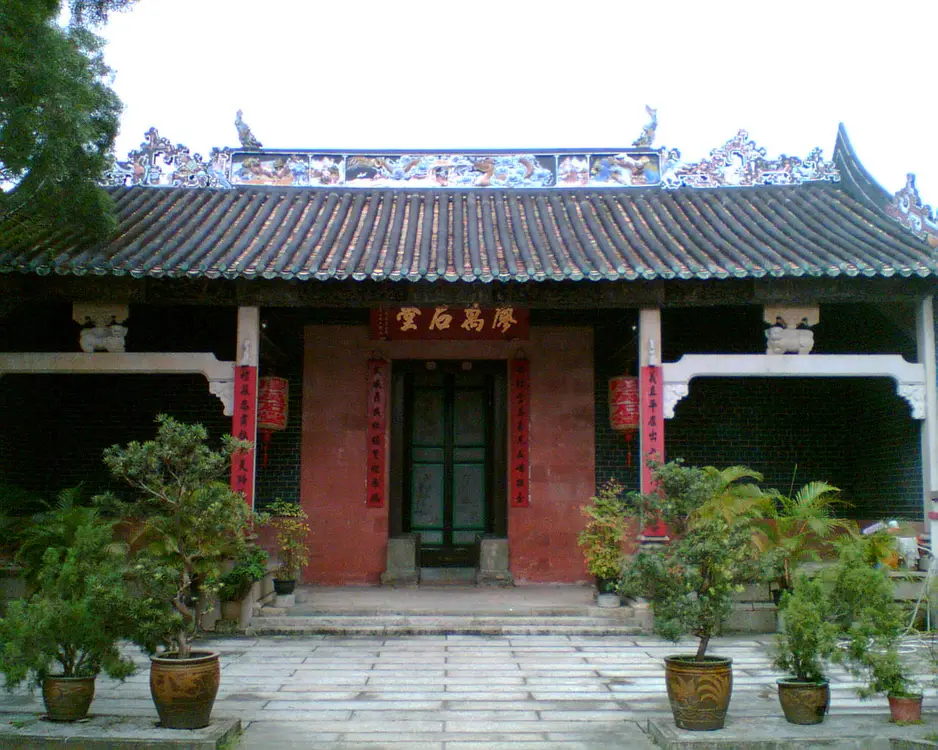
The clan’s main ancestral hall, Liu Man Shek Tong (廖萬石堂), shown above, was built in 1751 and restored in 1984 and 1985, when it was declared a monument. Chinese Wikipedia explains the name, “ten thousand shi”, as a reference to a Song ancestor and his four sons, each paid two thousand shi of grain as high officials. Spring rites are still held there every year. The Hong Kong Cantonese guide explains why 廖 becomes Liu there.
How Liao is spelled around the world
| Spelling | Language or system | Where you meet it |
|---|---|---|
| Liao | Pinyin and Wade-Giles | mainland China, Taiwan |
| Liu | Hong Kong Cantonese (liu6) | Hong Kong, Macau |
| Lew / Leow / Liew / Lio | other Cantonese spellings | Malaysia, Singapore, older US families |
| Liau / Leow / Liow | Hokkien (Liāu) | Taiwan, Singapore, Malaysia |
| Liew / Liau | Hakka | Malaysia, Indonesia |
| Liêu / Liệu | Vietnamese | Vietnam |
| Ryo (료) | Korean | Korea |
| Ryō | Japanese | Japan |
English Wikipedia adds Liaw and Liauw, older Dutch-influenced spellings. Liao is also a common Hakka surname, which is why Liew and Liau turn up in Hakka communities across Southeast Asia; see the Hakka guide and one surname, many spellings.
Liao in the United States
The 2010 US Census counted:
- Liao: 8,482 people (95.9% Asian or Pacific Islander), the pinyin and Taiwan spelling.
- Lew: 7,410 people (71.5%), an old Cantonese spelling, also an English name.
- Lieu: 3,612 people (95.1%), mostly Vietnamese.
- Liew: 1,017 people (93.4%).
- Lio: 516 (39.0%), Leow: 286 (44.4%) and Liau: 238 (89.1%).
Liu (78,370) appears in the data panel as the Hong Kong spelling, but in the United States it is overwhelmingly the pinyin spelling of 刘. The US census surname lookup shows these overlaps.
Famous people named Liao
- Liao Hua (廖化, died 264), general of Shu Han, one of the few officials who served the state from beginning to end.
- Liao Zhongkai (廖仲恺, 1877 to 1925), American-born revolutionary and Kuomintang leader, assassinated in 1925.
- Liao Chengzhi (廖承志, 1908 to 1983), his son, a senior official in charge of overseas Chinese affairs.
- Liao Chi-chun (廖继春, 1902 to 1976), Taiwanese painter.
- Liao Yiwu (廖亦武, born 1958), writer and poet, imprisoned after 1989.
- Bernice Liu (廖碧兒, born 1979), Hong Kong actress, an example of the spelling Liu for 廖.
Related surnames and pages
- For the far more common surname spelled Liu in pinyin, see Liu 刘.
- Liao is much more common in Taiwan; see the most common surnames in Taiwan.
- The surname finder lists every character behind a spelling such as Liu, Lew or Liew.
- See the full ranking in the 100 most common surnames in China.
Frequently asked questions
Is Liao the same surname as Liu?
It depends on the spelling system. In pinyin, Liu is 刘, a different and far more common surname. In Hong Kong Cantonese spelling, however, 廖 itself is written Liu, while 刘 is written Lau. Only the Chinese character settles the question.
What does the character 廖 mean?
The Unihan database glosses it as a surname and the name of an ancient state. It has no common meaning in modern Chinese apart from the surname. It is built from the shelter radical 广 and 翏, which gives the sound.
What is the Zhang-Liao lineage?
A lineage from Guanbei in Zhao'an, Fujian. According to the Liao clan genealogy cited by Chinese Wikipedia, Zhang Yuanzi married into a Liao family in the early Ming, and his descendants took the Liao name. They are known as the "double Liao", as opposed to the "single Liao" of other lines, and many later settled in Taiwan.
Why is Liao more common in Taiwan than in mainland China?
Taiwan's Chinese population descends largely from migrants from southern Fujian and from Hakka districts of Guangdong, the regions where Liao is strongest. The surname ranks 18th in Taiwan against 60th on the mainland.
Sources and open data
- Unihan database entry for U+5ED6 廖, Unicode Consortium
- Frequently Occurring Surnames from the 2010 Census, US Census Bureau
- Liao (surname), English Wikipedia
- 廖姓 (Liao surname), Chinese Wikipedia
- Five Great Clans of the New Territories, English Wikipedia
- 廖萬石堂 (Liu Man Shek Tong), Chinese Wikipedia
- Liao, family name (Q1929472), Wikidata